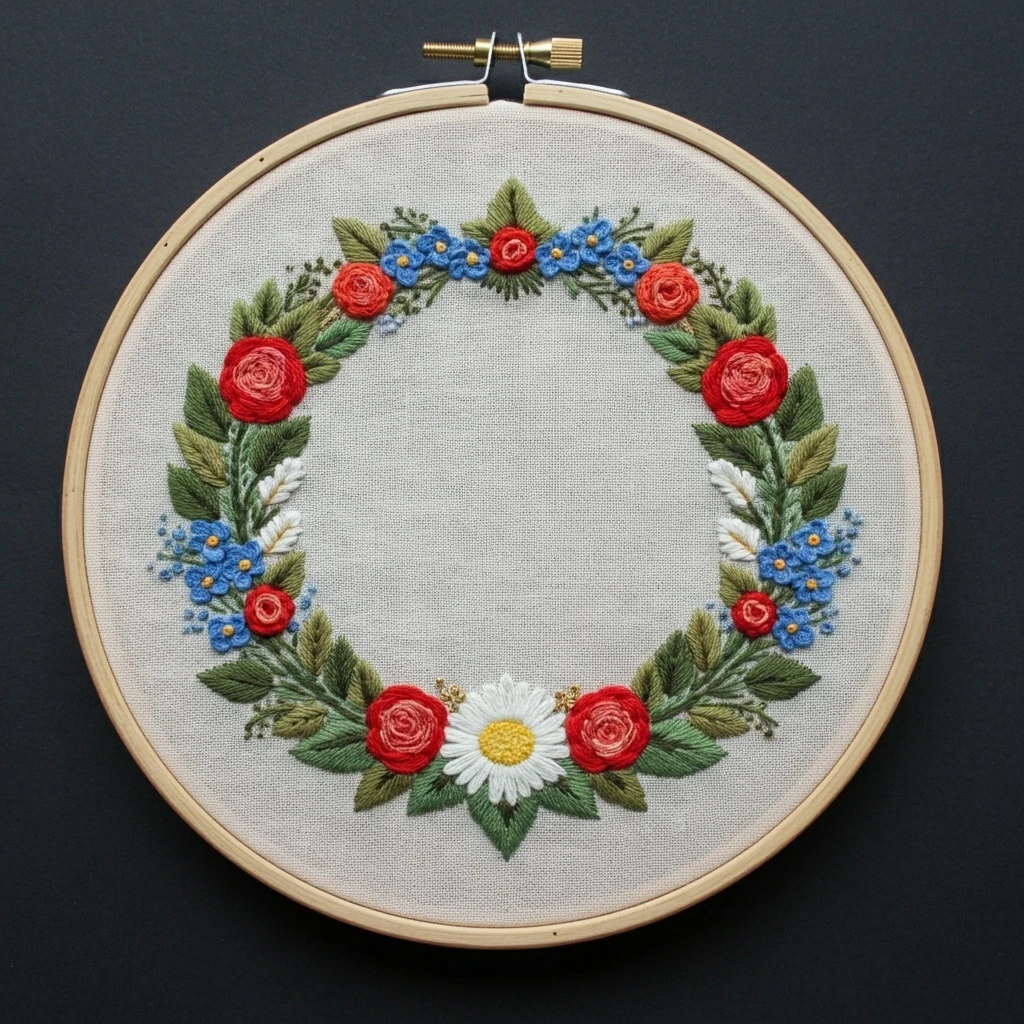

Vibrant Folk Art Floral Wreath
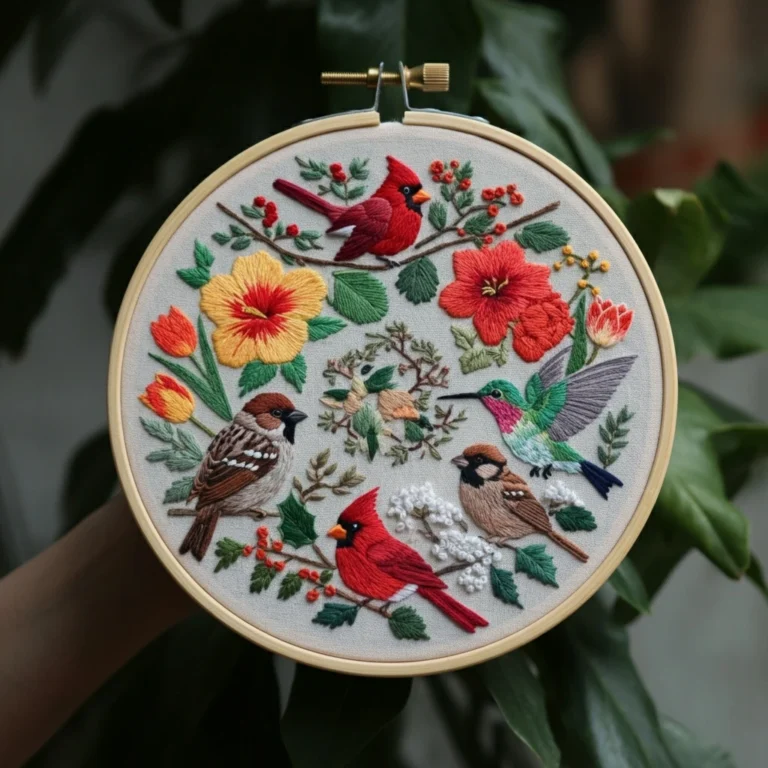
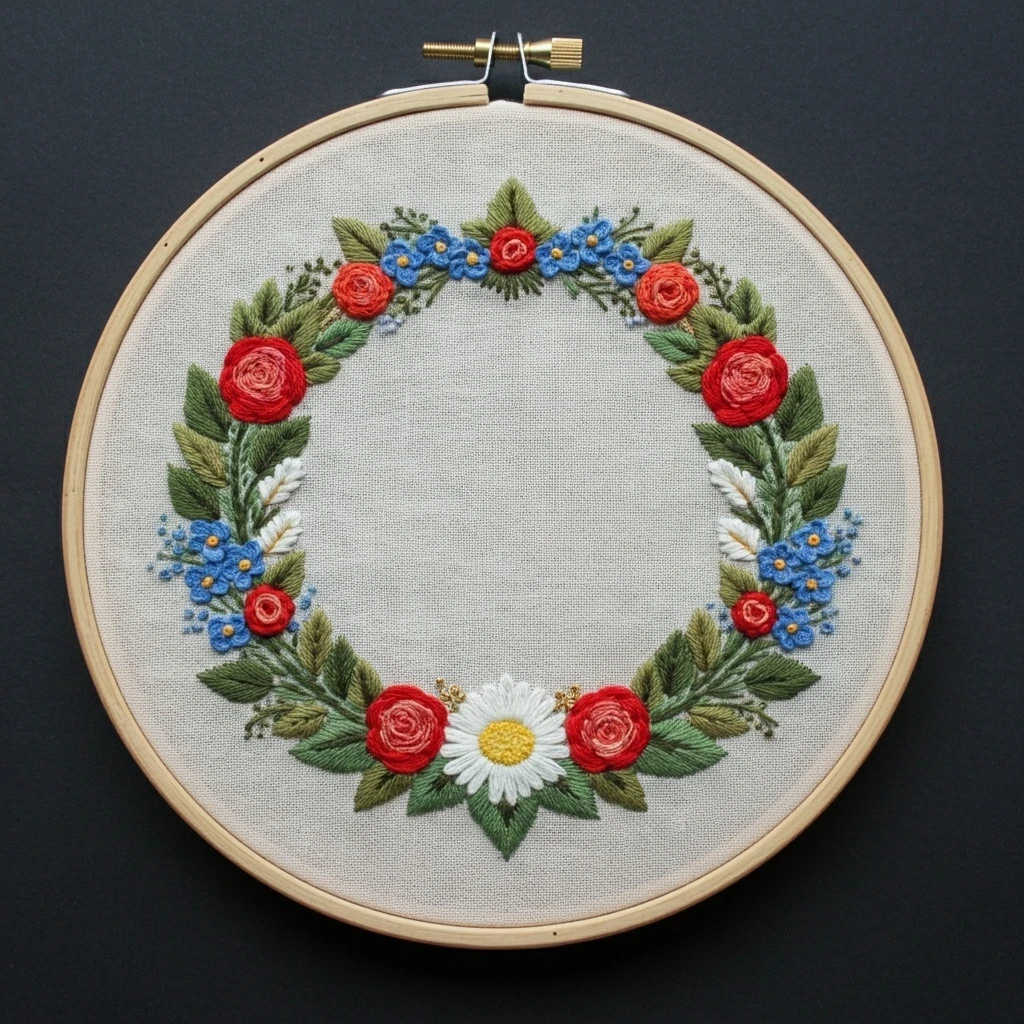
A polished DMC palette and practical hand-embroidery plan inspired by the visible hoop preview: a circular folk-style wreath with red rosette blooms, small blue flowers, a white daisy anchor, golden centers, layered green leaves, and fine sprig texture on natural linen.
Likely DMC Color Palette
Colors are estimated from the reference image and matched to close DMC embroidery floss shades. Coverage is a visual planning guide, not exact thread usage.
Stitching Suggestions
This design works best when the wreath is built symmetrically: mark the circular guide first, stitch the main red flowers, then balance blue blossoms, leaves, sprigs, and raised knot details.
| Element | Recommended Stitch | Practical Notes |
|---|---|---|
| Red folk rosettes | Woven wheel, whipped backstitch spiral, or rose stitch | Use 3 strands for plush rosettes. Start with 347 or 352 in the center and finish outer wraps with 321 for a bold rim. |
| Blue five-petal flowers | Lazy daisy, detached chain, or small satin petals | Work petals in 798 with one tiny 827 highlight stitch on each flower. Add a 726 French knot center after petals are complete. |
| White daisy anchor | Straight stitch petals or narrow satin stitch | Stitch petals from the yellow center outward with 2 strands of 3865. Keep petal lengths varied for a hand-drawn folk look. |
| Leaf clusters | Fishbone stitch, satin stitch, or long-and-short stitch | Use 3362 near the stem, 3345 through the middle, and 3012 along upper edges. Angle stitches toward the leaf tip to create a vein naturally. |
| Fine wreath stems | Stem stitch or split stitch | Use 1 strand for delicate arcs. Keep the circle light and broken so the wreath feels airy rather than like a heavy outline. |
| Tiny filler sprigs | Straight stitch, seed stitch, and single-wrap French knots | Add small olive and blue dots after the main flowers. This fills gaps and gives the design a lively folk-garden texture. |
| Gold centers and accents | French knots or colonial knots | Use 2 strands of 726 with one or two wraps. Cluster knots tightly for daisy centers and place single knots inside blue flowers. |
| Outlining details | Backstitch, split stitch, or couching | Use one strand of 3362 around select leaves and 321 around only the deepest red flower edges. Avoid outlining every shape; selective outlining keeps it polished. |
Thread Count, Blending & Shading Plan
Thread-count guidance
- 1 strand: fine stems, small blue filler dots, delicate outlines, and tiny sprigs.
- 2 strands: most leaves, daisy petals, small flowers, and general satin or fishbone work.
- 3 strands: woven rosettes, raised flower centers, and places where the design needs cheerful folk-art volume.
- 4 strands: only for a few bold red rosette wraps if stitching on a looser linen or larger hoop.
Blending ideas
- Blend 321 + 347 in the same needle for lively red rosette midtones.
- Blend 3362 + 3345 for leaves that need depth without looking striped.
- Use 3345 + 3012 for olive-highlight leaves near the top and sides.
- For blue flowers, keep darker petals outside and add one short 827 stitch near the center.
Texture & Beginner-Friendly Workflow
1. Mark the circle
Lightly draw the inner and outer wreath path with a washable pen. Mark the large flowers at clock positions first so the wreath stays even.
2. Stitch focal blooms
Complete red rosettes and the bottom daisy before adding small fillers. These larger shapes set the scale for everything else.
3. Layer greenery
Work dark stems first, then mid-green leaves, then olive leaf highlights. Let some leaves tuck under flowers for depth.
4. Add blue flowers
Use small detached-chain petals and bright yellow knots. Keep the blue clusters uneven in size for a natural handmade look.
5. Finish with knots
Save French knots, seed stitches, and tiny berries until the end so they stay raised and do not snag while filling larger areas.
6. Press carefully
Press from the back on a folded towel. This protects raised rosettes, daisy centers, and knot clusters while smoothing the linen.
Helpful Notes
- Use a sharp embroidery needle for crisp leaf tips and clean daisy petals.
- Keep tension relaxed on woven rosettes; tight wraps flatten the spiral and reduce the folk-art charm.
- When stitching paired motifs on the left and right sides, complete one side first, then mirror the color placement on the opposite side.
- Leave a little fabric space between small blue flowers and red rosettes so the colors do not visually merge.
- For a beginner-friendly version, simplify each large leaf to fishbone stitch and each red flower to a single woven wheel.