
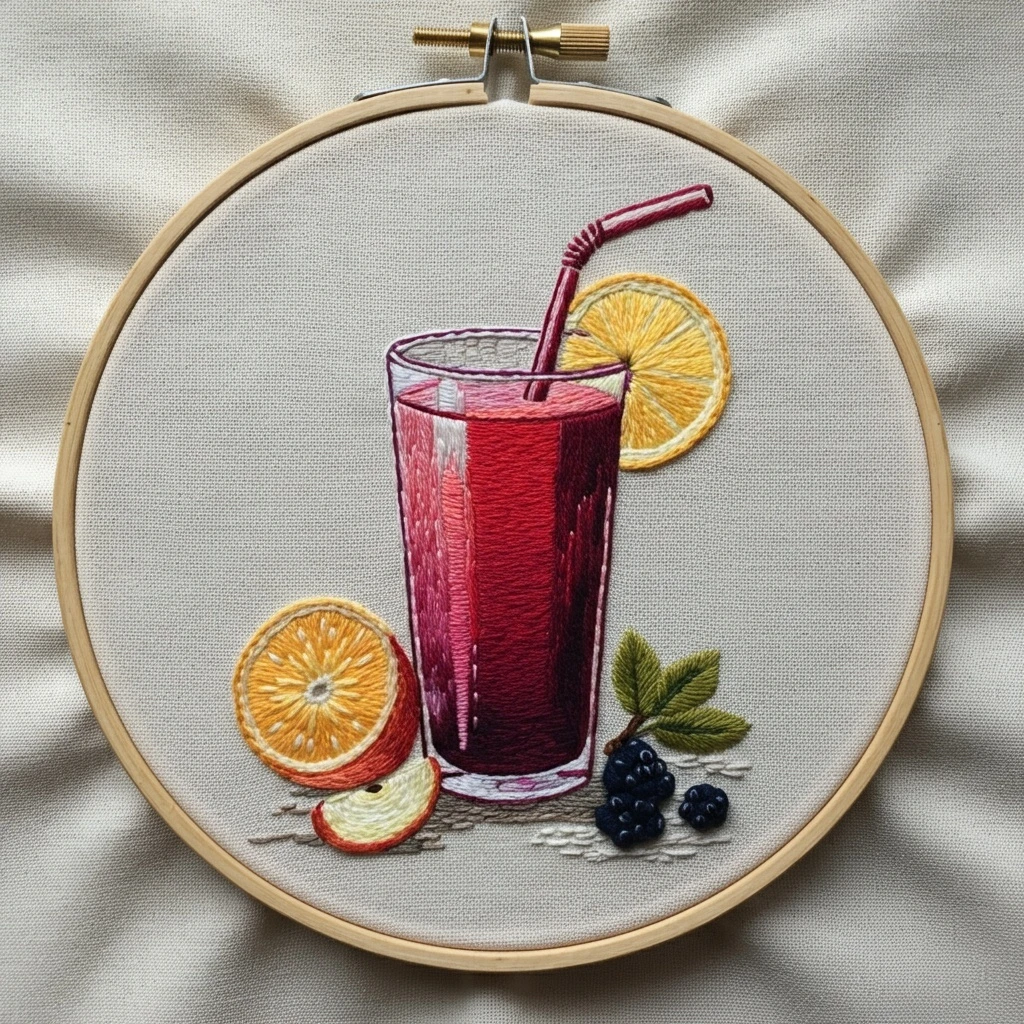
Vibrant Fruit Drink
A polished DMC palette and stitching plan for a bright berry-red drink with citrus slices, a glossy glass, bendy straw, dark berries, and small leafy accents. Colors are estimated from the visible embroidery preview and matched to close DMC embroidery floss shades.
Likely DMC Color Palette
The design is dominated by saturated berry reds and wine shadows, balanced with golden citrus, olive leaves, inky berries, and pale glass reflections. Coverage percentages are visual estimates, not exact thread usage.
Design Elements to Notice
The picture reads best when the glass is stitched as a transparent object rather than a flat red rectangle.
- Drink: vertical red satin/long-and-short bands, with dark wine shading on the right and at the base.
- Glass: pale gray and white lines sit over the red, especially along the rim, left reflection, and bottom ellipse.
- Citrus: round slices need radial spokes and a thicker golden rind so they look juicy.
- Straw: narrow stem-stitch lines plus darker bends make the straw stand away from the drink.
- Berries and leaves: raised knots and fishbone leaves add texture without making the composition busy.
Thread Count Guidance
2 strands
Use for most drink filling, citrus pulp, leaves, straw body, and medium outlines. This gives good coverage on linen while keeping the details controlled.
1 strand
Use for glass highlights, fruit segment lines, tiny berry shine, and narrow shadow accents. One strand is especially useful where the glass overlaps the red drink.
3 strands sparingly
Use only for the outer citrus rind, bold drink rim, or a few foreground berry knots if you want extra dimensional emphasis.
Stitching Suggestions
Work the large color areas first, then layer transparent glass lines, fruit texture, and final highlights on top.
| Element | Best Stitch Types | Practical Notes |
|---|---|---|
| Berry drink fill | Long and short stitch, satin stitch | Stitch vertically to follow the glass height. Blend DMC 321 into 815 and 814 at the right side and lower base. |
| Drink rim and surface | Split stitch, whipped backstitch | Use a dark garnet outline, then add a thin pink highlight across the left side for a glossy liquid surface. |
| Glass walls | Backstitch, couching, straight stitch | Use DMC 762 and 415 over the drink after the fill is finished. Keep stitches broken and light so the glass feels transparent. |
| Citrus slices | Radial straight stitch, split stitch, padded satin | Outline the rind first, stitch spokes from center outward, then add tiny white pith marks between yellow-orange segments. |
| Bendy straw | Stem stitch, wrapped backstitch | Curve the straw with two parallel lines. Add short dark bars at the bend to suggest the flexible ridges. |
| Leaves | Fishbone stitch, fly stitch | Start at the leaf tip and angle stitches toward the center vein. Alternate 3011 and 3348 for a natural tropical green. |
| Dark berries | French knots, colonial knots, satin dots | Cluster knots in 939 and 823. Add a single 3865 or 762 speck on a few berries for shine. |
| Ground shadows | Seed stitch, sketchy straight stitch | Use one strand of 415 or 3371 in scattered horizontal marks so the fruit and glass feel anchored. |
Blending Ideas
- Blend the drink with a two-needle approach: 321 in the middle, 815 along edges, 814 only in the darkest right column.
- For the bright vertical reflection, stitch a narrow 3801 band, then overlay a few one-strand 762 highlights.
- Mix 726 and 742 in alternating citrus spokes so the slices look round instead of flat.
Outlining Details
- Use 3371 very selectively; heavy black lines can make the glass look cartoonish.
- Outline the citrus rind with 976 or 742, then add a pale inner pith line in 3823 or 3865.
- For the straw, place the darkest outline on the underside and the highlight on the upper-left edge.
Texture Suggestions
- Keep the drink smooth with close, even stitches.
- Make berries raised with knots so they contrast with the satin drink.
- Use tiny seed stitches around the base for crumbs, table texture, or cast shadows.
Where to Start
Beginner-Friendly Tips
- Do not try to fill the entire glass with gray. The red drink supplies most of the shape; gray only describes the edges and shine.
- Use shorter stitches near the glass edges and longer stitches in the center to avoid puckering.
- Rotate the hoop when working citrus spokes so each stitch radiates cleanly from the center.
- Test French knots on scrap fabric before stitching the berries; one or two wraps is enough for small fruit.
- Save white highlights for the end. They are more convincing when placed on top of finished colors.
Shading Guidance
Aim for a strong light source from the upper left: bright reflection on the left glass wall, rich red in the center, and dark wine tones along the right side.