
DMC Palette & Stitching Suggestions
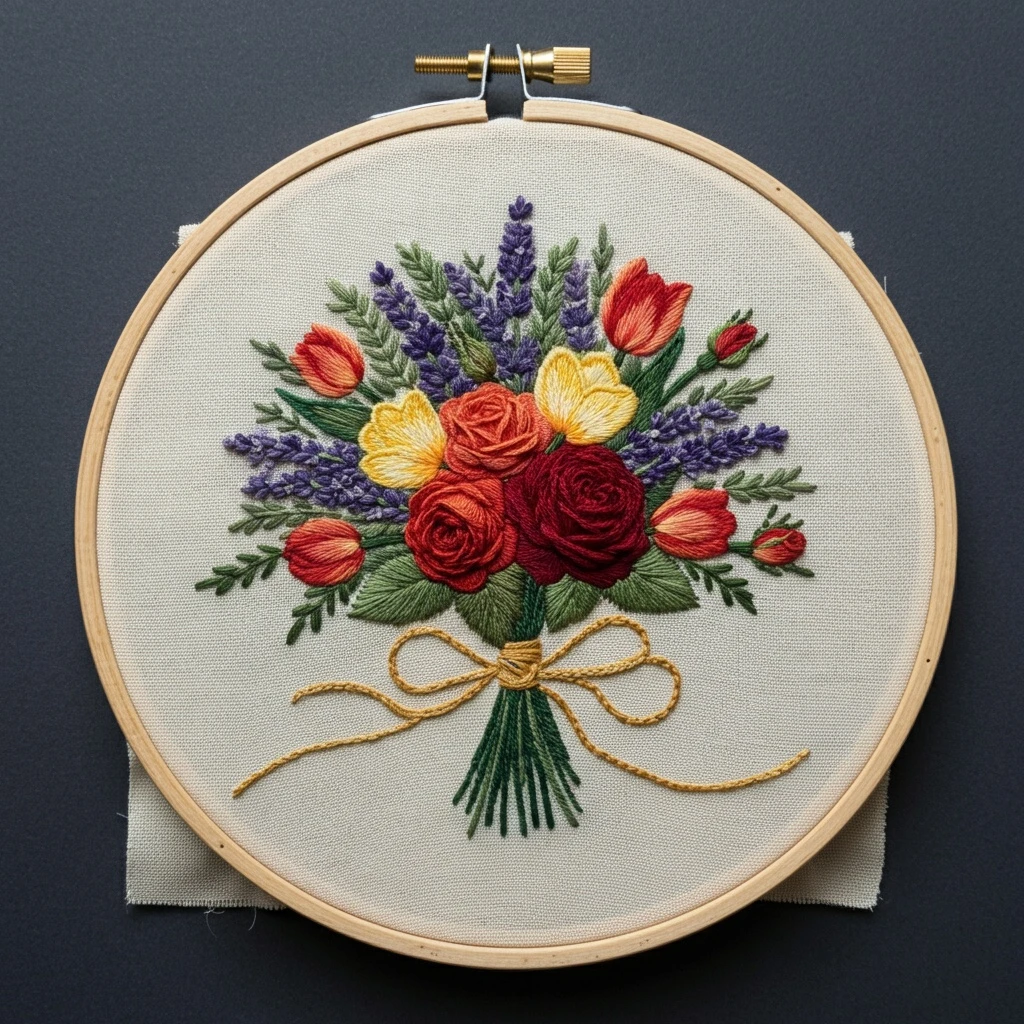
Vibrant Garden Bouquet
A cheerful hand-embroidery bouquet built around deep red roses, coral-orange tulips, buttery yellow blossoms, purple lavender spikes, layered green leaves, dark bundled stems, and a golden bow on natural linen.
Likely DMC Color Palette
Colors are estimated from the visible hoop preview and matched to close DMC six-strand cotton shades. The bouquet benefits from strong contrast: saturated rose reds, sunny yellows, violet lavender, olive foliage, and warm straw-gold ribbon.
Deep rose centers, darkest petal folds, and shadowed red bloom edges.
Main red rose petals and tulip outer edges where the color is brightest.
Coral highlights on tulips, warm rose highlights, and lively petal tips.
Orange tulip underlayers and warm transitions between red and yellow petals.
Yellow flower centers, petal bases, and bright sunny accents.
Soft yellow petal tips and tiny glints that keep blossoms luminous.
Dark lavender buds, back rows of purple spikes, and depth between flower clusters.
Midtone lavender blossoms and soft purple highlights on outer sprigs.
Bundled stems, dark leaf veins, and shadow pockets under flowers.
Main leaves, ferny greenery, and medium stem lines.
Muted leaf highlights and delicate background sprigs.
Golden bow, wrapped bouquet tie, and warm shadow on the ribbon loops.
Stitching Suggestions
Work from the densest central blooms outward. This keeps the bouquet tidy and lets the lavender sprigs and ribbon remain light, graceful finishing details.
| Design Element | Recommended Stitch | Practical Notes |
|---|---|---|
| Red roses | Long and short stitch, woven rose, or curved satin stitch | Use 814 in the deepest center curls, 321 for main petals, and 606 sparingly on raised petal ridges. Follow the spiral direction so the rose reads dimensional. |
| Coral-orange tulips | Satin stitch with split-stitch outlines | Outline each petal first in one strand of 321 or 606, then fill with 741 and blend toward red along the edges. Angle stitches from the base toward the petal tip. |
| Yellow blossoms | Long and short stitch or padded satin stitch | Place 725 near the petal bases and 3823 on the outer tips. A few tiny straight stitches in 782 make the centers warmer. |
| Lavender spikes | French knots, detached chain, and tiny straight stitches | Use 333 for shadow knots and 340 on the visible bud tops. Vary knot size so the spikes look organic rather than perfectly dotted. |
| Broad leaves | Fishbone stitch | Work from the leaf center vein outward. Alternate 3362 and 3346, then add 3052 along one side for a soft highlight. |
| Fine greenery | Straight stitch, fly stitch, or fern stitch | Use one strand for airy background sprigs. Keep stitches slightly uneven for a natural garden-bouquet feel. |
| Stem bundle | Stem stitch and straight stitch | Use 3362 for the darkest vertical stems. Add a few 3346 lines over the top so the bundle has separation without becoming bulky. |
| Golden bow and tie | Whipped backstitch, couching, or stem stitch | Stitch the loops after the stems. Couch a heavier strand of 782 with matching thread for a raised cord effect, or use whipped backstitch for beginners. |
Thread Count, Blending & Shading
Thread Counts
- Use 2 strands for most flower petals and medium leaves.
- Use 1 strand for fine outlines, lavender tips, leaf veins, and small stems.
- Use 3 strands only for the bow cord or the darkest rose centers if you want extra relief.
Blending Ideas
- Blend 321 + 606 for warm red-orange tulip transitions.
- Blend 725 + 3823 for creamy yellow petal tips.
- Blend 3346 + 3052 for soft, muted leaf highlights.
Shading Guidance
- Keep darkest reds at rose centers and under overlapping petals.
- Put pale yellow only on the brightest petal tips to avoid flattening the flowers.
- Reserve dark green for stems hidden behind the bouquet and under the bow.
Suggested Stitching Order
Beginner-Friendly Practical Tips
Keep the bouquet crisp
Use split stitch outlines before satin filling on tulips and yellow petals. The outline acts like a neat border and helps prevent uneven edges.
Avoid bulky centers
Roses can become heavy quickly. Use shorter stitches, change direction often, and avoid carrying thread across the back of open linen areas.
Texture balance
Pair smooth satin petals with knotty lavender and a raised bow. This contrast makes the design look more polished even with simple stitches.