
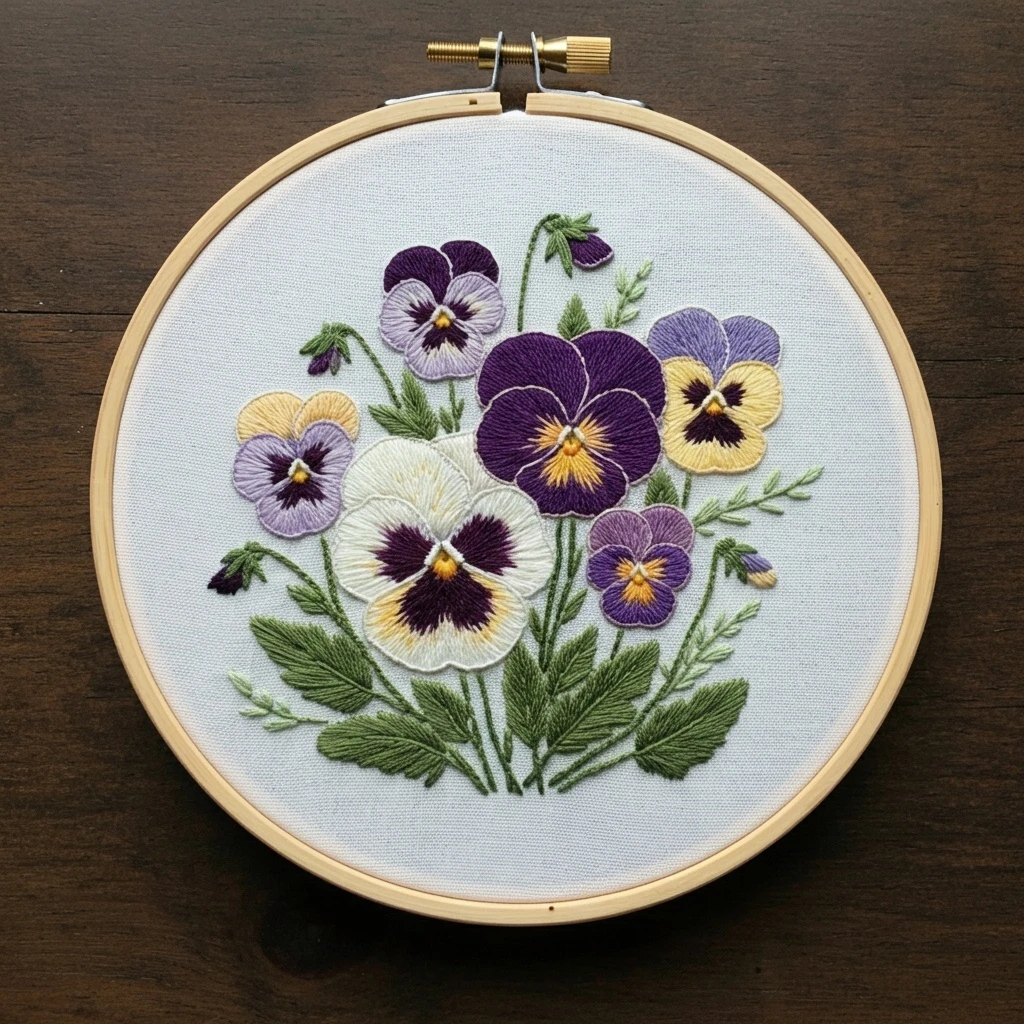
Vibrant Pansy Bouquet
A polished DMC color palette and hand-embroidery plan for a pansy hoop with deep violet faces, creamy white and butter-yellow petals, lavender companions, fine green stems, and textured serrated foliage.
Design Read
The reference shows a round hoop bouquet arranged from a dense lower cluster of leaves upward into pansy blooms. The strongest visual anchors are the central deep-purple pansy, the large cream pansy with burgundy face markings, and a yellow-lavender bloom at left. Smaller buds and side flowers repeat the same colors so the piece feels balanced rather than busy.
Most stitched texture is directional: petals radiate from each flower center, leaves angle outward from a central vein, and stems rise in gentle curves. Keeping those stitch directions consistent will make the bouquet look full, dimensional, and realistic even with a limited number of floss colors.
Likely DMC Color Palette
Colors are close visual matches to the visible hoop preview. Coverage is a practical estimate for planning thread amounts, not a precise yardage calculation.
| DMC | Thread name | Where it appears | Use notes |
|---|---|---|---|
| 550 | Violet Very Dark | Central pansy petals, deepest buds, dark petal folds | Use as the main shadow for purple pansies; place near petal bases and outer curl lines. |
| 333 | Blue Violet Very Dark | Medium-deep purple petals and side bloom shading | Blend with 550 for smoother petal transitions and less flat dark areas. |
| 340 | Blue Violet Medium | Lavender pansy petals, upper flower highlights | Use in long-and-short stitches radiating outward from the center vein. |
| 210 | Lavender Medium | Pale lavender petals and soft blended edges | Excellent for petal tips and for softening the boundary between cream and purple. |
| 154 | Grape Very Dark | Burgundy face markings and dramatic pansy throats | Use sparingly with 1 strand for the velvety central blotches. |
| 746 | Off White | Large cream pansy petals, pale petal highlights | Keep stitches smooth and clean; pair with 712 for warm shadow. |
| 745 | Yellow Pale Light | Yellow pansy petals and soft glow near centers | Works as a gentle butter-yellow base before adding darker gold accents. |
| 725 | Topaz Medium Light | Pansy throats, tiny center rays, bud tips | Use short straight stitches from the center outward for the bright pansy “face.” |
| 3362 | Pine Green Dark | Deep leaf veins, lower foliage shadows, darker stems | Use for central veins and tucked leaves under blossoms. |
| 3345 | Hunter Green Dark | Main leaves, stems, sepals | A dependable mid-dark green for the bouquet structure. |
| 3347 | Yellow Green Medium | Leaf highlights, new growth, fern-like sprigs | Use on one side of leaves to catch light and prevent a heavy green mass. |
| 3052 | Green Gray Medium | Muted stems and soft background greenery | Good for distant stems so the brighter flowers remain the focus. |
Stitching Suggestions
- Pansy petals: long-and-short stitch, following each petal’s curve from center outward.
- Petal rims: split stitch or fine backstitch with 1 strand in a lighter lavender or cream.
- Dark face markings: small satin stitches and short straight stitches in DMC 154 or 550.
- Golden throats: tiny straight stitches in 725, finished with a small French knot if the center needs lift.
- Leaves: fishbone stitch for larger serrated leaves; straight stitch for narrow leaflets.
- Stems: stem stitch with 1–2 strands, curving naturally upward into the flower heads.
- Buds: padded satin stitch for the purple bud body, with tiny green straight stitches for sepals.
Thread-Count Guide
- 1 strand: face markings, fine outlines, petal veins, small stems, and tiny leaf tips.
- 2 strands: most petal filling, medium leaves, and standard stems.
- 3 strands: large lower leaves or petals where you want fuller coverage on loose-weave fabric.
- Optional padding: add one layer of straight stitches beneath the central pansy petals before satin or long-and-short stitch for a plush raised face.
Blending, Outlining & Shading
Purple petal depth
Blend one strand of 550 with one strand of 333 in shadow areas, then switch to 333 + 340 toward the petal tips. This creates a velvety pansy look without needing many separate colors.
Cream petals
Use 746 as the visible light, then add 745 or a very few 725 stitches near the throat. Keep dark markings compact so the cream flower still feels luminous.
Leaf dimension
Work a dark central vein first, then fill one side with 3345 and the other with 3347 or 3052. This gives each leaf a folded, botanical shape.
Suggested Stitching Order
Mark the flower centers, petal directions, and main stem paths lightly so the bouquet does not drift.
Start with the cream bloom and central purple bloom. Use smooth long-and-short stitch and keep each petal separate.
Use 1 strand for dark blotches, then place tiny golden rays on top so the centers sparkle.
Use stem stitch for long curves and fishbone stitch for broad leaves, changing green shades as leaves overlap.
Add small buds, fine backstitch rims, and a few light petal veins last for definition.
Beginner-Friendly Tips
- Keep the hoop fabric drum-tight; pansy satin and long-and-short stitches look cleaner on taut fabric.
- Do not carry dark purple thread behind cream petals where it may show through light fabric.
- Shorter stitches curve more easily around rounded petals than very long satin stitches.
- Use a single direction of light: keep the upper petal tips lighter and flower centers deeper.
Texture Notes
- Use French knots sparingly for center lift, not as a heavy cluster.
- Whip a few stem-stitch lines with a lighter green to suggest raised stems.
- For serrated leaves, let tiny straight stitches extend slightly beyond the outline for a natural leafy edge.
- Finish with a gentle steam press from the back on a towel to preserve raised centers.