
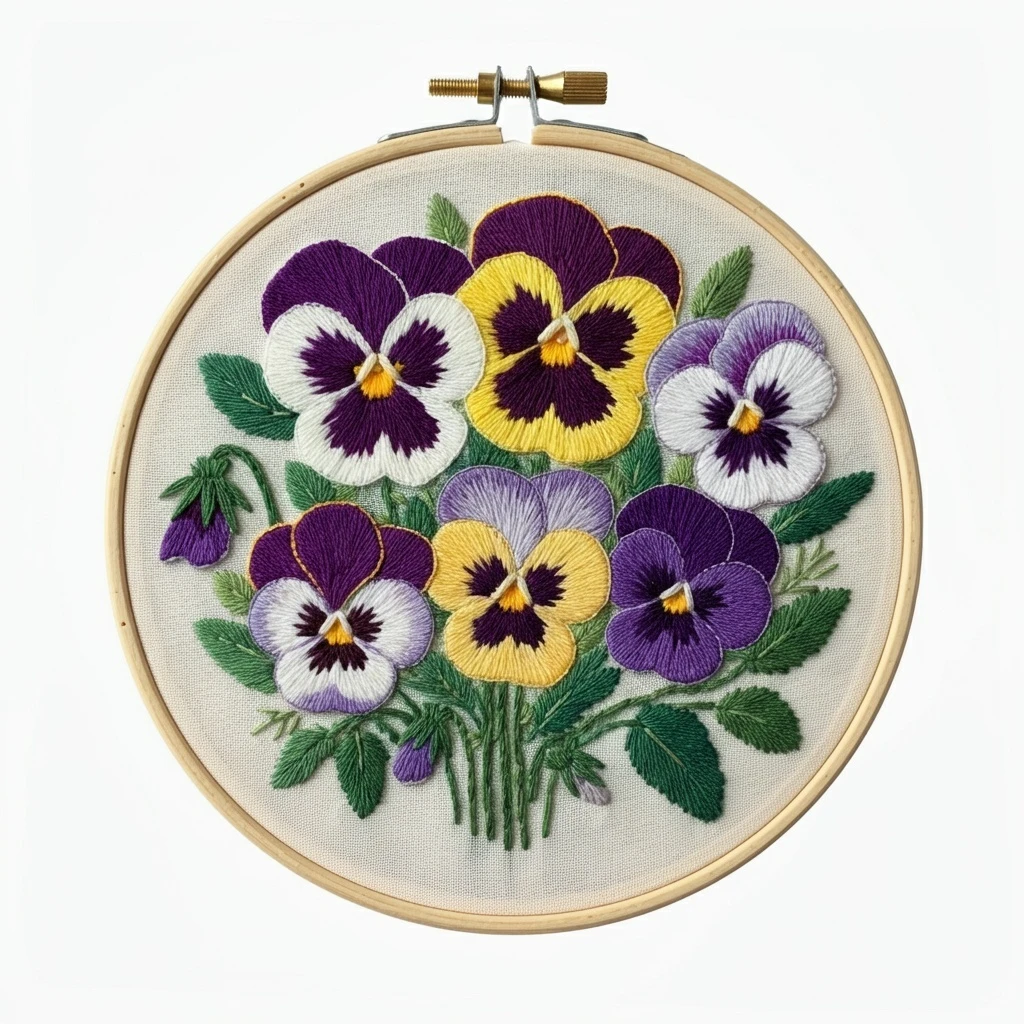
Vibrant Pansy Bouquet
A cheerful hoop bouquet built around velvety pansies: deep plum faces, sunny yellow petals, white-lavender highlights, small nodding buds, and a tidy cluster of green stems and serrated leaves. Colors are estimated from the visible preview and matched to practical DMC embroidery floss shades.
Likely DMC Color Palette
This palette favors rich pansy purples, creamy whites, clear yellows, small orange throats, and multiple greens for stems and leaves. Coverage percentages are visual estimates, not exact floss usage.
Stitching Suggestions
| Element | Best stitch | Practical notes |
|---|---|---|
| Large pansy petals | Long and short stitch | Work from the outer petal edge toward the center so the stitch direction follows the natural fan shape. Use 2 strands for fill; switch to 1 strand near tight overlaps. |
| Dark face markings | Short satin stitches or split stitch fill | Place the dark plum markings after the pale/yellow petal base so they sit cleanly on top. Keep the edges slightly feathered for a painted pansy effect. |
| Yellow petals | Satin stitch with long-and-short shading | Start with DMC 307 on the outer petal, shade inward with 725, then add a few 742 stitches at the throat. |
| White lavender petals | Long and short stitch | Use 3865 for the base, feather in 554 along edges and veins, then add small 154 or 550 markings near the center. |
| Petal outlines | Split stitch or fine backstitch | Use 1 strand. Choose 550 around purple petals, 725 around yellow petals, and 554 around pale petals to avoid a heavy cartoon outline. |
| Flower throats | Tiny satin stitch + French knot | Add a small wedge of 742 and one tiny knot or straight stitch in 3865 for the raised central beard. |
| Leaves | Fishbone stitch | Fishbone makes the serrated leaves look dimensional. Use 3363 down the midrib side and 367/368 toward the leaf tips. |
| Stems and bud stalks | Stem stitch | Use 1–2 strands depending on thickness. Vary 3363 and 367 so the gathered stems do not become one flat green mass. |
| Small buds | Detached chain, satin, and straight stitches | Use purple for bud petals and green straight stitches for sepals. Keep buds slightly looser than the main flowers for a natural bouquet edge. |
Thread Count, Blending & Shading
Thread count guide
- 2 strands for most petal fills and larger leaves.
- 1 strand for outlines, veins, tight centers, and small buds.
- 3 strands only for extra-raised flower throats or bold foreground stems.
Blend combinations
- 1 strand 154 + 1 strand 550 for rich pansy shadows.
- 1 strand 552 + 1 strand 554 for lavender transitions.
- 1 strand 307 + 1 strand 725 for warm yellow petal depth.
Texture strategy
- Keep petal stitches smooth and directional.
- Use fishbone leaves for crisp botanical texture.
- Add centers last so they remain raised and clean.
Where to Start
Beginner-Friendly Practical Tips
Control the petals
Use shorter long-and-short stitches than you think you need. Pansy petals are rounded, so frequent stitch-length changes make the curves more believable.
Avoid muddy purples
Keep dark 154 in the central face markings and deepest edges only. Let 550 and 552 do most of the visible purple petal work.
Keep the bouquet airy
Do not fill every gap with green. A few open linen spaces between stems help the flowers remain bright and readable.
Encouraging Finish
This pansy bouquet will look best when the petals are smooth and velvety, the centers are bold, and the leaves have just enough texture to frame the flowers without competing. Build the design from back greenery to front blooms, save the dark face markings for the final shaping pass, and the bouquet will feel bright, dimensional, and lively in the hoop.