
DMC palette & hand embroidery notes
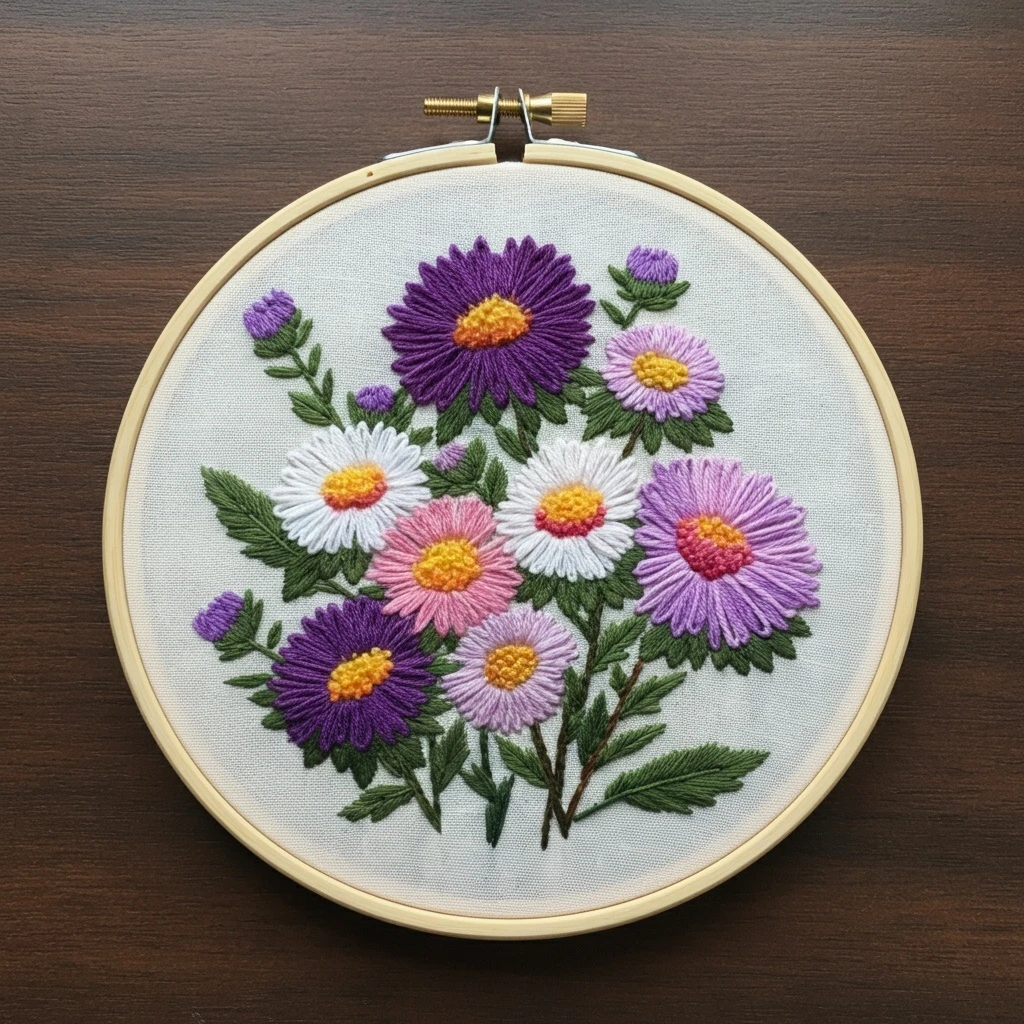
Vibrant Wildflower Aster Bouquet
This design reads as a lively gathered bouquet: daisy-like aster blooms with slender petals, warm yellow centers, small accent flowers, and fresh leafy stems. The best embroidery approach is bright but controlled—clear outlines, directional petal stitches, textured centers, and airy greenery so the bouquet keeps its wildflower charm.
Suggested DMC Color Palette
Use these flosses as a practical match for a vivid aster bouquet. Keep the brightest colors for front petals and centers; reserve the deeper tones for shadow, separation, and fine outlines.
Stitch Suggestions by Design Element
Aster petals
- Use long and short stitch from the flower center outward so each petal follows its natural direction.
- Work with 1 strand for small petals, 2 strands for bolder outer petals.
- Blend DMC 333 + 552 at the base, then 552 + 554 toward the tips for dimensional violet petals.
Flower centers
- Use clustered French knots in DMC 725, with a few 783 knots tucked along the lower edge.
- For flatter centers, use seed stitch or tiny straight stitches radiating in a circle.
- Add one or two winter-white knots only where you want sparkle.
Leaves and stems
- Use stem stitch for curved stems; keep tension relaxed for smooth arcs.
- Use fishbone stitch for larger leaves and lazy daisy for small leaflets.
- Alternate DMC 905, 906, and 907 so the greenery does not look flat.
Small wildflower accents
- Use lazy daisy petals for quick blossoms in pink, blue, or coral.
- Use straight stitch sprays for tiny filler flowers and grasses.
- Keep these accents lighter than the main asters so the bouquet has a clear focal point.
Thread Count, Blending & Shading
| Area | Recommended strands | Practical guidance |
|---|---|---|
| Main aster petals | 1–2 strands | Use 1 strand for delicate inner petals and color blending; use 2 strands for larger, graphic petals at the front of the bouquet. |
| Centers and pollen dots | 2 strands | French knots look plump with 2 strands. Wrap once for neat dots, twice for larger textured centers. |
| Stems | 2 strands | Stem stitch or split stitch gives a clean line. Switch to 1 strand for thin background stems. |
| Leaves | 1–3 strands | Use 2 strands for most leaves, 1 strand for veins, and 3 strands only for bold foreground foliage. |
| Outlines | 1 strand | Use DMC 934 or a matching darker shade sparingly around overlapping petals and busy bouquet sections. |
Suggested Stitching Order
Map the stems
Begin with the stem structure in medium green. This anchors the bouquet and prevents flowers from floating.
Add background leaves
Work lighter greenery first with lazy daisy and fishbone stitches, leaving room for the flower heads.
Fill main asters
Stitch petals from center outward, rotating the hoop so your stitches follow each petal naturally.
Texture the centers
Add French knots after petals are complete so the centers sit cleanly on top.
Place accent blooms
Add pink, blue, coral, and white details in small clusters to balance the bouquet.
Finish with outlines
Use minimal back stitch or split stitch only where shapes need crisp separation.
Texture & Finishing Tips
Make the bouquet feel lively
- Vary petal length slightly rather than making every stitch identical.
- Angle leaves away from the stems to create a hand-gathered wildflower look.
- Use small gaps of fabric between petals if the design feels crowded.
Avoid common beginner issues
- Keep thread lengths around 16–18 inches to reduce fuzzing and knots.
- Do not over-outline every flower; too much dark line can flatten the soft bouquet effect.
- Press from the back on a towel after stitching to protect French knots and raised texture.
Beginner-friendly shortcut: If long-and-short shading feels difficult, stitch each aster petal with a single straight stitch in the mid-tone color, then add one shorter darker stitch at the base and one lighter stitch at the tip. The result still looks shaded without complex blending.