
DMC palette & hand embroidery notes
Vintage Ornate Street Lamp
A refined guide for a monochrome Victorian-style lamp motif: crisp ironwork, delicate glass panes, tiny floral flourishes, warm hoop-and-linen contrast, and optional antique highlights for a softly aged finish.
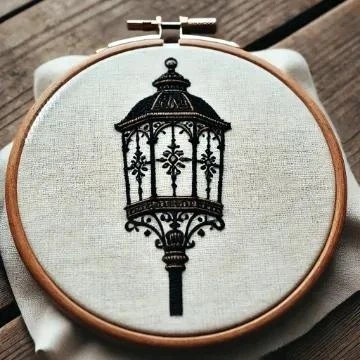
Preview illustration is interpretive; palette is matched to the visible black lamp on warm natural linen.
Likely DMC Color Palette
The reference reads as a mostly blackwork-style street lamp: dense black iron, softer charcoal edge detail, pale glass spaces, natural linen ground, and a warm wooden-hoop atmosphere. Percentages are visual estimates, not exact floss usage.
Stitching Suggestions
The success of this pattern depends on clean line weight, even curves, and open glass panes. Work slowly and keep tension light so the fine bars do not pucker the fabric.
| Element | Stitch type | Practical notes |
|---|---|---|
| Lamp silhouette | Split stitch, backstitch, or whipped backstitch | Use 2 strands of DMC 310 for the strongest outer contour. Whip the backstitch if you want a smoother wrought-iron line. |
| Canopy roof | Satin stitch with split-stitch border | Outline first, then fill from the lower rim toward the cap. Blend 310 with 3799 in alternating rows to show the domed roof. |
| Glass pane dividers | Single-strand backstitch | Use 1 strand so the panes stay delicate. Stitch vertical bars before curved decorative lines for better alignment. |
| Scrollwork and curls | Stem stitch or couching | For tiny curls, couch a strand of 310 with short 3799 holding stitches; this keeps tight curves graceful. |
| Floral ornaments | Detached chain, tiny straight stitch, French knots | Use small lazy-daisy petals around a 310 or 844 French-knot center. Keep these crisp rather than bulky. |
| Lamp base and post | Satin stitch and long straight stitch | Use 3 strands for the narrow post if you want dense coverage. Add a 3799 side line to create a rounded metal column. |
| Glass glow option | Seed stitch, small straight stitch | Add 1-strand 822, 642, or 3828 stitches inside the panes only after the black framework is complete. |
| Antique patina | Very light couching or single accent stitches | Use 975 or 3862 only in tiny touches on knobs, rim edges, and lower ornaments so the lamp stays elegant. |
Thread Count, Blending & Shading
Best strand counts
Use 2 strands for most outlines and heavy ironwork, 1 strand for pane dividers and delicate scrolls, and 3 strands only for the post or filled canopy if your fabric weave is coarse.
Black that is not flat
Pair 310 with 3799 or 844 in small areas: deepest black on the outside edge, pewter gray on inner ribs, and beaver gray where light might catch the metal.
Glass without filling everything
Leave most pane areas as negative space. A few 822 or 642 stitches near one side of each pane are enough to suggest reflection.
Vintage warmth
For a lamplit variation, add tiny 3828 seed stitches near the center and soften with 822. Keep the warm colors sparse so the ornate silhouette remains the focus.
Texture & Outlining Details
- Trace the design lightly and check every vertical bar before stitching; the lamp looks best when the frame is symmetrical.
- Stitch from the top finial downward so your hand does not rub over finished narrow lines as often.
- For ornate curls, shorten stitch lengths around curves instead of pulling long stitches into an arc.
- Use a sharp needle for tight details and switch to a slightly larger needle only for 3-strand filled areas.
- Anchor thread tails away from open glass panes so dark carry threads do not shadow through pale linen.
- Press from the back on a towel after finishing to preserve raised knots and whipped outlines.
Beginner-Friendly Work Order
Start with the simple structural lines before adding the decorative filigree. This keeps the design readable and prevents the small details from drifting out of place.
1. Main frame
Backstitch the outer canopy, side frame, lower base, and post in 2 strands of 310.
2. Pane bars
Add the vertical and horizontal dividers with 1 strand, keeping each line straight and evenly spaced.
3. Decorative curls
Work scrolls, flower-like ornaments, dots, and little arches with short stitches or couching.
4. Final polish
Add glass glints, gray shading, optional sepia patina, and any French knots last.
Encouraging Finish
This design is elegant because it is restrained. Clean black outlines, tiny balanced ornaments, and carefully preserved negative space will make the vintage street lamp feel detailed, architectural, and timeless without needing a large color range.