
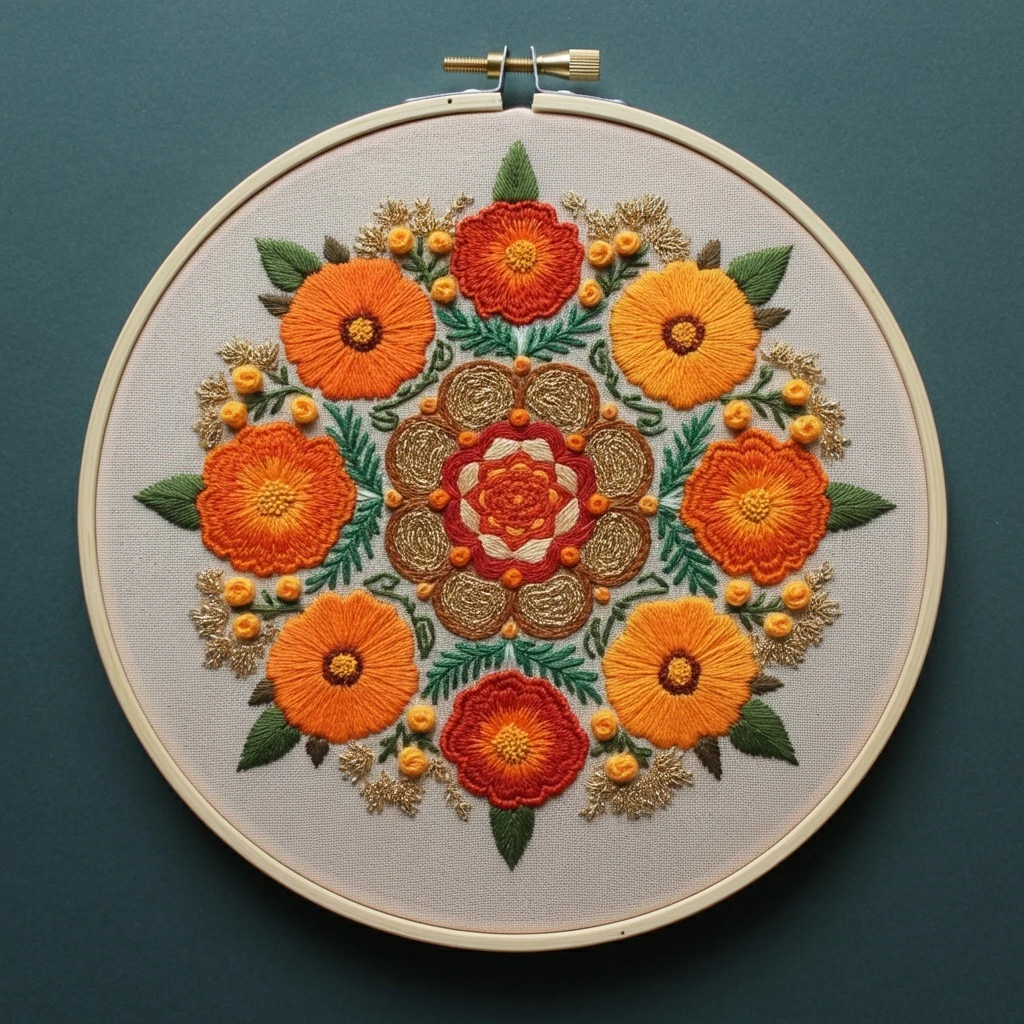
Warm Tones Floral Mandala
Colors are estimated from the visible hoop preview and matched to close DMC embroidery floss shades. The design reads as a symmetrical warm floral mandala: orange and golden flowers, rust-red scalloped blooms, a textured bronze center, dark green leaves, ferny stems, and tiny golden filler sprigs.
Preview image from linked reference file. Palette and stitch notes are based on the visible stitched colors, shapes, and raised texture.
Likely DMC Color Palette
Use the oranges and golds for the large radial flowers, deeper rusts for scalloped accent blooms, olive/forest greens for leaves, and antique browns/golds for the central mandala.
Stitching Suggestions
| Element | Stitch Type | Practical Notes |
|---|---|---|
| Large round flowers | Long and short stitch, satin stitch | Radiate stitches from the center outward. Use 740 in the fullest areas, 741/742 toward glowing edges, and keep stitch direction consistent so each bloom looks circular. |
| Scalloped rust blooms | Split stitch outline plus satin fill | Outline the wavy petal edge first with 3777 or 922, then fill inward. This keeps the scallops crisp and prevents the orange-red flower edges from wobbling. |
| Central mandala flower | Layered satin stitch and whipped backstitch | Work from the middle outward. Alternate rust, cream, and brown-gold shapes; whip the circular outlines to make the center look raised and ornamental. |
| Bronze oval petals | Chain stitch, couching, or padded satin | Use 975 and 832 in curved rows. For a metallic effect without metallic floss, couch a strand of golden olive over a darker brown base. |
| Flower centers | French knots or colonial knots | Cluster one-wrap knots in 725 and 832. Add a few darker knots near the lower edge to suggest shadow and depth. |
| Outer leaves | Fishbone stitch | Begin at the leaf tip and angle stitches toward the central vein. Blend 469 with 500 near the vein for stronger definition. |
| Fern-like greenery | Stem stitch with straight-stitch fronds | Use one strand for slim stems and quick straight stitches for fronds. Vary the greens so the foliage does not become a flat ring. |
| Golden filler sprigs | Seed stitch and tiny straight stitches | Scatter 832 or a light gold shade in short uneven marks. Keep these airy so they sparkle around the heavier flowers. |
| Small orange berries | French knots, satin dots, or woven roses | For raised dots, use two strands and two wraps. For tiny rosettes, make a small five-spoke wheel and weave 742 around it. |
Thread-count guidance
- Use 2 strands for most satin, long-and-short, and fishbone fills.
- Use 1 strand for fern stems, mandala outlines, and inner contour details.
- Use 3 strands only for raised knots or padded central accents.
Blending ideas
Blend 740 + 741 in a needle for lively orange petals, 922 + 3777 for dark rust edges, and 469 + 500 for shaded leaf veins. For the bronze center, combine 975 with 832 to mimic a muted antique-gold shine.
Outlining details
Outline the mandala rings, scalloped flowers, and leaf veins after the fills are complete. A single strand of 3777 or 500 gives clean definition without making the warm design look too heavy.
Shading & Texture Plan
Where to Start
Start with the central mandala because it controls the symmetry. Next, stitch the large orange and golden flowers at the four sides, then add the rust scalloped blooms. Fill the leaves and fern shapes after the main flowers are balanced, and finish with golden filler sprigs, small orange knots, and final outlines.
Beginner-Friendly Finish
Keep the hoop fabric drum-tight, rotate the hoop as you work so radial stitches always feel natural, and compare opposite sides often. This design succeeds when repeated shapes are tidy rather than perfect: warm colors, raised knots, and clean green leaves will make the mandala feel full, bright, and beautifully balanced.