
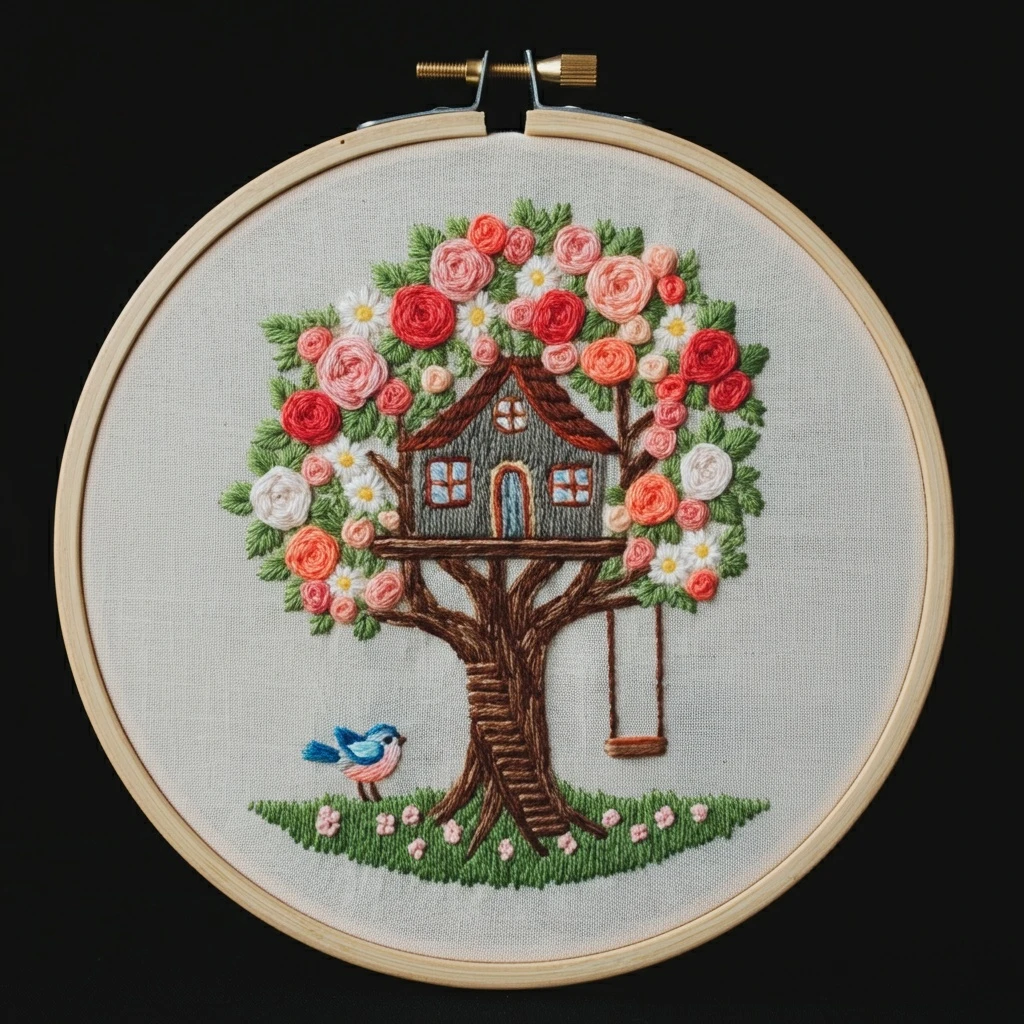
Whimsical Treehouse Garden
A polished DMC floss palette and practical stitch plan for a storybook treehouse nestled in a leafy garden, with warm wood, textured bark, climbing greenery, tiny blooms, soft sky tones, and charming architectural details.
Image Color & Design Read
The reference reads as a cozy fantasy garden: a sturdy tree trunk supports a small wooden house, surrounded by rounded green foliage, climbing stems, little flowers, and soft outdoor light. The palette should balance earthy bark browns and honeyed wood with leafy greens, gentle blue sky, muted shadows, and small pink, gold, and cream accents.
Coverage percentages are visual estimates to help prioritize floss purchases, not exact yardage.
Stitching Character
Let the tree trunk feel textured, the house boards neat and readable, and the garden loose and lively. This design benefits from crisp outlines on windows, roof edges, ropes or ladders, then softer layered stitches for leaves, moss, flowers, and ground cover.
Likely DMC Color Palette
Stitch Types & Thread Guidance
| Element | Recommended stitch | Thread count & practical notes |
|---|---|---|
| Main tree trunk | Long and short stitch with split-stitch texture | Use 2 strands. Blend 975 and 434 vertically, then add 1-strand 898 bark cracks following the trunk curve. |
| Branches | Stem stitch and split stitch | Use 2 strands for thick branches and 1 strand for tips. Keep the direction flowing outward so the tree supports the house naturally. |
| Treehouse walls | Satin stitch or long straight stitches | Use 2 strands of 434/435. Stitch each plank in the board direction; add 1-strand 975 seams to make the structure readable. |
| Roof and trim | Brick stitch, backstitch, or short straight stitches | Use 1-2 strands. Alternate 975 and 3828 for shingles or trim; outline roof edges with one strand so they stay delicate. |
| Windows and door | Satin stitch plus fine backstitch | Use 1 strand for frames. Add tiny 747 or 3865 highlights after dark interiors are stitched. |
| Leaf clusters | Fishbone stitch, detached chain, and seed stitch | Use 2 strands. Layer 3363 underneath, 3052 as the main green, and 3013 on top for light-catching leaves. |
| Vines and tendrils | Stem stitch and whipped backstitch | Use 1 strand for curling stems. Add detached-chain leaves in 3013 or 3052 at intervals. |
| Flowers | French knots, lazy daisy, tiny satin stitches | Use 2 strands for petals and centers. Keep flowers small so they decorate rather than overwhelm the treehouse. |
| Garden ground | Straight stitch, fly stitch, seed stitch | Use 1-2 strands. Mix greens and browns irregularly; vary stitch length for grass, moss, and soil texture. |
| Fine outlines | Backstitch or split backstitch | Use 1 strand of 898 or 975. Outline only key shapes: house silhouette, door/window frames, ladder rungs, and selected branch edges. |
Blending & Shading Ideas
- For bark, thread the needle with one strand of 975 and one strand of 434 to create a natural heathered trunk.
- Use darker greens behind the house and lighter greens at the outer leaf tips to keep the treehouse from disappearing.
- Add a few 3828 strokes along plank tops and window frames for a soft sunlit storybook effect.
- Keep sky blue accents sparse; too much blue can flatten the garden scene.
Texture Suggestions
- Use irregular split stitches over the trunk instead of perfectly parallel lines.
- Cluster French knots around the base for moss and flowers.
- Whip selected vine stitches with a lighter green for a raised climbing-plant look.
- Use tiny straight stitches across planks to suggest wood grain without filling every board.
Beginner-Friendly Stitch Order
Anchor the structure
Backstitch the treehouse, trunk edges, roofline, and major branches with 1 strand so the composition stays organized.
Fill wood and bark
Work the trunk and house boards before adding leaves. Follow natural grain directions and leave tiny gaps for later highlights.
Layer the garden
Add dark foliage first, then mid greens, then light leaves, flower knots, window glints, and final outlines last.
Practical Finishing Tips
- Use a tightly hooped cotton or linen ground so long wood stitches do not pucker.
- For tiny details, shorten the working thread to 12-14 inches; this keeps 1-strand backstitch clean.
- Do not over-outline every leaf. Selective outlines make the scene feel whimsical and breathable.
- Check the design from arm's length before adding more knots; miniature garden details can become crowded quickly.
- Press face down on a towel after stitching to protect raised knots and textured bark.