
DMC palette & hand embroidery notes
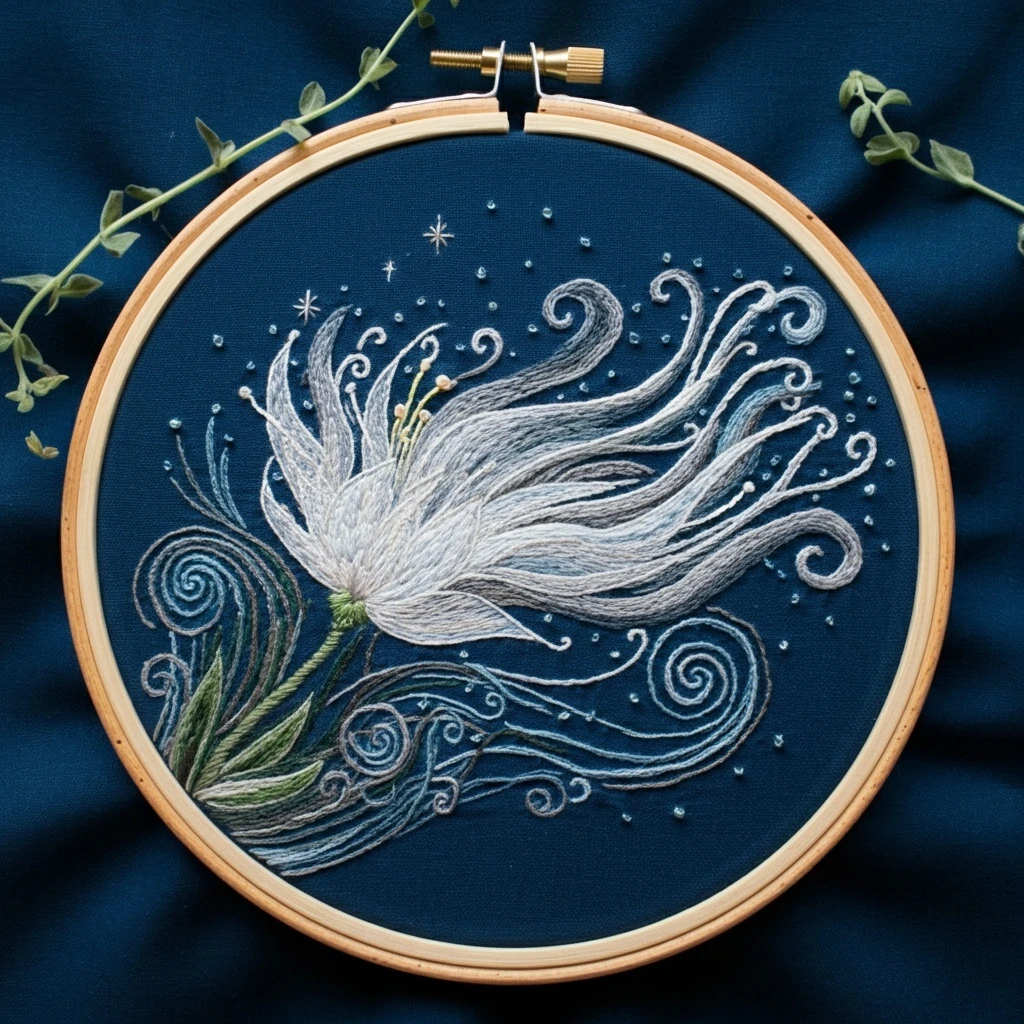
Whimsical White Flower And Swirls On Dark Blue
A polished stitching plan for a high-contrast design: creamy white blossoms and playful curling tendrils floating over a deep midnight-blue ground.
Design read
This piece is built around contrast rather than a large rainbow palette. The dark blue background makes the white flower feel luminous, while the curling swirls add movement and a slightly magical, folk-art rhythm. Keep the white areas dimensional by avoiding a single flat white: use soft greys, pale blue shadows, and warm cream highlights.
Suggested DMC palette
Stitch plan by motif
White flower
Use long-and-short stitch from petal base to tip. Blend Blanc with 762 for lower petal shadows, then add B5200 on the upper ridges.
Swirls and curls
Stem stitch gives graceful curves. For thicker curls, couch a 4-strand laid thread with 1 strand of matching white or pale grey.
Flower center
Cluster French knots in 745 and 783. Add one or two 3799 seed stitches at the deepest center for definition.
Leaves or small sprigs
Fishbone stitch works well for tiny leaves. Use 3052 on top and 3051 in the center vein.
Thread-count guidance
- Petal shading: 1 strand for refined long-and-short stitches; 2 strands only on larger petals.
- Swirl outlines: 2 strands for clean stem stitch; 3 strands for bolder decorative curls.
- Centers: 2 strands wrapped once or twice for tidy French knots; vary wrap count for texture.
- Dark accents: 1 strand of 336 or 3799 is enough on navy fabric.
- Highlights: 1 strand B5200 after all shading is complete.
Blending and shading
For luminous white petals, think in three values: warm body, cool shadow, bright highlight. Start with Blanc, feather in 762 at the base or under overlaps, and reserve B5200 for the last stitches. A touch of 798 beside a white curl can make it look raised off the dark cloth.
For a softer look, blend one strand Blanc with one strand 762 in the transition areas. For stronger graphic contrast, keep each color in separate directional strokes.
Texture suggestions
- Use split stitch underneath satin-stitched petal edges to create a padded, clean contour.
- Alternate short and long stem stitches around curls so the line does not look ropey.
- Add tiny straight stitches or seed stitches around the flower for a stardust effect.
- Keep the background mostly unstitched; the dark fabric is part of the design.
Beginner-friendly stitching order
- Transfer only the main flower, swirl paths, and essential veins. Too many pale guide marks can clutter dark fabric.
- Stitch the inner petal shadows first with 762 and 415 using 1 strand.
- Fill petal bodies with Blanc, following the natural curve of each petal.
- Add B5200 highlights on the petal tips and top edges after the flower shape is complete.
- Work the swirls in stem stitch, rotating the hoop often so your needle follows the curve comfortably.
- Finish with French knots, tiny seed stitches, and any green sprig details. Press from the back over a towel.
Practical tips for a clean dark-fabric finish
- Wash hands before stitching; white floss picks up oils quickly, especially against navy cloth.
- Use short floss lengths, about 14–16 inches, to keep B5200 and Blanc from fraying.
- Anchor white thread under existing white stitches rather than carrying it across the back of dark fabric.
- Test transfer marks on a scrap of the same fabric before drawing the full design.
- When in doubt, outline less. The strong background already gives the flower crisp contrast.