
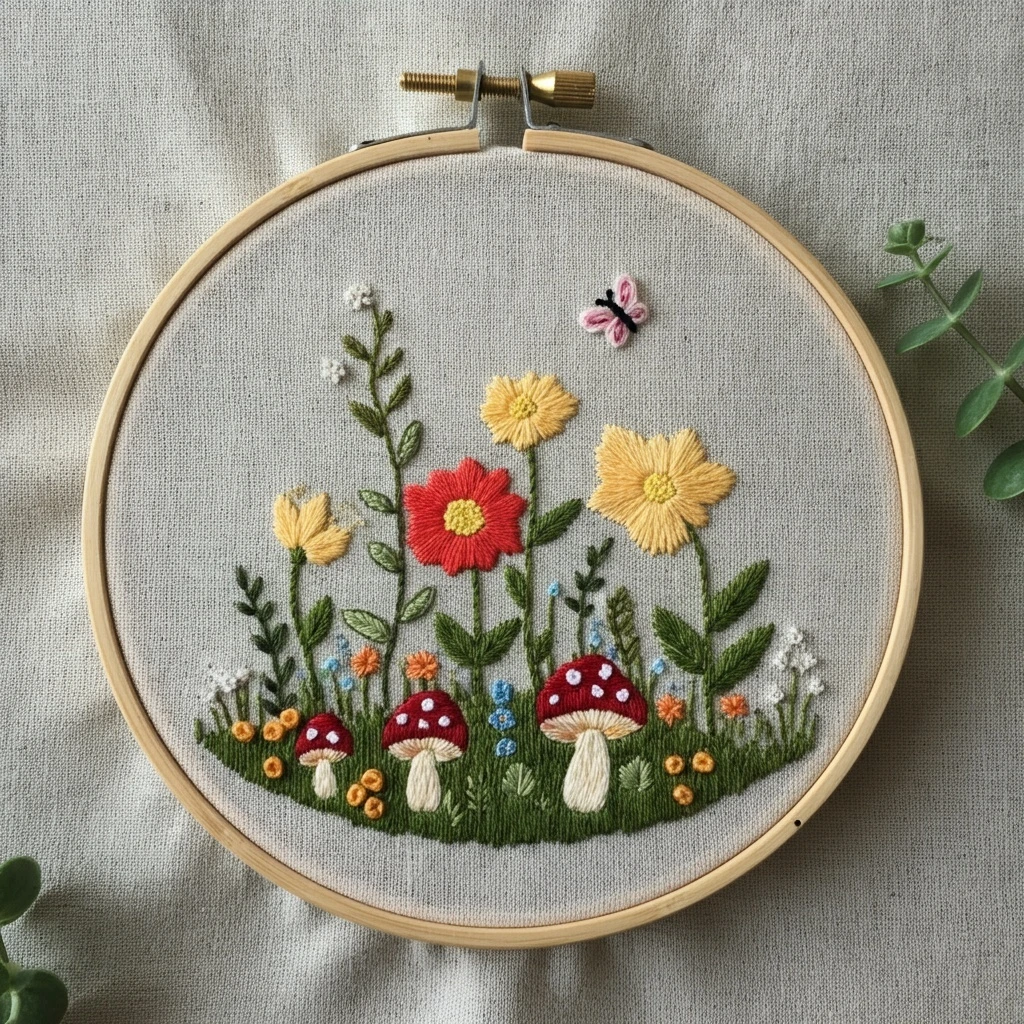
Whimsical Wildflower And Mushroom
A cozy woodland embroidery guide for a playful mushroom-and-wildflower motif: soft earthy stems, cheerful cap colors, small meadow blossoms, and light storybook outlines. The palette below keeps the design bright enough for hoop art while preserving a gentle beginner-friendly feel.
Use the image as a color and placement reference; keep stitches neat and slightly raised for a charming illustrated finish.
Design read: colors, shapes, and mood
What stands out
- A central woodland mushroom with a warm cap, pale underside, and gently curved stem.
- Loose wildflower sprigs around the mushroom, giving the design a meadow-garden frame without heavy filling.
- Soft greens and warm browns carry the natural base, while coral, yellow, violet, and cream make the small flowers pop.
- Fine dark linework is best kept delicate so the design remains whimsical rather than graphic.
Embroidery approach
Work from the main mushroom outward: fill the cap and stem first, add leaf/stem lines next, then finish with blossoms, dots, and outline accents. This prevents tiny flowers from being crowded by larger stitched areas.
For a light hoop-art look, avoid filling every background space. Let the fabric show between sprigs so the mushroom reads as the focal point.
Suggested DMC palette
Stitch plan by design area
| Area | Recommended stitches | Thread count & notes |
|---|---|---|
| Mushroom cap | Long and short stitch, satin stitch for small sections, split stitch edge. | Use 2 strands for fill. Blend 351 + 722 for the middle glow, then 347 near the lower rim or folded side. |
| Mushroom spots and gills | French knots, tiny satin ovals, straight stitches, short back stitch. | Use 1 strand for gill lines and 2 strands for raised dots. Keep spots uneven for a natural hand-drawn look. |
| Stem | Long and short stitch following the curve, stem stitch outline, tiny seed stitches. | Use 2 strands of 3864, shade one side with 975, and add one strand of 746 on the light edge. |
| Wildflower stems | Stem stitch, whipped back stitch, couching for very long curves. | Use 1 strand for thin sprigs and 2 strands for the main stems. Alternate 3012 and 3013 to avoid flat greenery. |
| Leaves | Lazy daisy, fishbone stitch, detached chain, straight stitch veins. | Use 2 strands for leaf bodies and 1 strand for inner vein marks. Add 3011 only at bases or overlapping shadows. |
| Small blossoms | Lazy daisy petals, woven wheel roses, French knots, satin dots. | Use 2 strands for petals. Use 743 for centers; add 209 for violet accents and 351/722 for warm blooms. |
| Outlines and tiny details | Back stitch, split stitch, seed stitch. | Use 1 strand of 3371 or 975. Avoid heavy black outlining unless the printed design calls for a graphic edge. |
Blending, shading, and texture ideas
Mushroom cap gradient
Start with 347 at the shadowed rim, transition to 351 across the main cap, then feather in 722 near the highest light. A few short 746 stitches beside the cap spots make the surface look glossy.
Woodland greenery
Use 3012 for most stems, then add 3013 at tips and 3011 behind the mushroom. This three-step green range gives depth without requiring complex thread painting.
Whimsical flower texture
Mix lazy daisy petals with French-knot centers. Place the brightest colors sparingly around the mushroom so the design feels lively but not crowded.
Beginner-friendly stitching sequence
Practical tips for a polished hoop
Thread-count guidance
- 1 strand: fine outlines, gills, stem veins, tiny grass strokes.
- 2 strands: most fills, lazy daisy petals, leaves, mushroom shading.
- 3 strands: occasional bold flower centers or raised foreground knots only.
Fabric and hoop handling
- Use cotton or linen with a firm weave so small knots and detached chains stay crisp.
- Keep tension drum-tight but not stretched; woodland curves look best when the fabric is stable.
- Use shorter floss lengths, about 14–16 inches, to reduce fuzzing on satin and long-and-short areas.
Optional finishing touch: add a few scattered 743 or 746 French knots around the wildflowers as pollen or fairy-light dots. Keep them asymmetric for the sweetest whimsical effect.