
DMC palette & hand embroidery guide
Wildflower Bouquet Mandala
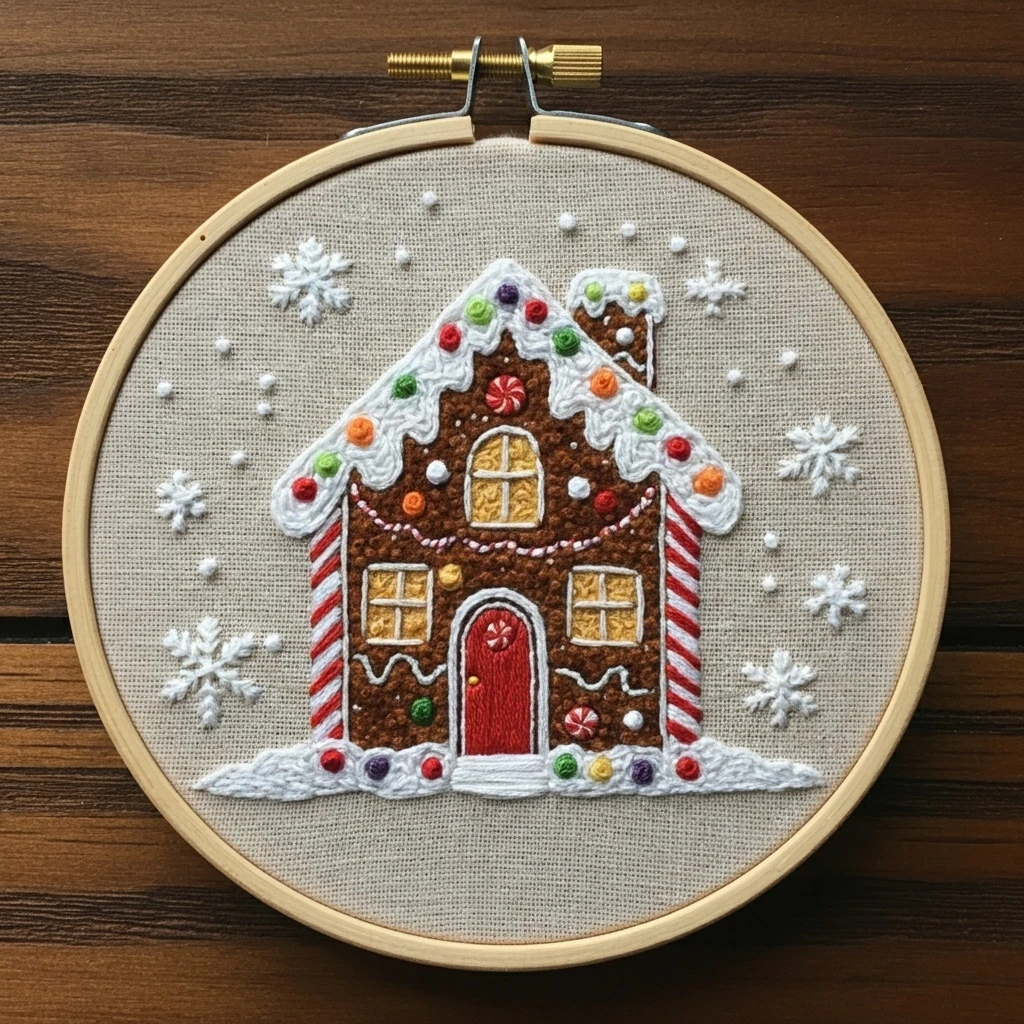
Colors estimated from the visible hoop preview and matched to close DMC embroidery floss shades. The linked preview reads as a festive circular composition with crisp whites, gingerbread browns, candy reds, bright ornament accents, soft linen neutrals, and raised snow-like texture around the design.
Preview Color Read
The visible sample has a neutral linen ground, a warm brown central motif, snowy white edging and dots, candy-cane red striping, small green, yellow, orange, purple, and red accent knots, plus pale gold window areas. The palette below is practical rather than exact; use it as a strong starting point and adjust for your fabric tone and lighting.
| DMC | Color | Use note | Coverage |
|---|---|---|---|
| 3865 | Winter White | Snow caps, snowflakes, dots, roof icing, ground border, and brightest highlights. Keep this clean and slightly raised. | 22% |
| 822 | Beige Gray Light | Soft shadow inside white areas so snow and icing do not look flat on light fabric. | 7% |
| 801 | Coffee Brown Dark | Main warm brown body, dense fill, and chocolate-toned central shapes. | 18% |
| 898 | Coffee Brown Very Dark | Deep body shadows, outer edges, under roof drips, and separation between white trim and brown fill. | 8% |
| 975 | Golden Brown Dark | Warm speckles, raised crumb texture, and highlights mixed through the brown fill. | 6% |
| 321 | Red | Door, candy stripes, red ornaments, peppermint accents, and strong festive focal points. | 12% |
| 815 | Garnet Medium | Door shadows, dark red stripe sides, and depth in peppermint swirls. | 5% |
| 726 | Topaz Light | Window glow, tiny yellow candy dots, and warm highlights beside white outlines. | 6% |
| 741 | Tangerine Medium | Orange candy knots and lively round accents along the roof and base. | 4% |
| 701 | Green Light | Bright green candies and small contrast accents; good as French knots or padded dots. | 4% |
| 911 | Emerald Green Medium | Darker side of green knots and any tiny leafy or jewel-like accent shadows. | 3% |
| 550 | Violet Very Dark | Purple ornament knots; use sparingly for a jewel accent against the white base. | 3% |
| 415 | Pearl Gray | Fine outline shadow on snowflakes, white dots, door arch, and roof ridges when white needs definition. | 2% |
Stitching Suggestions
Main brown bodyUse long and short stitch or compact split stitch with 2 strands. Mix 801 and 975 in uneven patches, then touch the edges with 898 for depth.
White snow and icingWork padded satin stitch, whipped backstitch, or closely packed stem stitch in 3865. Add 822 only on the underside of curves.
Mandala snowflakesUse straight stitches radiating from the center with 1 strand, then add a tiny French knot or colonial knot in the middle.
Candy-cane stripesOutline the stripe column first in split stitch, then fill alternating red and white diagonal satin stitches. Keep each stripe angle consistent.
Door and windowsFill the red door with vertical satin stitch. Use 726 for window glow and couch or backstitch the panes with 3865 for clean geometry.
Raised candy dotsUse French knots, colonial knots, or tiny padded satin dots. One wrap gives small snow dots; two wraps gives round candy texture.
Thread Count & Blending Guide
Recommended strands
- 1 strand: snowflake arms, narrow outlines, tiny window panes, delicate string details.
- 2 strands: most fills, roof icing, door fill, brown body, candy stripes, and medium outlines.
- 3 strands: padded snow base or large white scallops when you want extra plush texture.
- 6 strands: rarely needed; reserve for very large display hoops or chunky decorative knots only.
Blending ideas
- Blend 1 strand 3865 + 1 strand 822 for shaded snow under roof drips and along the ground.
- Blend 1 strand 801 + 1 strand 975 to make the brown fill look warm and baked rather than flat.
- Blend 1 strand 321 + 1 strand 815 on the lower side of the red door for a rounded, shaded look.
- Use pure bright colors for the tiny ornaments so they stay cheerful and readable at a small scale.
Beginner tip: stitch the largest shapes first, then add white edging and final knots last. Raised knots catch easily while you work, so saving them for the end keeps them neat and round.
Suggested Stitching Order
Transfer and stabilize. Use a fine water-soluble pen on linen or cotton. Hoop the fabric drum-tight so satin stitches stay smooth.
Block in the central brown shape. Fill with 2 strands using directional long and short stitches. Add darker edges only after the base is complete.
Add doors, windows, and striped sides. These clean geometric areas help the design read clearly before texture is added.
Build the snow and icing. Use padded white stitches over roof edges, the ground line, and scalloped trims. Keep curves soft rather than perfectly rigid.
Finish with dots, knots, and snowflakes. Scatter French knots in white and bright colors. For snowflakes, work from the center outward to keep the spokes balanced.
Outlining, Shading & Texture Notes
- Outlines: Use split stitch for soft outlines and backstitch for crisp architectural lines. Pearl gray is helpful around white-on-linen details.
- Shading: Place the deepest brown under roof overhangs, near the door sides, and along the lower edges. Keep highlights small and irregular.
- Texture: Speckle the brown fill with tiny seed stitches in 975 and 898 to mimic crumbly, handmade texture.
- White areas: Vary stitch direction in the snow so it catches light. Horizontal stitches for the ground and curved stitches for roof drips work especially well.
- Mandala balance: Repeat knot size and spacing around the hoop. Even if the motifs are playful, the circular layout looks best when visual weight is balanced.