
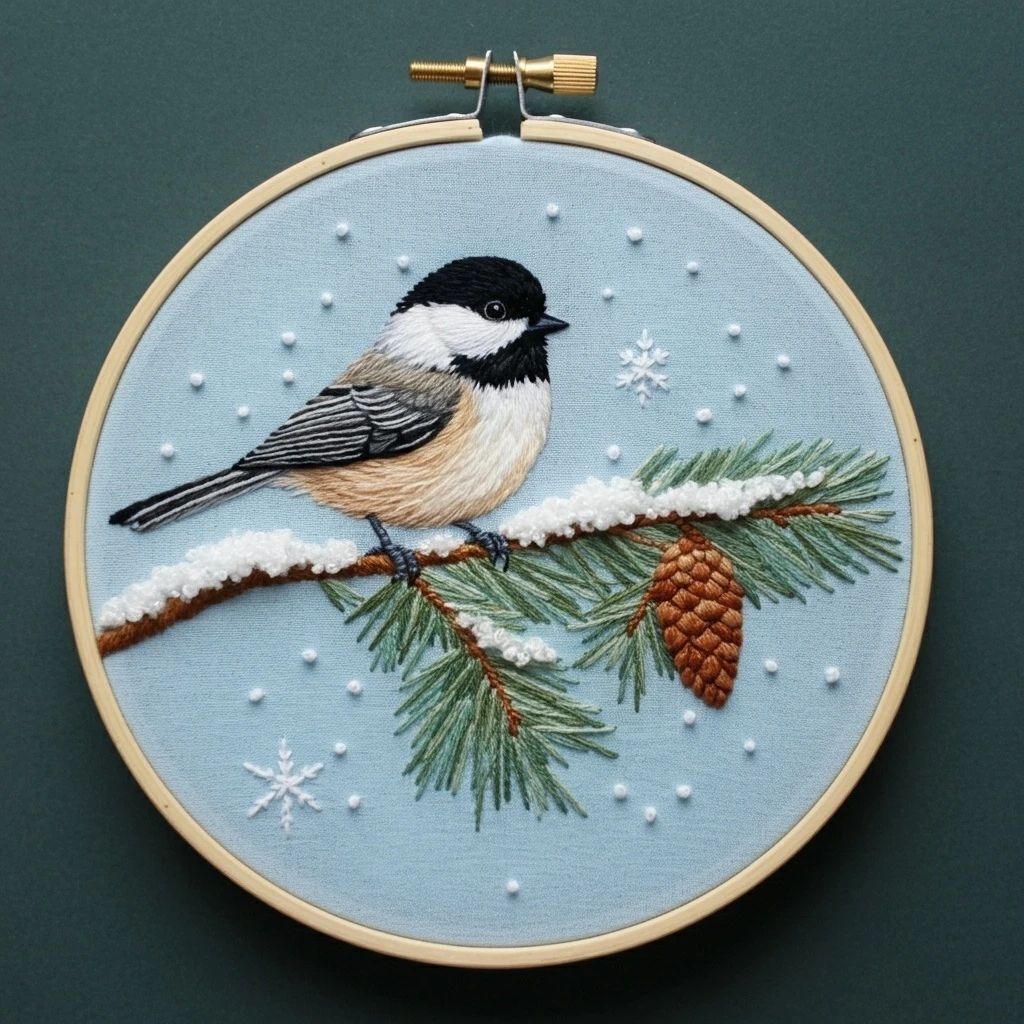
DMC palette & hand embroidery notes
Winter Chickadee
A polished stitching guide for a small winter bird scene: a black-capped chickadee with soft white cheeks, smoky grey wings, warm buff feathers, bare twigs, evergreen sprigs, red winter berries, and snowy highlights. The palette is designed to keep the bird crisp while the background botanicals stay delicate and seasonal.
Design read: what to emphasize
The charm of a chickadee comes from contrast: a very dark cap and throat against bright cheeks, then quieter grey and tan feathering through the body. Keep the stitches directional and light so the bird reads as soft, not flat. Let the berries and evergreen provide the strongest color accents.
Bird focal point
Use clean outlines around the cap, bib, eye, beak, and cheek edge. Feather shading should follow the wing and belly direction rather than filling in blocks.
Winter botanicals
Branches can be slightly textured with split stitch and one-strand brown highlights. Evergreen needles work best as tapered straight stitches in two greens.
Snow and air
Use white sparingly: a few couching or tiny satin highlights on branch tops, berry shine, and cheek edges will feel more natural than heavy white fill.
Suggested DMC color palette
This palette balances the graphic black-and-white markings of the chickadee with winter foliage, muted bark, and small red berry accents. Use the notes to decide where to keep thread single-stranded and where to blend.
Thread-count and blending plan
Stitch suggestions by design area
| Area | Recommended stitches | Practical notes |
|---|---|---|
| Black cap and throat | Split stitch outline, padded satin, very short long-and-short | Outline first in 310, then fill toward the cheek edge. Add 3799 at the outer edge to prevent the black from looking like a flat patch. |
| White cheek patch | Long-and-short, single-strand feather strokes | Avoid filling with pure white only. Build with 762 and 318, then place B5200 along the brightest cheek curve. |
| Wing and tail | Directional long-and-short, fly stitch, straight stitch overlays | Angle stitches from shoulder to tail. Use 413 and 414 as the base, then 318 for feather tips and 3799 for dark separations. |
| Warm belly | Long-and-short, seed stitch accents | Blend 822 with 3864 for a soft buff underside. Keep the belly fluffier than the cap by varying stitch length. |
| Evergreen needles | Straight stitch, detached chain, fly stitch | Stitch from the stem outward so each needle tapers naturally. Mix 3363 with 3052; reserve 934 for hidden shadow clusters. |
| Red berries | Satin stitch, colonial knots, French knots | For tiny berries, use knots. For larger berries, satin stitch with 321 and tuck 816 on the lower edge for roundness. |
| Branch and twigs | Stem stitch, split stitch, couching | Follow the curve of the twig. Add irregular 840 strokes over 839 for bark, then tiny B5200/762 snow caps where needed. |
Step-by-step stitching order
Use a fine water-soluble pen or pale graphite. Hoop the fabric drum-tight and add a light stabilizer if your fabric is loosely woven.
Complete the main branch and twig lines before the bird so the feet and belly can sit convincingly on top.
Outline the cap and bib in 310, fill grey wing areas, then soften the cheeks and belly with pale grey and beige.
Work greens after the bird silhouette is clear. Keep needles slightly varied in length; place red berries last so they remain clean.
Add one-strand feather strokes, snow touches, eye catchlight, and berry highlights only after the main fill is complete.
Shading and texture guidance
Feather softness
Use uneven long-and-short rows rather than straight satin blocks on the body. Let individual stitches overlap slightly so the grey, white, and beige shades melt together.
Graphic contrast
The cap and throat should remain the darkest values in the design. A thin 3799 transition line beside 310 helps the black markings feel embroidered, not drawn on.
Winter sparkle
Place B5200 in tiny accents: eye catchlight, cheek rim, berry glint, and snow on twigs. Too much bright white can flatten the quiet winter palette.
Natural branches
Do not make every bark stitch symmetrical. Short broken lines in 840 over 839 look more organic, especially where the twig bends or branches split.
Beginner-friendly practical tips
Needle choice
A size 7 or 8 embroidery needle works well for 2 strands; switch to size 9 or 10 for one-strand facial details and feather overlays.
Hoop tension
Retighten the fabric before satin stitching the berries and cap. Slack fabric can distort small round shapes and facial lines.
Thread lengths
Use shorter lengths, around 14–16 inches, for black and red floss. These colors show fuzz and wear more quickly.
Clean color changes
Finish dark threads securely away from white cheek areas so black fibers do not shadow through the pale stitches.
Layering order
Work base fills first, then outline and detail. Single-strand top stitches can correct shape edges and add feather direction.
Final rinse
If using water-soluble marks, rinse gently in cool water and lay flat to dry. Press from the back on a towel to protect raised knots.