
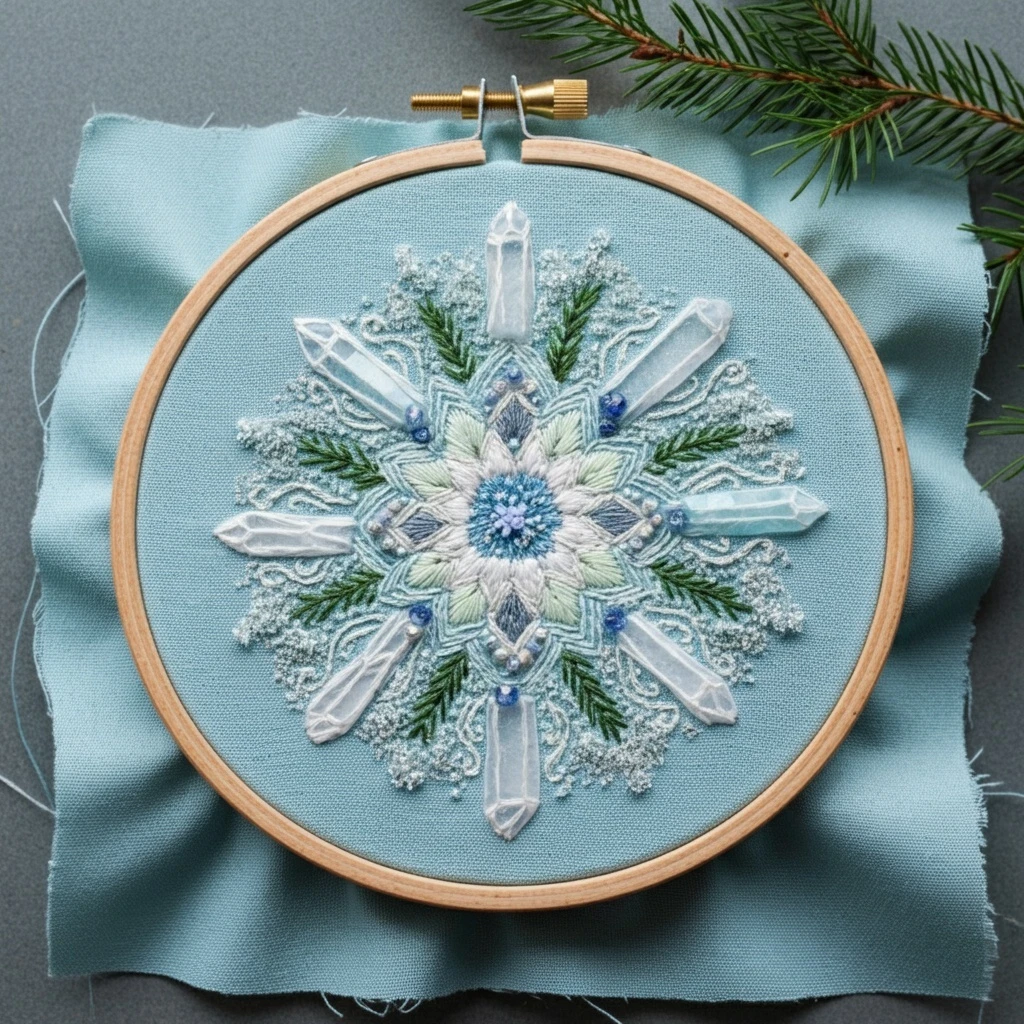
DMC palette & hand embroidery notes
Winter Crystal Snowflake
A polished stitching plan for a crisp crystalline snowflake: bright white arms, pale blue frost shadows, silver-gray depth, and tiny sparkling accents that keep the design delicate rather than heavy.
Design read: what to capture in thread
This motif depends on clean geometry more than dense fill. Keep the central star sharp, make the long arms even, and use very restrained blue-gray shading so the white snowflake still feels luminous on fabric.
Crystal structure
Work from the center outward. Mark all main axes lightly before stitching so each branch mirrors the opposite branch.
Frosted dimension
Add pale blue only along one side of arms and at inner joins. This creates cold shadow without turning the snowflake blue.
Fine sparkle
Use metallic or pearlescent accents sparingly at the center and tips. Too much shine can blur the lace-like detail.
Suggested DMC color palette
These shades match a winter snowflake palette: clean white, soft icy blues, cool grays, and a tiny optional metallic glint. Use the darkest colors only for punctuation and the deepest creases.
Stitch map and thread-count guidance
Blending and shading approach
For a crystal effect, avoid broad blocks of color. Instead, place narrow shadows beside white ridges and blend in the direction of each snowflake arm.
| Area | Blend | Effect |
|---|---|---|
| Bright ridges | 1 strand B5200 + 1 strand Blanc | Clean snow-white body with a softer handmade finish. |
| Icy shadows | 1 strand Blanc + 1 strand 747 | Cool tint that still reads as white from a distance. |
| Deep joins | 1 strand 762 + 1 strand 775 | Subtle blue-gray depth at branch intersections. |
| Sparkle accents | 1 strand E168 couched beside B5200 | Controlled glimmer without rough metallic coverage. |
Outlining details
Outlining should be delicate. White-on-white designs need definition, but heavy outlines can make a snowflake look cartoonish.
Texture suggestions
- Raised icy ridges: pad the main center-to-tip arms with one line of split stitch, then cover with satin stitch in B5200 or Blanc.
- Glassy points: work straight stitches that meet precisely at each tip; trim thread tails carefully so the back does not show through light fabric.
- Soft snow haze: use one-strand seed stitch in 747 and Blanc around the motif, leaving plenty of open space for a clean winter feel.
- Metallic control: stitch metallic slowly with shorter lengths, or couch it with matching white cotton instead of pulling it repeatedly through fabric.
Beginner-friendly practical tips
- Transfer lightly: use a pale blue or water-soluble pen and test removal first. Dark transfer marks can show under white floss.
- Start at the center: complete one full arm, then rotate the hoop and repeat the same stitches on the opposite arm to maintain symmetry.
- Use fewer strands: for most snowflake details, 1–2 strands look cleaner than 3. Add thickness by padding only the main arms.
- Protect the whites: wash hands often, keep floss in a clean bag, and avoid dragging white thread across pencil or ink lines.
- Check from a distance: step back after each round of shading. If the design begins to look too blue, return to Blanc and B5200 highlights.