
DMC palette & hand embroidery notes
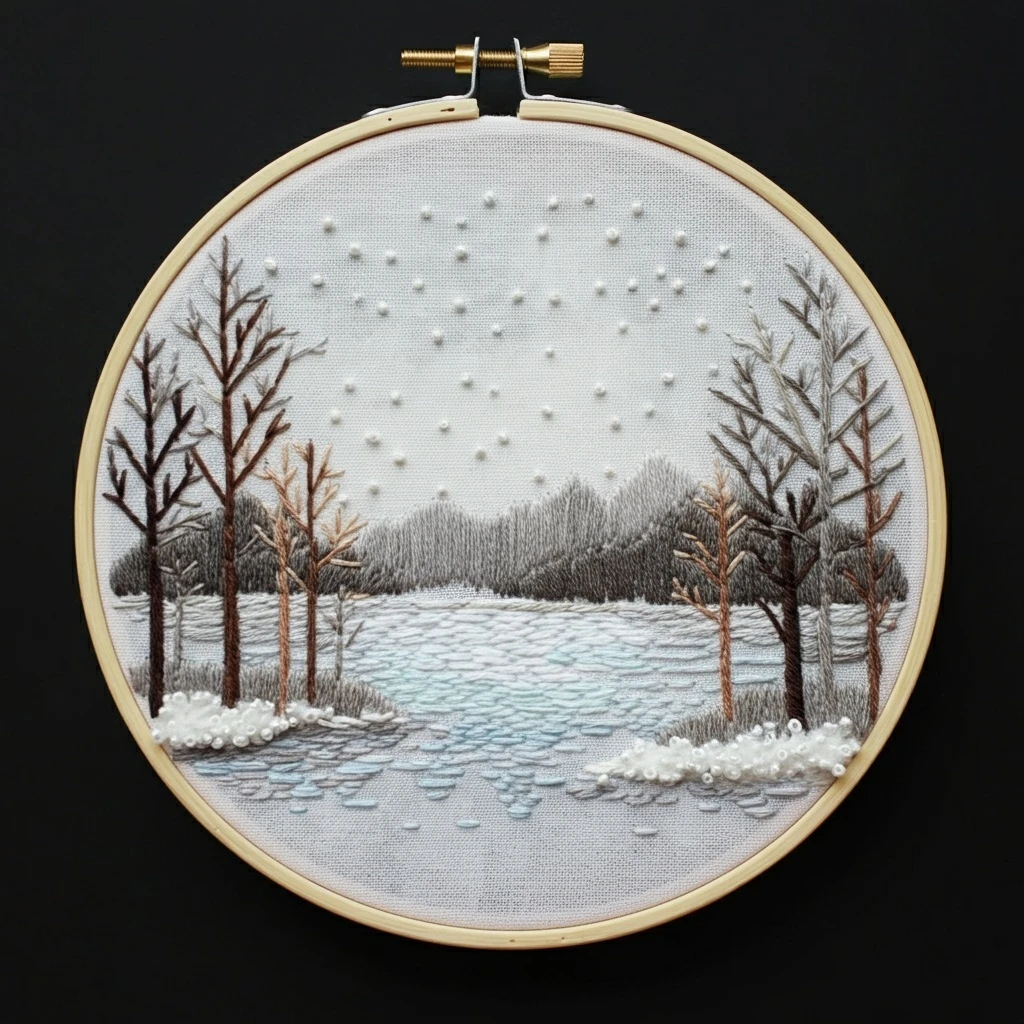
Winter Landscape
A quiet snowy lake scene with bare winter trees, soft banks of snow, and cool reflected light. The design works best when the lake and sky stay airy, while the tree trunks and branchwork provide crisp contrast.
Design read
A calm frozen or snowy lakeside framed with leafless trunks and fine branch silhouettes.
Winter whites, blue-gray lake reflections, muted taupe bark, and small warm beige notes in reeds or exposed earth.
Keep the horizon and waterline clean, stitch the largest snow shadows softly, and save the sharp dark branches for last.
Suggested DMC floss palette
This palette gives you a full value range for snow, lake reflections, bark, distant tree lines, and subtle winter warmth. Use the darkest shades sparingly so the finished hoop still feels quiet and luminous.
Stitch plan by area
| Area | Recommended stitches | Thread count & handling |
|---|---|---|
| Snow banks | Long and short stitch, split stitch contour lines, tiny straight stitches for sparkle. | Use 1 strand for shadow lines, 2 strands for foreground highlights. Leave open fabric in the brightest areas. |
| Lake or icy water | Horizontal straight stitch, seed stitch, and broken satin lines. | Work mostly with 1 strand so the surface stays flat and reflective. Vary line length to avoid stripes. |
| Bare trunks | Stem stitch for trunk edges, split stitch for bark ridges, couching for long clean silhouettes. | Use 2 strands for primary trunks, 1 strand for secondary trunks. Add dark details only after the water and snow are finished. |
| Fine branches | Single-strand back stitch, whipped back stitch, and short fly stitches. | Keep branch tips delicate. Taper by ending with a single tiny straight stitch rather than a knotty buildup. |
| Distant tree line | Seed stitch, tiny vertical straight stitches, and soft running stitch. | Blend 762 with 648 or 932 with 648 for atmospheric distance. |
| Reeds and warm grasses | Straight stitch, fly stitch, detached chain, and small couching stitches. | Use 1 strand of 613 or 3782. Keep grasses sparse so they do not overpower the winter palette. |
Blending, shading & texture notes
Snow and ice blending
- Blend one strand B5200 with one strand 3865 for soft luminous snow.
- Blend one strand 762 with one strand 932 for blue-gray shadow that still feels snowy.
- Place shadows under banks, around tree roots, and beside the lake edge instead of filling every white shape.
- Use very small seed stitches in B5200 only at the end for fresh snow sparkle.
Bark and branch detail
- Build trunks with 646 first, then add 648 on the light side and 3371 in narrow creases.
- For foreground bark, alternate stem stitch direction slightly to imitate natural wood grain.
- Use one-strand back stitch for branches; branch lines should be irregular, not perfectly geometric.
- Stop branch stitches just before the lake and snow highlights so the scene stays crisp.
Outlining and composition guidance
Outline the most important shapes only: the near tree trunks, the lake edge, and a few foreground snow contours. Avoid outlining every snowy mound because heavy borders can make winter landscapes look cartoonish.
Use 2 strands for trunks and the clearest snowbank edges. Add a few textured bark knots for depth.
Use broken lines for the waterline and pale blue-gray threads for ripples. Keep stitches horizontal to suggest stillness.
Use 1 strand and lighter colors. Distant trees should be stitched thinner and softer than foreground trees.
Beginner-friendly practical tips
- Start with the palest snow and sky shadows, then stitch the lake, then trunks, then fine branches last.
- Use a water-soluble pen lightly; winter scenes show guide marks easily in open white areas.
- Shorten thread lengths to 12–15 inches when using pale floss so it stays clean and untwisted.
- Keep your hoop tension firm but not drum-tight; too much tension can distort long horizontal water stitches.
- Step back often. The lake and snow should read through value contrast, not dense filling.
- For a cleaner back, carry dark bark threads only over very short distances and restart when crossing pale snow.
Finishing suggestion
Press face down on a thick towel after the embroidery is fully dry. Mount with the snow areas smoothed outward from the center, then trim any fuzzy pale floss ends with sharp embroidery scissors. A simple natural wood hoop or muted gray frame complements the quiet winter palette without competing with the bare-tree silhouettes.