
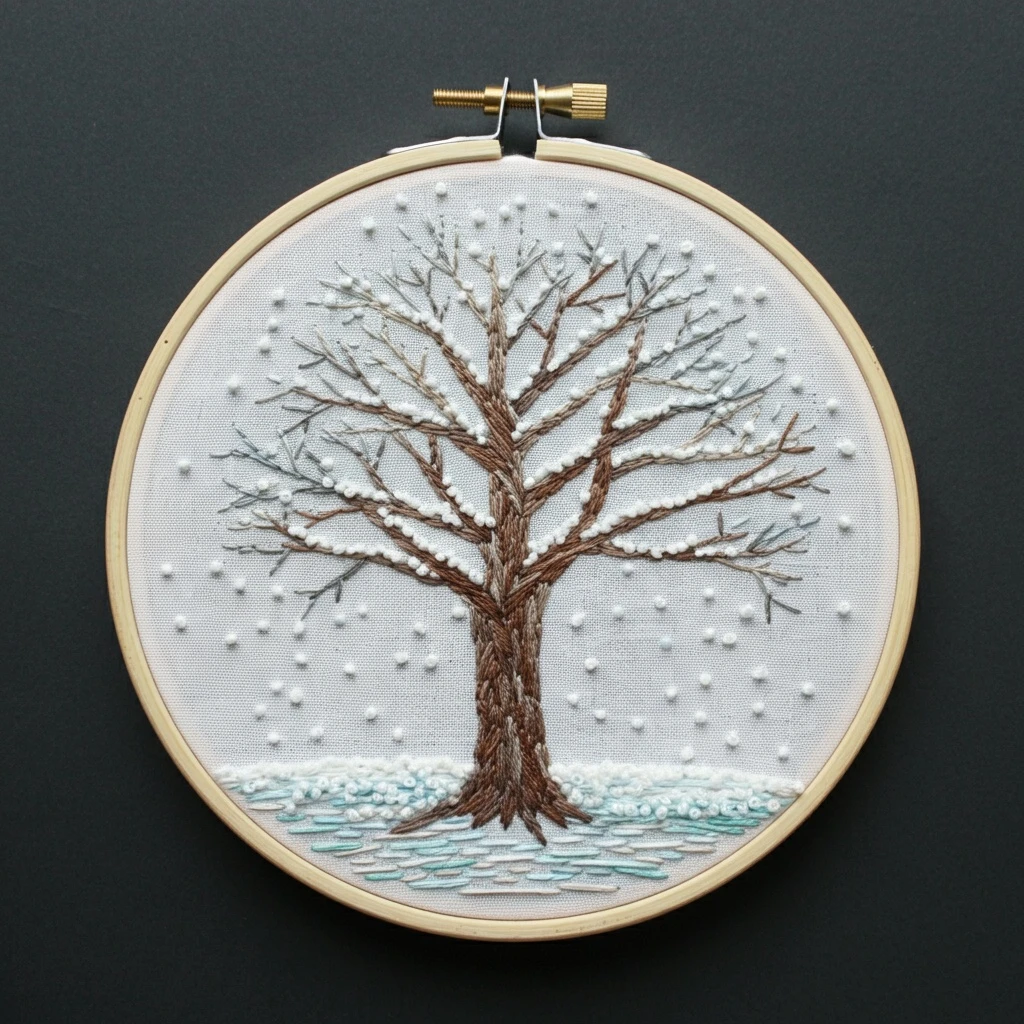
DMC palette & hand embroidery notes
Winter Serenity
A peaceful winter design with soft snow light, cool blue-gray shadows, muted evergreen structure, and gentle warm accents. Keep the stitching airy and quiet: the charm comes from delicate value shifts rather than heavy fill.
snowy calmsoft winter bluesevergreen texturegentle highlights
Design read
Main impression:
A serene winter scene with a quiet, frosted atmosphere. The design should feel light, composed, and still rather than heavily textured.
A serene winter scene with a quiet, frosted atmosphere. The design should feel light, composed, and still rather than heavily textured.
Color mood:
Clean white, creamy off-white, pearl gray, icy blue, muted pine, bark brown, and small warm touches for berries, windows, stars, or golden winter light.
Clean white, creamy off-white, pearl gray, icy blue, muted pine, bark brown, and small warm touches for berries, windows, stars, or golden winter light.
Stitch priority:
Preserve open fabric for the brightest snow. Build shadows in thin layers, add greenery and branch details next, and finish with knots, highlights, and crisp outlines.
Preserve open fabric for the brightest snow. Build shadows in thin layers, add greenery and branch details next, and finish with knots, highlights, and crisp outlines.
For a calm winter artwork, less thread can look more refined. Let some background fabric breathe between stitched areas so the snow feels luminous and soft.
Suggested DMC floss palette
This palette balances snowy neutrals, cool blue shadows, natural greens, twig browns, and restrained warm accents. Use the darkest colors sparingly so the final embroidery stays gentle and serene.
DMC B5200
Snow White
Brightest snow caps, sparkle points, and the cleanest edges of frosted details.
DMC 3865
Winter White
Soft snow fill, pale petals or glow areas where pure white would look too sharp.
DMC 822
Beige Gray Light
Warm cream undertone for gentle highlights, snow touched by low winter light, or pale background details.
DMC 762
Pearl Gray
Faint snow shadows, frosty haze, and a bridge between white and blue-gray areas.
DMC 415
Pearl Gray
Cooler shaded edges under branches, on snowbanks, and around overlapping forms.
DMC 932
Antique Blue Light
Icy blue cast for snow shadows, distant sky, and soft winter atmosphere.
DMC 931
Antique Blue Medium
Main cool shadow color for deeper snow folds, distant trees, and shaded contours.
DMC 930
Antique Blue Dark
Selective depth in the coldest shadows; use in thin lines rather than large blocks.
DMC 3052
Green Gray Medium
Muted foliage, soft pine needles, and winter greenery that sits quietly behind the focal details.
DMC 520
Fern Green Dark
Main evergreen stems, pine sprigs, and darker leaf clusters.
DMC 890
Pistachio Green Ultra Dark
Deepest evergreen accents under needles and at the base of foliage; use sparingly.
DMC 840
Beige Brown Medium
Soft twig color, warm bark midtones, and natural outlines that should not read black.
DMC 646
Beaver Gray Dark
Cool bark shadows, fine branch lines, and subdued outlining around rustic details.
DMC 816
Garnet
Tiny berries or winter floral accents; keep dots small and bright against the cool palette.
DMC 3046
Yellow Beige Medium
Warm glints, seed centers, lantern/window warmth, or subtle golden light accents.
DMC 3371
Black Brown
Final pin-point contrast for eyes, deepest twig tips, or the smallest structural marks only.
Stitch plan by area
| Area | Recommended stitches | Thread count & handling |
|---|---|---|
| Snow and pale background | Long and short stitch, split stitch contouring, tiny straight stitches, and open fabric for highlights. | Use 1 strand for soft shading and 2 strands only on foreground snow edges. Leave white fabric visible for glow. |
| Icy shadow areas | Feathered long and short stitch, broken running stitch, and light seed stitch. | Blend 762 with 932 for delicate blue-gray. Move to 931 only where the design needs stronger depth. |
| Evergreen sprigs | Fishbone stitch, fly stitch, detached chain, and short angled straight stitches. | Use 2 strands for main sprigs, 1 strand for fine needle tips. Alternate 3052, 520, and tiny touches of 890. |
| Branches, stems, or rustic lines | Stem stitch, split stitch, back stitch, and couched straight stitches for long clean limbs. | Use 1 strand for delicate twigs and 2 strands for primary stems. Add 3371 only as final contrast. |
| Berries, seed dots, or small ornaments | French knots, colonial knots, satin dots, and small padded satin stitch. | Use 2 strands for round berries. Add one tiny B5200 highlight stitch on a few berries for shine. |
| Fine frost and sparkle | Single straight stitches, tiny cross stitches, scattered knots, and small star stitches. | Use 1 strand B5200 or 3865. Keep spacing uneven for a natural frosted effect. |
Blending, shading & texture notes
Snowy softness
- Start with 3865 and 762 before adding bright B5200, so the snow has gentle volume.
- Use short directional stitches that follow the curve of banks, petals, or frosted shapes.
- Avoid filling every white area; exposed fabric reads as clean snow and keeps the page-like calm.
- Place the strongest white highlights last to avoid dulling them while handling the hoop.
Cool winter shadows
- Blend one strand 762 with one strand 932 for the palest blue shadow.
- Use 931 for shadow under foliage, beside trunks, or where forms overlap.
- Keep 930 in narrow lines and small pockets so the design does not become stormy.
- Feather the ends of shadow stitches instead of making hard blocks of color.
Evergreen detail
- Lay the central stem first, then add small angled needle stitches outward from it.
- Use 3052 for distant or frosted needles, 520 for main needles, and 890 for undersides.
- Add tiny B5200 stitches on selected needle tips to suggest snow resting on greenery.
- Let some needles overlap snow shadows to create a natural layered look.
Warm accents
- Use 816 berries in small grouped knots; too many red dots can overpower the serene palette.
- Add 3046 only where a small golden note is visible or useful for visual warmth.
- For a softer red, mix one strand 816 with one strand 815 or 221 if you have them on hand.
- Keep warm accents balanced across the composition so the eye moves gently through the piece.
Best beginner shortcut: choose one white, one gray, one blue, two greens, one brown, and one accent color first. Add the remaining colors only after the main design is stitched.
Outlining and finishing guidance
Outlining
- Use split stitch for soft contours around snowy shapes; it is smoother than back stitch.
- Use back stitch only for crisp twig ends, tiny architecture lines, or small accent shapes.
- For dark outlines, prefer 646 or 840 first. Reserve 3371 for the final few deepest points.
- Break outlines occasionally so snow and light areas stay airy rather than cartoon-like.
Practical finish
- Work from pale to dark, then from background to foreground to avoid muddying light floss.
- Use shorter thread lengths with white floss; it frays and collects lint more noticeably.
- Keep hoop tension firm but not stretched, especially if using satin stitch for berries or glow areas.
- Press finished embroidery face down on a towel so knots and raised stitches keep their texture.
Beginner-friendly order of work
- Transfer only the main lines first: large snow shapes, key stems, greenery clusters, and major focal elements.
- Stitch the pale snow or background with 3865, 762, and small touches of 932.
- Add evergreen stems and needles with 3052 and 520, then deepen just a few undersides with 890.
- Work branches and outlines in 840 or 646, using 3371 only at the very end.
- Add berries, warm dots, sparkle stitches, and final B5200 highlights after all large areas are complete.