
DMC palette & hand embroidery notes
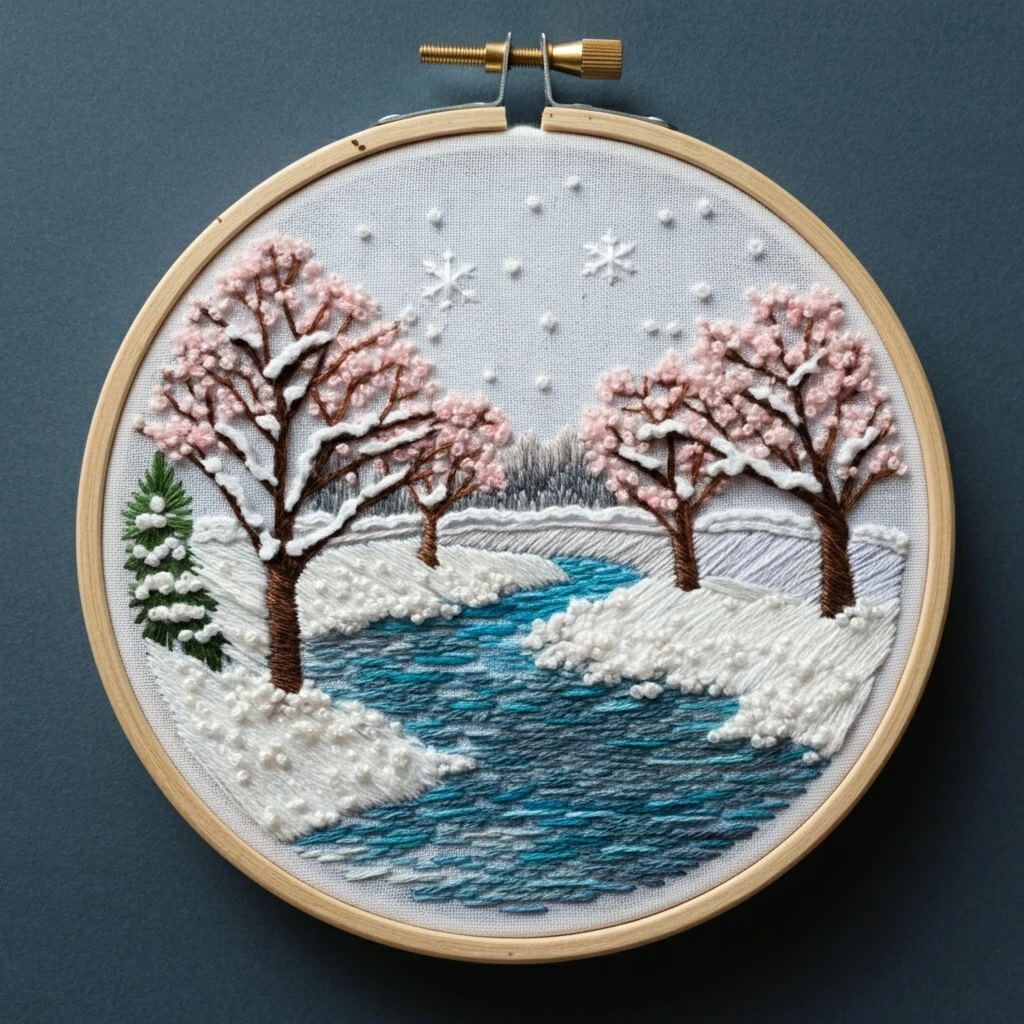
Winter Wonderland Stream
A quiet woodland stream cutting through soft winter snow, framed by cool shadows, evergreen depth, bare branches, and glints of moving icy water. Let the fabric carry the brightest snow while thread defines the water path, banks, trees, and sparkling frozen edges.
Design read
A winter forest scene where a winding stream creates movement through the otherwise quiet snowfield.
Clean whites, blue-gray water shadows, deep pine greens, bark browns, and a few pale beige notes for winter grasses or exposed earth.
Keep the stream flowing with horizontal and slightly curved marks, then use trees and banks to frame the composition.
Suggested DMC floss palette
This palette balances luminous snow, icy water, evergreen foliage, bark, and winter-bank shadows. Use the darker shades sparingly so the stream remains clear and the snow still feels bright.
Stitch plan by area
| Area | Recommended stitches | Thread count & handling |
|---|---|---|
| Open snow fields | Long and short stitch, tiny straight stitches, and sparse seed stitch. | Use 1 strand for shadows and 2 strands only for raised foreground snow. Leave plenty of fabric unstitched. |
| Winding stream | Horizontal straight stitch, split stitch ripples, couching for smooth curves, and broken satin bands. | Use mostly 1 strand. Follow the curve of the stream so the eye travels naturally through the scene. |
| Icy stream edges | Whipped back stitch, short straight stitches, and tiny detached chain stitches. | Blend B5200 with 3756 or 3865 with 932 for frosted edges. Keep marks uneven and sparkling. |
| Evergreen trees | Fly stitch, fishbone stitch, detached chain, and layered straight stitches. | Use 2 strands for foreground boughs and 1 strand for distant pines. Add darker green only under the boughs. |
| Bare trunks and twigs | Stem stitch, split stitch, back stitch, and tiny straight branch marks. | Use 2 strands for main trunks, 1 strand for twigs. Add 3371 only in small final touches. |
| Grasses and bank texture | Straight stitch, fly stitch, seed stitch, and short couching stitches. | Use 1 strand of 613 or 648. Keep grasses low and sparse so they feel partially buried in snow. |
Blending, shading & texture notes
Snow and stream blends
- Blend one strand B5200 with one strand 3865 for soft raised snow on the stream banks.
- Blend one strand 932 with one strand 415 for blue-gray snow shadows beside the water.
- Use 931 as the main stream value and place 930 only at bends, under banks, and behind rocks or roots.
- Add 3756 in tiny stitches across the top of the water for a cold glimmer without heavy shine.
Pines, bark, and woodland depth
- Work evergreen boughs from light to dark: 3052 first, then 3051 underneath for shadow.
- For trunks, start with 648, reinforce one side with 646, then add a few 3371 notches.
- Use short, irregular branch stitches rather than perfect straight lines for a natural forest edge.
- Fade distant trees by stitching with one strand and more open spacing.
Outlining and composition guidance
Outline only the features that need definition: the stream banks, foreground trunks, and a few evergreen silhouettes. Avoid heavy outlines around every snow mound; winter scenes look softer when the snow is shaped by shadow rather than a hard border.
Use 2 strands for the nearest trunk bases, pine boughs, and firm snow-bank edges. Add texture after the main shapes are set.
Keep stitches directional. Curved rows should lead inward, with darker tones at the sides and lighter blue-white marks in the center.
Use paler gray, blue, and green with 1 strand. More spacing in the background creates distance and keeps the hoop airy.
Beginner-friendly practical tips
- Stitch in this order: pale snow shadows, stream base, evergreen shapes, trunks and branches, then final sparkle.
- Use a fine needle for single-strand water details so the ripples stay clean and delicate.
- Keep pale thread lengths short, around 12–15 inches, to prevent dulling from hand oils and friction.
- When changing from dark green or bark to snow, restart the thread instead of carrying it behind white areas.
- Step back often to check the flow of the stream; it should read as one continuous path, not separate blocks.
- For extra texture, add a few tiny French knots in B5200 or 3865 as snow caught on pine tips.
Finishing suggestion
Press the finished embroidery face down on a thick towel once the fabric is completely dry. Mount with the stream centered and the snow areas smoothed outward from the middle. A natural wood hoop, pale gray frame, or cool blue mat complements the winter palette while letting the water path remain the focal point.