
DMC Palette & Stitching Notes
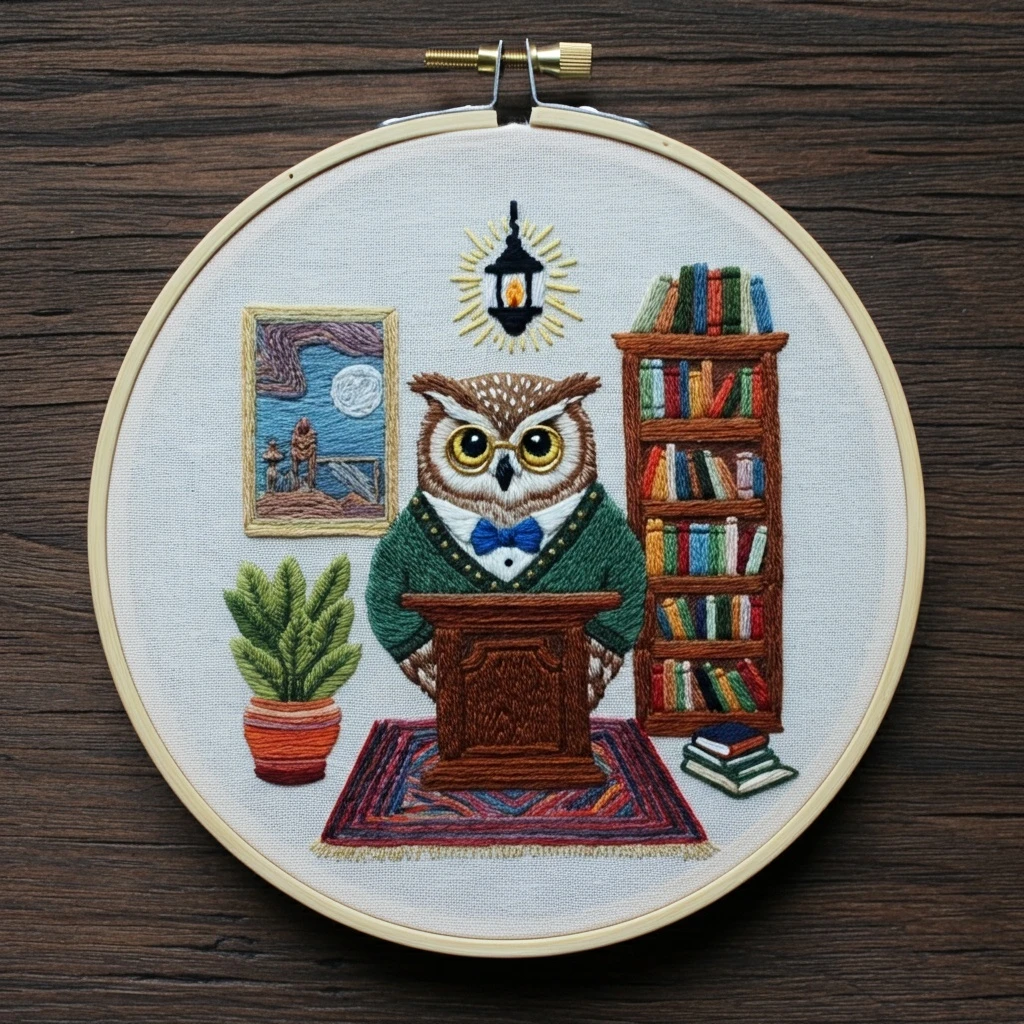
Wise Owl Lecturer
A cozy storybook embroidery guide for a scholarly owl: warm tawny feathers, creamy face highlights, dark expressive outlines, tiny bookish details, and soft woodland accents. The palette below is chosen to keep the owl readable, textured, and beginner-friendly while preserving the charming hand-drawn character of the design.
Design Color Read
The design relies on a warm academic woodland mood: golden-brown plumage, darker wing and eye accents, cream highlights around the face and chest, small red-brown beak and book notes, plus muted greens or olive tones where foliage or classroom-style decorative sprigs appear. Keep the darkest browns reserved for the eyes, pupils, feather separations, and the final outline so the owl keeps its wise, expressive personality.
Suggested DMC Floss Palette
Use these as close practical matches for a warm brown owl with scholarly details. The notes explain where each shade works best and how to blend it into neighboring tones.
Thread Count Guidance
Face & chest
Use 1–2 strands for smooth satin or long-and-short stitches. Keep direction curved around the face disks so the owl looks rounded.
Wings & body
Use 2 strands for feather fill, with occasional 1-strand strokes over the top for fine texture and layered markings.
Eyes, beak, book lines
Use 1 strand for tiny outlines and details. Switch to one strand before stitching pupils, glasses, page marks, or any lecture props.
Bold outer lines
Use 2 strands for back stitch or split stitch outlines; add 3371 only at the very end where contrast is needed.
Blending & Shading
- Soft cream blend: combine one strand 746 with one strand 738 for feather patches that need warmth without becoming brown.
- Golden feather blend: combine 3828 + 977 for the owl’s main body, then add 975 in lower or tucked areas.
- Deep shadow blend: use 898 + 975 for wing separations; reserve 3371 for pupils and tiny under-feather accents.
- Book detail blend: 738 for page fill, 3852 for aged edges, 918 or 975 for cover details.
Recommended Stitch Map
| Design Area | Best Stitches | Suggested Colors | Practical Notes |
|---|---|---|---|
| Face disks | Long-and-short stitch, satin stitch, split stitch contour | 746, 738, B5200 | Work in curved wedges from the eye outward. Keep stitches short near the eye and longer toward the cheek edge. |
| Eyes and brow | Satin stitch, French knots, tiny back stitch | 3852, 898, 3371, B5200 | Place the highlight last. One tiny white stitch can make the owl look alert and wise. |
| Wing feathers | Fishbone stitch, fly stitch, long-and-short stitch | 3828, 977, 975, 918 | Alternate warm tones feather by feather so the wing does not become flat. |
| Chest texture | Seed stitch, scattered straight stitch, short split stitch | 746, 738, 3828 | Use open spacing so the fabric breathes through and keeps the belly soft. |
| Book or lecture prop | Back stitch, satin stitch, straight stitch | 738, 3852, 918, 898 | Keep edges crisp with 1-strand outlines. Do not overfill tiny text; suggest lines rather than writing full letters. |
| Leaves and sprigs | Detached chain, fishbone leaf, stem stitch | 3012, 3363 | Use olive greens sparingly so they frame the owl without stealing focus. |
| Outer silhouette | Split stitch or back stitch | 898, small touches of 3371 | Outline after fills are complete; vary tension gently around curves to avoid puckering. |
Step-by-Step Stitching Order
Texture Suggestions
- Use slightly uneven seed stitch on the chest for downy softness.
- Angle wing stitches downward to mimic layered feathers.
- Mix 1-strand overlay strokes into 2-strand fills for a sketched illustration effect.
- Use detached chain leaves to add dimension around the owl without heavy filling.
- For a cozy classroom feel, keep book/page stitching neat and geometric.
Beginner-Friendly Practical Tips
Control the eyes
Stitch both eyes in the same sitting so their shape, highlight angle, and outline thickness match.
Avoid bulky browns
Brown floss can visually darken fast. Use fewer strands and layer short strokes instead of packing every area solid.
Use a sharp needle
Small lecture details and eye highlights need clean fabric piercing. A crewel needle size 7–9 works well for 1–2 strands.
Press from the back
After stitching, place the embroidery face down on a towel and press lightly from the wrong side to protect raised texture.