
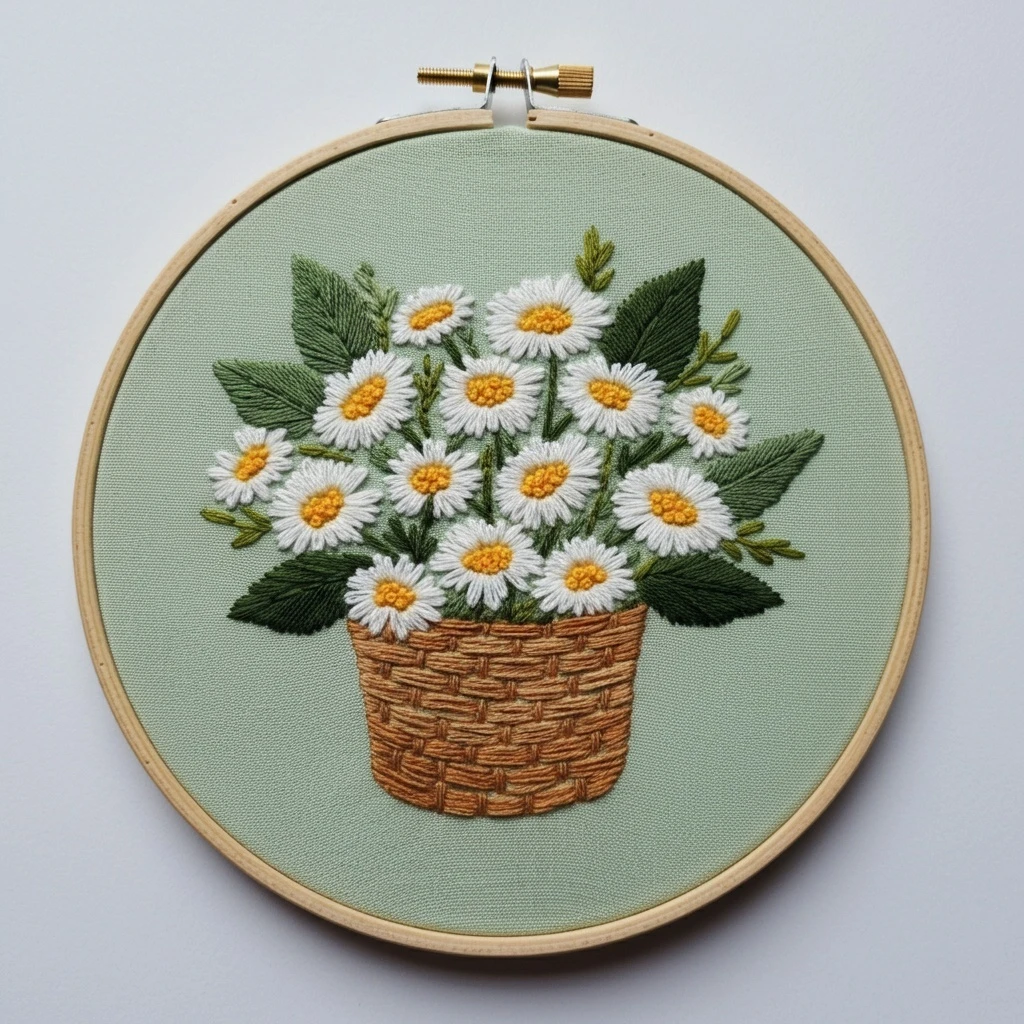
Woven Basket of Daisies
A warm cottage-garden design built around creamy daisy petals, golden centers, leafy green stems, and a honey-brown basket with visible woven texture. The stitching goal is soft petal movement, bright but natural flower centers, and a basket that feels dimensional without becoming bulky.
Suggested DMC Color Palette
Use this as a practical working palette rather than a strict chart. The design benefits from close-value blending: pale petals, mellow yellows, fresh greens, and layered basket browns.
Stitch Plan by Design Area
| Area | Recommended stitches | Thread count & handling |
|---|---|---|
| Daisy petals | Long-and-short stitch, fishbone stitch for narrow petals, detached chain for small side petals. | Use 1 strand for smooth shading; 2 strands only on larger petals if the pattern is scaled up. |
| Flower centers | French knots, colonial knots, tiny seed stitches. | Use 2 strands for plump knots; mix 3078, 725, and a few 783 knots for natural depth. |
| Leaves and stems | Stem stitch, split stitch, fly stitch, lazy daisy leaves. | Use 1 strand for fine stems; 2 strands for foreground leaves or heavier curved stems. |
| Basket weave | Satin bands, couching, whipped backstitch, woven filling, alternating horizontal and vertical straight stitches. | Use 2 strands for visible texture; add 1-strand dark accents only in the weave intersections. |
| Outlines and finishing | Split backstitch, fine stem stitch, selective couching around the rim. | Keep outlines mostly 1 strand. Avoid black; use 898 or 977 for softer definition. |
Blending, Shading & Texture Notes
Petal softness
Start petals with 822 near the center, transition into 3865, then add a few B5200 strokes at the tips. Leave tiny fabric breaks between some stitches so the daisies do not become a solid white mass.
Dimensional centers
Cluster French knots irregularly rather than in a perfect circle. Place darker 783 knots low or toward the overlapping side, then dot 3078 on the light-facing edge.
Basket texture
Alternate 3828 and 977 in short horizontal passes, then cross with a few vertical or diagonal strands. Add 898 sparingly under the rim and between woven rows to create depth.
Useful blends
- Petal shadow: 1 strand 3865 + 1 strand 822 for a creamy gray-white.
- Fresh greenery: 1 strand 3012 + 1 strand 3363 for lively leaf highlights.
- Basket mid-tone: 1 strand 3828 + 1 strand 977 for warm woven variation.
- Deep basket crease: 1 strand 977 + 1 strand 898 for the lowest shadow line.
Outlining approach
Outline only the most important edges: the basket rim, a few foreground petals, and the main stems. Use split stitch for petal outlines in 822, stem stitch for greenery in 3011, and whipped backstitch for the basket rim in 977.
Beginner-Friendly Practical Tips
- Stitch the basket first if it sits behind the flowers; this lets petals and stems overlap it cleanly.
- Work daisies from back to front, saving the brightest B5200 highlights until the end.
- Keep flower centers slightly raised but not oversized; too many bulky knots can warp the fabric.
- For smoother petals, use shorter long-and-short stitches and turn the hoop often so stitches follow the petal direction.
- When stitching the basket, vary stitch length by a few millimeters to avoid a flat, striped look.
- Use a sharp needle for clean petal stitching and a slightly larger needle for French knots so the thread passes through smoothly.
- Press from the back over a folded towel after finishing to preserve knots and basket texture.