
DMC palette & hand embroidery guide
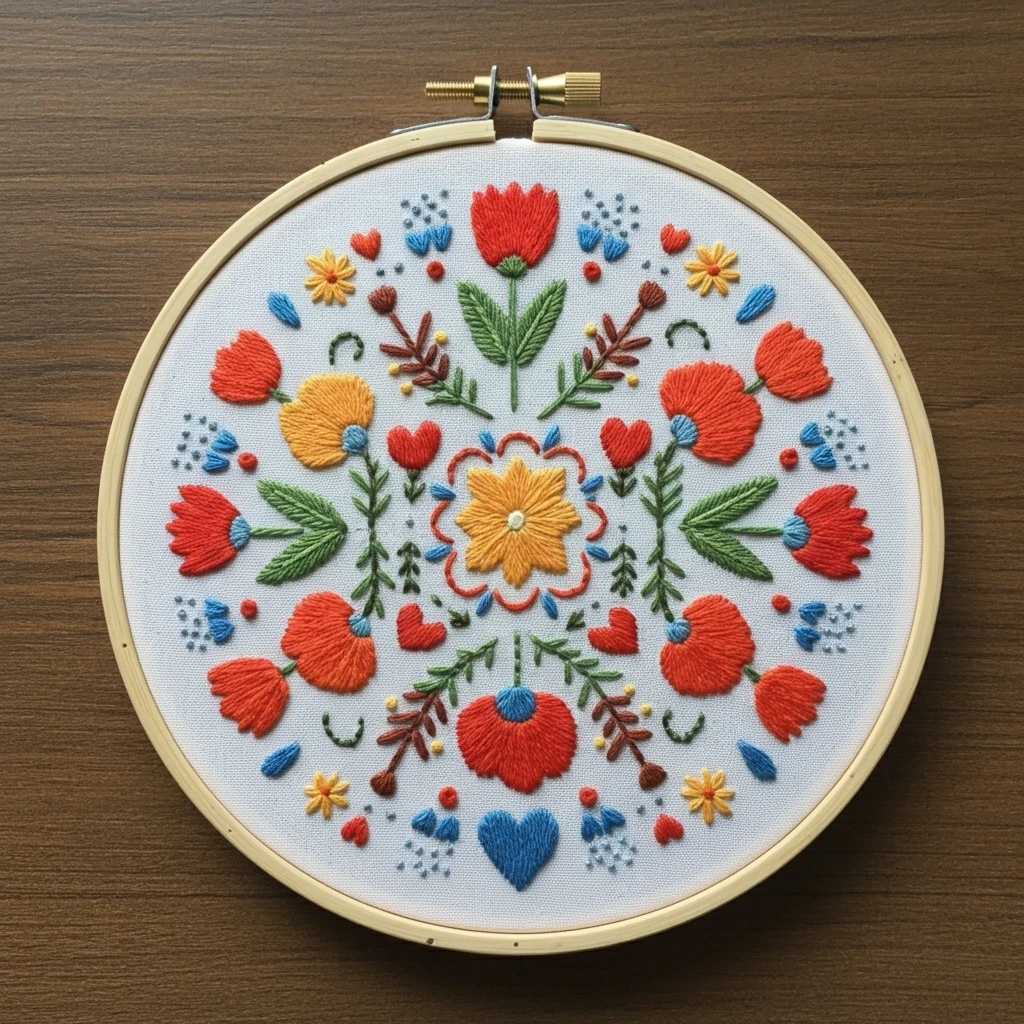
Vibrant Floral Mandala
A bright, symmetrical floral mandala calls for clean outlines, repeating petal colors, jewel-toned accents, and careful thread control. Use this guide to keep the design crisp while still giving the petals, leaves, and center medallion lively stitched texture.
Design color read
The reference design reads as a circular floral medallion: saturated petals radiate from the center, smaller accent shapes repeat around the ring, and fine outlines keep the composition tidy. The strongest visual notes are hot pink and coral blossoms, golden centers, leafy greens, turquoise/teal accents, and a few plum shadows that make the bright colors feel grounded.
For embroidery, treat the mandala as a set of repeated units. Work matching petals in the same direction, keep stitch angles mirrored across the circle, and reserve the darkest thread for definition rather than heavy filling.
Suggested DMC palette
Stitch plan by design area
| Area | Recommended stitches | Use notes |
|---|---|---|
| Center medallion | Satin stitch, French knots, tiny back stitch rings | Use 972 and 725 for a raised golden center. Keep knots evenly spaced and stitch the ring in short sections. |
| Large petals | Long and short stitch, satin stitch, fishbone stitch | Angle stitches from petal base to outer tip. Blend 718 with 3801 or 741 for lively color movement. |
| Small petals | Detached chain, lazy daisy, short satin | Perfect for repeated mandala shapes because each petal remains neat and beginner friendly. |
| Leaves and sprigs | Fishbone stitch, stem stitch, fly stitch | Use 702 for body and 704 for highlight veins. Keep leaf stitches mirrored around the circle. |
| Fine outlines | Back stitch, split stitch, whipped back stitch | Use 3371 in 1 strand. A whipped outline gives smooth curves on circular motifs. |
| Accent dots | French knots, colonial knots, seed stitch | Use 3846, 972, or B5200 for small pops that brighten the mandala without filling extra space. |
Thread-count guidance
- 1 strand: outlines, fine veins, tiny dots, delicate separators, and small interior marks.
- 2 strands: most petals, leaves, satin shapes, lazy daisies, and visible decorative lines.
- 3 strands: only for bold outer petals or chunky center knots if the printed pattern is large enough.
- 6 strands: avoid for the mandala details; it can blur symmetry and make tight curves bulky.
Blending ideas
For gradient petals, thread one strand of each color together in the same needle:
- 718 + 3801 for rich pink petals.
- 3801 + 741 for coral transitions.
- 972 + 725 for warm center glow.
- 702 + 704 for dimensional leaves.
- 3846 + B5200 for cool sparkle dots.
Outlining details
Outline after the fill stitches are complete. Use 1 strand of 3371 for crisp definition, or choose 550 when you want a softer jewel-toned outline around pink and turquoise motifs.
For the outer circle, use whipped back stitch so the curve looks smooth and continuous.
Texture suggestions
Mix flat satin petals with raised French-knot centers and seed-stitch accents. This contrast keeps the mandala bright and dimensional while still looking clean.
For leaves, alternate fishbone and fly stitch so the greenery does not look repetitive.
Beginner-friendly workflow
1. Mark the symmetry
Lightly mark vertical, horizontal, and diagonal guide lines before stitching. Check each repeated petal against the opposite side.
2. Work in color batches
Complete all matching pink petals first, then coral, yellow, green, and teal. This keeps the rhythm even and reduces thread changes.
3. Keep satin short
For wide petals, split the shape with long-and-short stitch rather than carrying a single long satin stitch across the full width.
4. Rotate the hoop
Turn the hoop as you stitch curves so your needle angle stays comfortable and each repeated motif remains smooth.
5. Press from the back
After stitching, place the embroidery face down on a towel and press gently from the back to protect raised knots.
6. Balance bright colors
If the palette feels too intense, reduce turquoise and violet accents first, while keeping the pink, coral, yellow, and green foundation.