
DMC Palette & Hand Embroidery Notes
Autumn Harvest Mandala
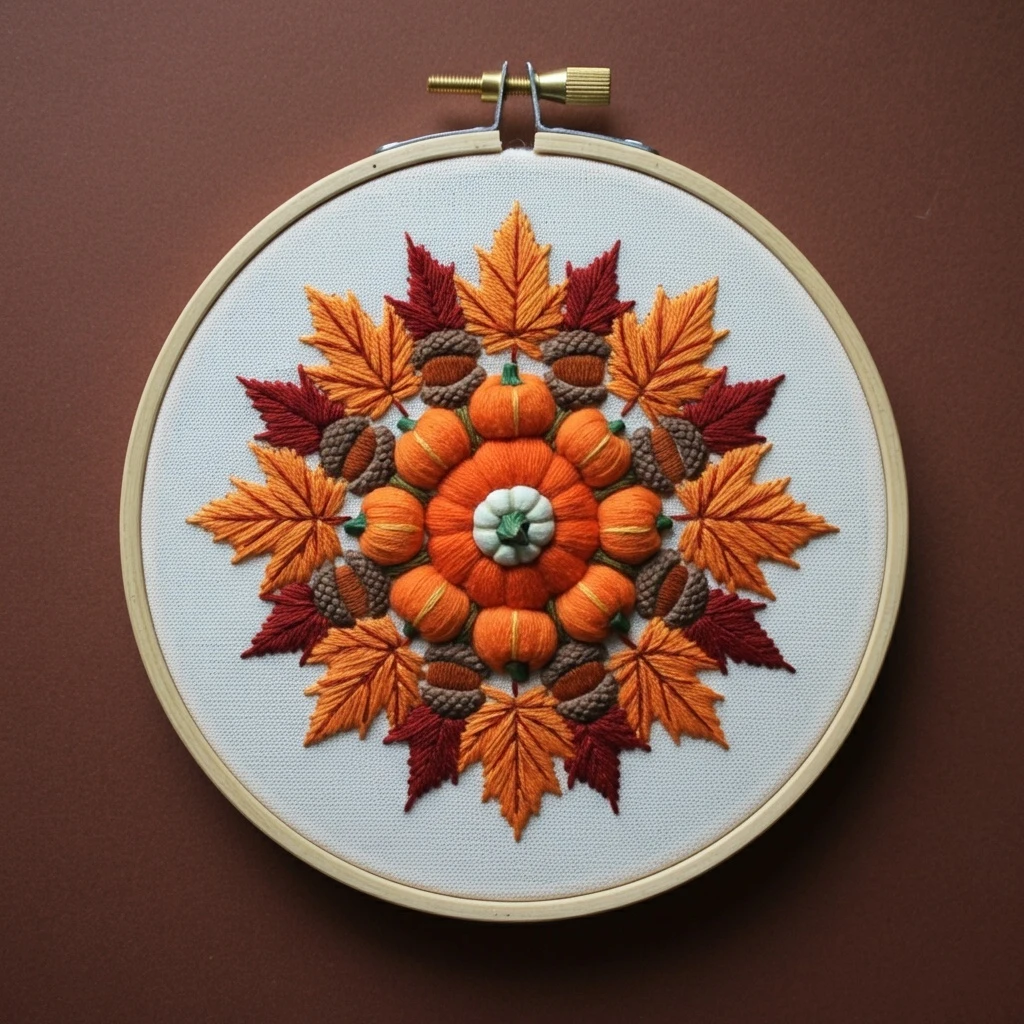
A polished floss guide for a symmetrical hoop design built around plump pumpkins, maple leaves, acorns, warm copper petals, burgundy points, earthy caps, and small sage-green accents.
Recommended DMC Color Palette
Choose warm, saturated oranges for the pumpkins and leaf bodies, then balance them with garnet-red tips, brown acorn texture, pale cream highlights, and restrained green stems. The palette below is arranged from dominant colors to accent shades.
Main shadow color for central pumpkin grooves, lower gourd curves, and darkest orange leaf veins.
Primary pumpkin and maple-leaf orange; use it for the largest filled areas.
Bright ridges on gourds and sunlit leaf sections; excellent for satin stitch highlights.
Fine highlight strokes along leaf serrations and the tops of pumpkin ribs.
Rust shading between orange and red leaves; adds autumn depth without turning too brown.
Deep burgundy outer leaves, tips, and small shadow stitches near the mandala edge.
Darkest red outlines and vein bases; reserve for crisp contrast and not large fills.
Warm leaf glow, acorn stripe highlights, and soft transitions into copper areas.
Acorn bodies, seed pockets, and warm brown outlines around raised elements.
Acorn cap shadows, tiny separations between motifs, and occasional couching shadows.
Textured acorn caps and neutral ridges that keep the browns from looking flat.
Pale center pumpkin segments, soft top highlights, and subtle lift on light fabric.
Brightest center highlights and tiny sparkle stitches on raised pumpkin domes.
Pumpkin stems, small green tabs between gourds, and cool contrast against orange.
Stem highlights and short blended stitches where green turns toward gold.
Optional cool shadow in the pale center or on fabric-adjacent highlights.
Stitch Plan by Design Area
| Area | Best stitches | Thread guidance | Practical notes |
|---|---|---|---|
| Central pumpkin flower | Padded satin stitch, long-and-short stitch, split stitch outlines | 2 strands for satin; 1 strand for inner grooves; add padding with 2-3 foundation stitches. | Work each rib separately from groove to outer curve. Keep highlight colors on the upper center of each rib and DMC 900/918 in the valleys. |
| Small ring pumpkins | Satin stitch, stem stitch, couching for rib lines | 2 strands for body fill; 1 strand for rib lines; 1 strand green stems. | Angle stitches to follow the rounded gourd shape. A single strand of DMC 3826 or 922 couched over orange gives a neat raised rib. |
| Maple leaves | Fishbone stitch, long-and-short stitch, back stitch veins | 2 strands for leaf blades; 1 strand for veins and serrated edges. | Start at the center vein and stitch outward toward each point. Alternate DMC 920, 921, and 922 for a flame-like harvest effect. |
| Burgundy outer leaves | Fishbone stitch, split stitch, tiny straight stitch texture | 2 strands for fill; 1 strand DMC 816 for vein bases and outlines. | Use DMC 815 as the main red, then deepen the base and side notches with DMC 816 for clear mandala points. |
| Acorns and caps | Raised seed stitch, French knots, satin stitch, woven wheel accents | 2 strands for acorn bodies; 2 strands for French knots; 1 strand for dark separation. | Fill caps with clustered French knots or seed stitch in DMC 3863/433, then outline sparingly with DMC 938. |
| Stems and tiny green separators | Stem stitch, detached chain, straight stitch | 1-2 strands depending on scale. | Use green as an accent only. Too much green will cool the design; keep it small and crisp. |
Blending & Shading Notes
The design looks dimensional because the warm colors are layered from dark grooves to bright raised centers.
- Pumpkin blend: combine one strand DMC 900 with one strand DMC 920 for deep valleys; use two strands DMC 921 for mid-ridges; add single-strand DMC 922 at the highest curve.
- Leaf blend: stitch the central vein first in DMC 918 or 900, then radiate outward with 920 and 921. Use 922 only near leaf tips and the upper edges.
- Red transition: blend one strand DMC 815 with one strand DMC 918 when a burgundy leaf sits beside orange, creating a smoother rust-red bridge.
- Acorn texture: mix DMC 433 and 3863 randomly in seed stitch so the caps look naturally pebbled instead of striped.
Outlining & Definition
A mandala needs clean edges so every repeated motif stays readable.
- Use 1 strand split stitch for outlines around pumpkins and leaves before filling. This creates a tidy boundary for satin stitches.
- Use back stitch in DMC 938 only where shadows are needed: acorn separations, underside curves, and tiny gaps between overlapping motifs.
- For leaf serrations, stitch tiny angled straight stitches at the points rather than tracing every edge heavily.
- Keep the center pumpkin pale stitches clean by outlining with a muted green-gray or beige instead of black or very dark brown.
Texture Suggestions
Pad the central pumpkin ribs with short foundation stitches before satin stitching. This gives the center the plush, harvest-hoop look shown in the reference.
Use directional long-and-short stitches that radiate from each leaf vein. Vary the stitch length so the leaves feel organic, not striped.
French knots, seed stitch, or tiny detached chain stitches make the caps look dimensional. Work caps after the leaf fills so they sit visually on top.
Thread Count & Handling Guide
- General fills: 2 strands of floss gives smooth coverage on medium cotton or linen while preserving detail.
- Fine veins and outlines: use 1 strand for back stitch, split stitch, and small highlight lines. This prevents the leaf veins from overpowering the fill.
- Raised details: use 2 strands for padded satin stitch; use 3 strands only for intentional chunky texture on acorn caps or very bold pumpkin ridges.
- Blended needle: use two different single strands in the same needle for natural color shifts, especially 900+920, 920+921, 815+918, and 433+3863.
- Needle choice: a size 7 or 8 embroidery needle suits most 2-strand areas; switch to a finer needle for 1-strand veins.
Practical Embroidery Tips
- Keep the fabric drum-tight in the hoop. Satin stitch pumpkins look smoother when the fabric does not flex under the needle.
- Work matching motifs in rounds: all small pumpkin bases, then all pumpkin shadows, then all pumpkin highlights. This keeps the mandala balanced.
- Rotate the hoop often so each leaf is stitched from a comfortable angle. Symmetrical designs are easier when stitch direction stays consistent.
- Use short satin stitches on leaf tips and long-and-short stitch on wider leaf sections to avoid snagging long threads.
- Step back after every ring of motifs. If one side looks too dark, add a few DMC 922 or 3826 highlight stitches to the opposite side for balance.
- Press only from the back on a padded towel after stitching, especially if you used French knots or padded satin stitch.