Beginner Friendly Winter Bird on a Tree

Beginner Friendly Winter Bird on a Tree - DMC Palette & Stitch Guide
Beginner Friendly Embroidery  Bird on a Winter Tree
DMC palette & stitching notes

Beginner Friendly Winter Bird on a Tree

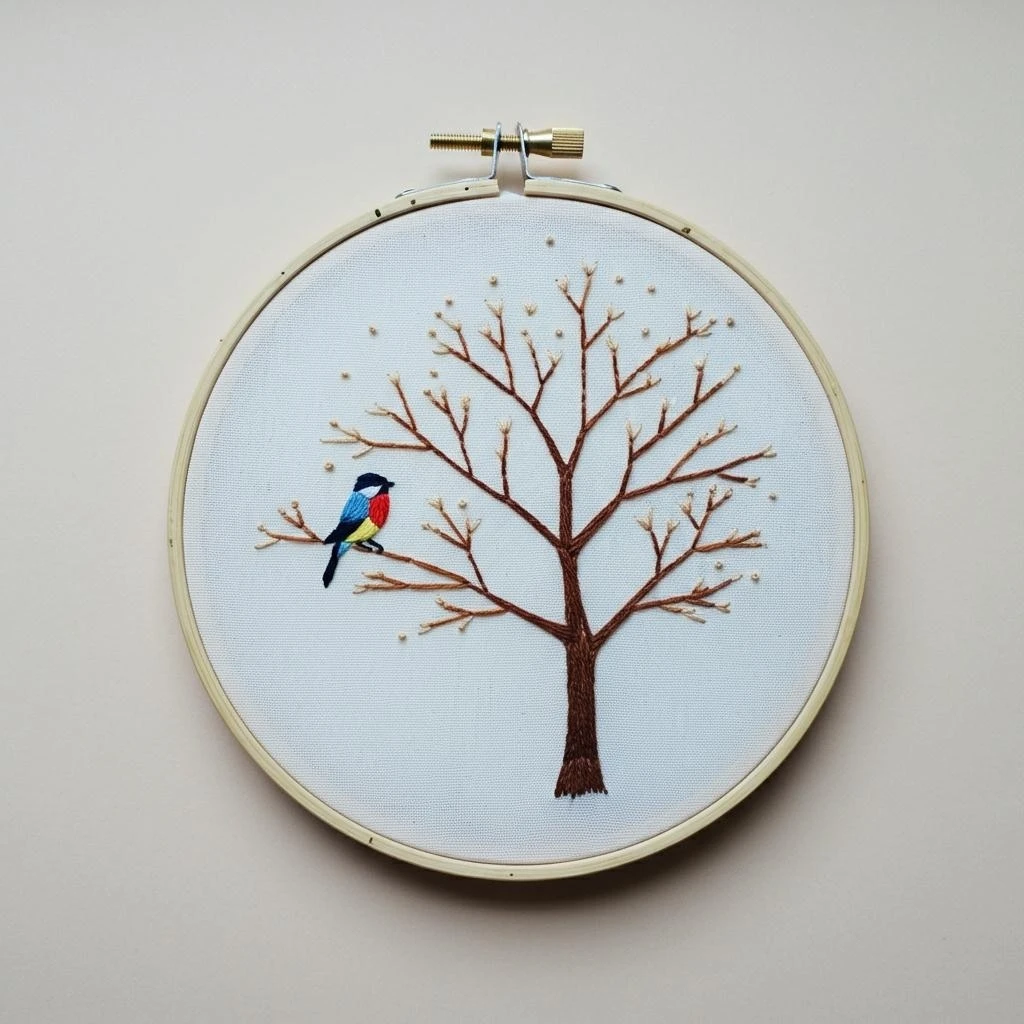
A polished color and stitch planning page for a simple hoop design featuring a bright winter bird perched on bare branches, with soft snow tones, bark texture, and gentle seasonal accents.

Beginner friendlySoft winter contrastBird + branch textureHoop art finish
Reference used for color mood: bright bird, winter bark, muted greenery and snowy neutrals.

Design color read

This design works best with a small but expressive palette: a warm red bird as the focal point, deep charcoal accents for the eye and beak details, layered browns for the bare winter tree, and cool off-whites and greys to keep the scene airy. The beginner-friendly finish comes from clean outlines, short directional fills, and restrained shading rather than heavy color changes.

Focal color:

Use saturated reds on the bird’s body so it remains crisp against the pale fabric and branch shapes.

Support colors:

Browns and taupes define branch direction, bark splits, and small twig endings without overpowering the bird.

Winter balance:

Soft white, light grey, and a hint of blue-grey suggest snow, chill, and highlights while keeping the hoop uncluttered.

Suggested DMC palette

Choose 10–12 colors for the full look, or simplify to the starred core shades for a first project. Color names are practical descriptions for planning; dye lots can vary slightly.

DMC 321 ★
Christmas Red
Main bird body; use 2 strands for satin or long-and-short fill.
DMC 816
Garnet Red
Wing shadow, belly underside, tiny feather separation.
DMC 666
Bright Red
Small highlight stitches on the head, chest, and wing curve.
DMC 310 ★
Black
Eye, beak line, feet, and the smallest outline accents.
DMC 898 ★
Very Dark Coffee Brown
Deep bark shadows, branch undersides, branch intersections.
DMC 839
Dark Beige Brown
Primary tree limbs and bark grain with stem stitch.
DMC 840
Medium Beige Brown
Upper-branch highlights and soft twig transitions.
DMC 3864
Light Mocha Beige
Optional bark highlight or warm ground/snow shadow.
DMC 3865 ★
Winter White
Snow caps, bird highlights, and clean fabric-light accents.
DMC 415
Pearl Grey
Cool snow shading and pale feather shadow under white areas.
DMC 318
Light Steel Grey
Fine winter shadows, beak softening, and branch cast-shadows.
DMC 3347
Yellow Green, Medium
Evergreen sprigs or muted foliage if present in the pattern.
Small-kit option: For a simple beginner kit, use DMC 321, 816, 310, 898, 839, 3865, 415, and 3347. Add 666 and 840 only if you want smoother red and bark shading.

Stitch plan by design area

Bird outlineUse split stitch or back stitch with 1 strand of DMC 816 along the wing and belly curves. Keep the outer edge smooth and avoid over-thick outlines around the head.
Bird body fillUse 2 strands of DMC 321 in long-and-short stitch. Angle stitches in the direction feathers would lie: downward on the breast, slightly backward on the wing. Add DMC 666 on the upper chest and DMC 816 under the wing.
Eye and beakUse 1 strand DMC 310. One tiny French knot or single seed stitch is enough for the eye. For the beak, use two short straight stitches rather than a bulky satin block.
Tree branchesWork the main limbs in stem stitch with 2 strands DMC 839. Add DMC 898 on the lower side of branches and DMC 840 on upper edges to create rounded bark.
Fine twigsUse 1 strand and short back stitches. Taper each twig by ending with a single straight stitch; this prevents heavy, cartoon-like branch tips.
Snow touchesUse DMC 3865 in small satin stitches or detached chain stitches on branch tops. Add one stitch of DMC 415 beside the white to give the snow a winter shadow.
Leaves or sprigsIf the pattern includes greenery, use detached chain, fishbone stitch, or lazy daisy in DMC 3347. Add a single DMC 898 center vein for definition.

Thread-count and blending guidance

Thread counts

  • 1 strand: eye, beak, feet, twig ends, small feather marks, and delicate outlines.
  • 2 strands: most branch lines, bird body fill, medium snow accents, and simple leaves.
  • 3 strands: only for bold branch bases or a chunky folk-art look; avoid it on the bird’s face.

Blending ideas

  • Blend 1 strand DMC 321 + 1 strand DMC 816 for a soft red shadow on the wing base.
  • Blend 1 strand DMC 839 + 1 strand DMC 840 for natural bark mid-tones.
  • Blend 1 strand DMC 3865 + 1 strand DMC 415 for snow that reads white but not flat.
For a beginner-friendly finish, do not blend every section. Use blending only in the bird body, the main branch, and one or two snow caps; the rest can stay clean and simple.

Outlining, shading, and texture suggestions

Outline after filling: Fill the bird first, then add a fine 1-strand split stitch line where the silhouette needs crispness. This hides uneven fill edges.
Keep bark directional: Stitch bark lines along the length of the branches, not across them. A few uneven long stitches look more natural than perfect parallel rows.
Use negative space: Let the fabric act as winter light. Avoid filling every background gap; the pale open areas make the bird feel brighter.
Snow should sit on top: Add snow stitches last so the white rests visually above the bark instead of disappearing into it.
Feather texture: On the wing, place three or four short DMC 816 stitches over the red fill. Keep them sparse so the beginner design remains gentle.

Beginner-friendly practical tips

Before stitching

  • Use a tightly woven cotton or linen blend in cream, oatmeal, or pale grey.
  • Hoop the fabric drum-tight; winter branch lines look best when the fabric does not ripple.
  • Mark only the main branch and bird outline first, then add tiny twigs as you stitch.

While stitching

  • Use shorter thread lengths, about forearm length, to prevent fuzzy red and dark brown floss.
  • Start with branches, stitch the bird next, then add snow, eye, and final highlights last.
  • Step back after every major color to check that the bird remains the strongest focal point.
Finishing note: Press from the back on a towel to protect raised knots and snow stitches. If framing in a hoop, keep the bird slightly above center so the branch line feels balanced and natural.

Leave a Reply

Your email address will not be published. Required fields are marked *