Lavender and Daisy Bouquet

Lavender and Daisy Bouquet — DMC Palette & Stitching Guide
Lavender and Daisy Bouquet Hand Embroidery
DMC palette & embroidery tips

Lavender and Daisy Bouquet

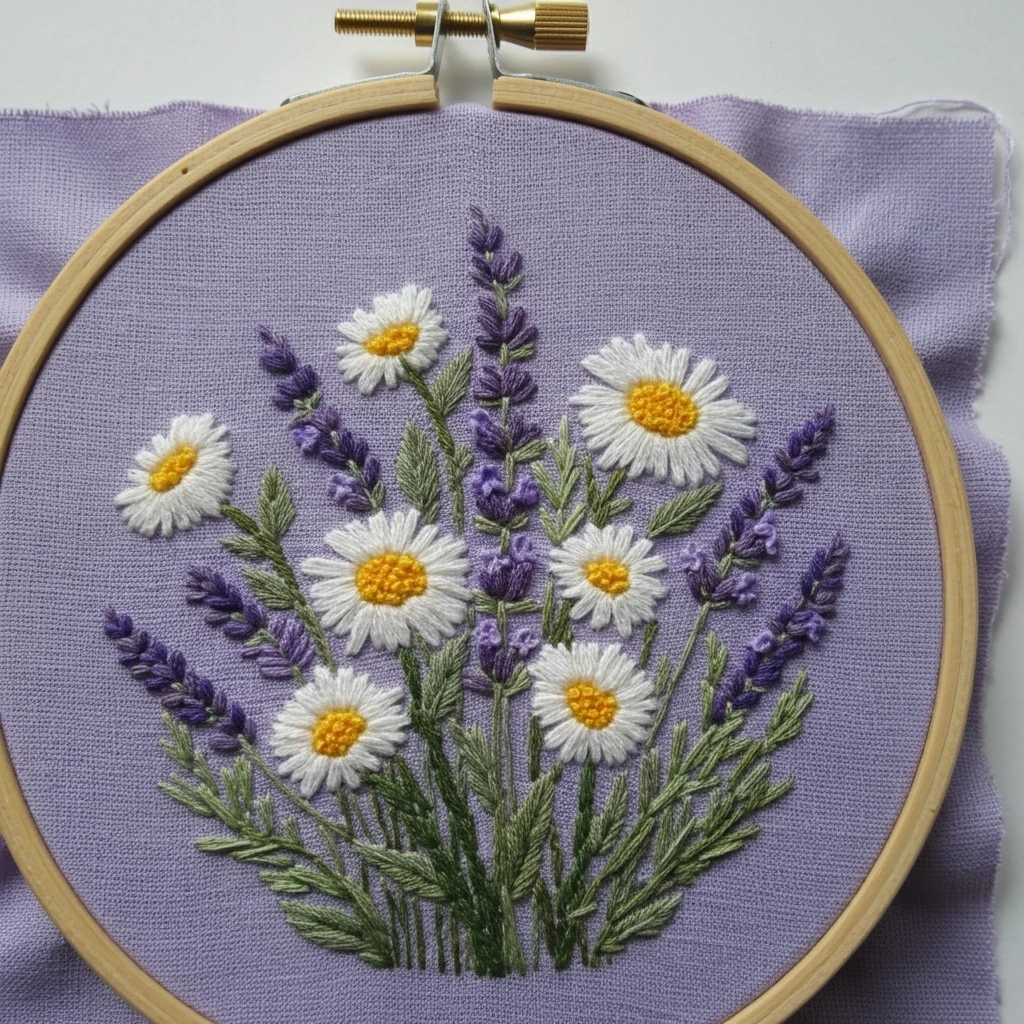
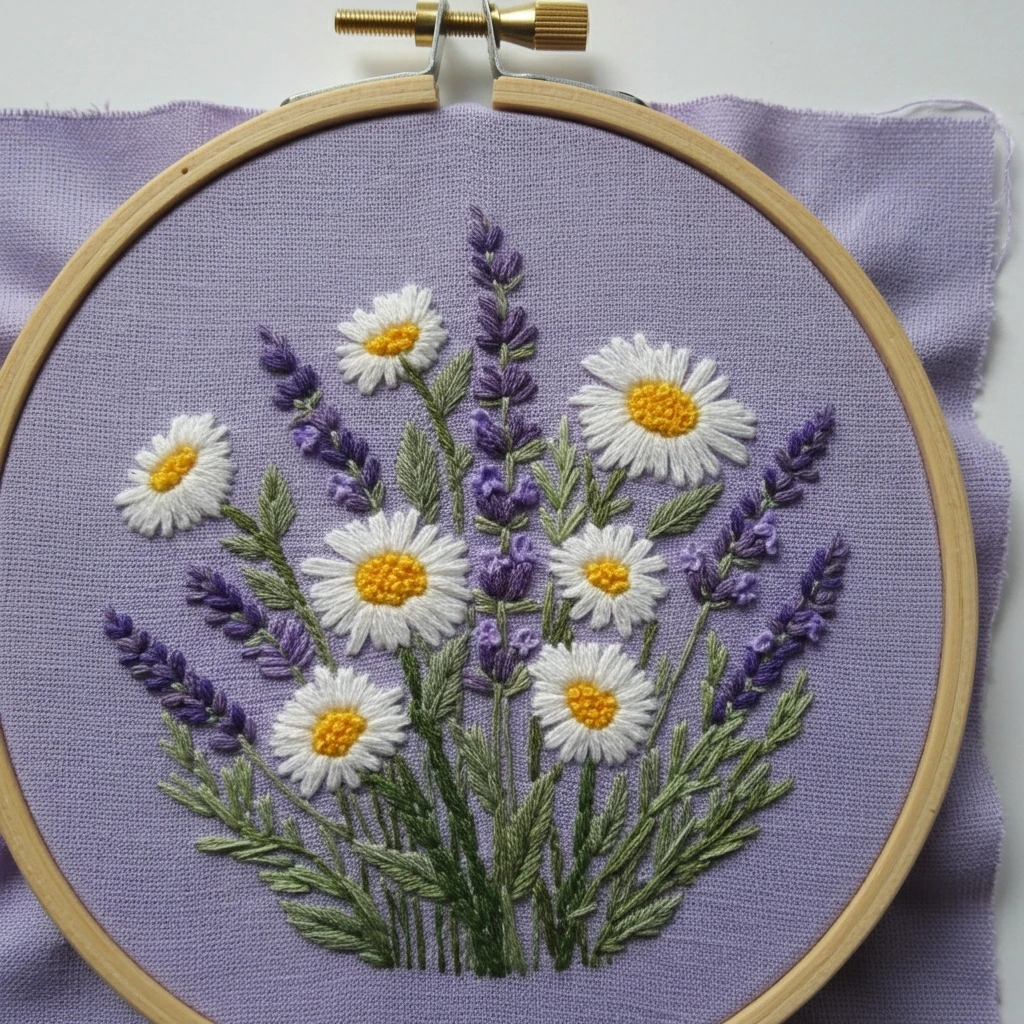
A fresh beginner-friendly bouquet stitched on lavender cloth: white daisies with sunny textured centers rise through purple lavender spikes, soft olive leaves, and fine grass stems. The palette keeps the flowers bright and cheerful while using layered greens and violets for depth.

Mood: cottage garden lavender Best fabric: lilac linen or cotton Skill level: beginner to confident beginner

Color read from the artwork

The design relies on a calm lilac background, clean white daisy petals, golden yellow centers, deep violet lavender blossoms, and a range of muted greens. To keep the bouquet dimensional, use very pale warm whites for petals, two yellows in the centers, three purples for lavender spikes, and at least three greens for leaves, stems, and shadowed base areas.

DMC B5200
Snow White
Bright daisy petal highlights and top stitches that need to pop on lilac cloth.
DMC 3865
Winter White
Main daisy petal fill; softer than pure white for natural petal bodies.
DMC 822
Beige Gray Light
Tiny petal shadows near the center and under overlapping petals.
DMC 726
Topaz Light
Raised daisy centers, especially the front-facing knot clusters.
DMC 783
Topaz Medium
Center shadows and lower knots to make the yellow discs look rounded.
DMC 210
Lavender Medium
Soft lavender bud highlights and small side blossoms.
DMC 209
Lavender Dark
Main lavender buds and mid-tone purple petals along the spikes.
DMC 333
Blue Violet Very Dark
Deepest bud shadows, tucked undersides, and occasional accent knots.
DMC 472
Avocado Green Ultra Light
Leaf highlights and fine strokes on the upper stems.
DMC 469
Avocado Green
Main leaves, daisy stems, and most of the greenery mass.
DMC 3345
Hunter Green Dark
Dark stem bases, leaf veins, and shaded grass at the bottom of the bouquet.
DMC 211
Lavender Light
Optional sparkle highlight on lavender buds and soft blending with 210.
Fabric note: On lavender fabric, white thread can look slightly cool. Use 3865 for most petals and reserve B5200 for the final bright strokes so the daisies stay dimensional instead of flat.

Stitch map by design element

Daisy petals
Use padded satin stitch or long-and-short stitch. Begin each petal at the yellow center and fan outward so the thread direction follows the petal shape. Work with 2 strands for smooth petals; add a single-strand B5200 highlight down the middle of selected front petals.
Daisy centers
Build texture with French knots, colonial knots, or tiny seed stitches in DMC 726. Place a few DMC 783 knots at the lower-left or underside of each center to create a rounded, sunlit dome.
Lavender spikes
Use detached chain, lazy daisy, or small fishbone-like pairs for the buds. Alternate 210, 209, and 333 along each stem: lighter stitches toward the light source, darker stitches tucked behind or near the base.
Fine stems
Stitch stems with stem stitch or split stitch using 1-2 strands of DMC 469. For very thin grass-like lines, use one strand and keep the stitches short so the stems remain graceful rather than ropey.
Sage leaves
Use fishbone stitch for the larger leaves and straight stitch for slim fronds. Blend one strand 472 with one strand 469 for a natural mid-green; add 3345 as a single center vein on leaves that sit behind the flowers.
Base greenery
Layer irregular straight stitches in 3345, 469, and 472. Start with dark vertical strokes at the back, then cross a few lighter stitches over the top to suggest dense stems without filling every gap.

Thread-count and blending guide

Recommended strands

Petals: 2 strands for satin or long-and-short stitch; 1 strand for final white accents. Centers: 2 strands for compact knots, 3 strands if you want a chunkier raised center. Stems: 1-2 strands depending on line weight. Leaves: 2 strands for fishbone leaves and 1 strand for vein details.

Needle and fabric

A size 7 or 8 embroidery needle is comfortable for 2 strands, while a size 9 needle works well for one-strand details. A medium-weight cotton, linen, or linen blend in lilac or pale lavender suits the reference and supports the dense knot centers.

Blending ideas

For leafy transitions, combine one strand 472 with one strand 469. For lavender buds, blend one strand 210 with one strand 209 on the outermost buds, then use solid 333 only for the deepest accents. Avoid overblending the daisies; their strength comes from crisp white petals against purple cloth.

Outlining details

Most shapes do not need heavy outlines. If a daisy petal disappears into the background, add a tiny split-stitch shadow in 822 at the base only. For lavender spikes, a fine 3345 or 469 stem line should be stitched before the buds so the blossoms sit neatly on top.

Shading and texture suggestions

Make the daisies airy

Leave slight spaces between some petals and vary petal lengths. Add the palest white strokes last, especially on the upper right of the flowers, to mimic the fluffy texture seen in the reference.

Keep lavender dimensional

Stagger bud sizes instead of making identical ovals. Use 333 on the underside of every third or fourth bud only; too much dark purple can make the spikes look heavy.

Layer the greens

Work the darkest stems first, then mid-green leaves, then light-green highlights. This order creates the dense garden effect while still keeping individual leaves readable.

Texture upgrade: Use one wrap fewer on knots near the edges of each daisy center and one wrap more in the middle. That small height difference makes the yellow centers look naturally rounded.

Beginner-friendly stitching order

Transfer the design lightly. On lavender fabric, a white transfer pencil, water-soluble pen, or very fine chalk pencil is easier to see than a dark pen.
Stitch the main stems first with 1-2 strands of 469, then add dark base strokes in 3345. Keep these lines slim so the bouquet stays delicate.
Add leaves using fishbone stitch and straight stitch. Blend 472 and 469 for natural movement, then place a few dark veins only where leaves overlap.
Work lavender buds next. Stitch from the bottom of each spike upward, alternating purples and keeping the smallest buds near the tips.
Fill the daisy petals with 3865, add subtle 822 base shadows, then place final B5200 highlights on top petals after the main petals are complete.
Finish with yellow knots in the centers. Rotate the hoop as needed so your knots sit snugly together without pulling the fabric out of shape.

Practical tips for a clean finish

Control bulk

Do not carry dark green or purple threads behind white petals; they may shadow through pale stitches. End and restart threads when crossing open spaces.

Use short satin stitches

If a petal is long, split it into long-and-short rows rather than one long satin span. Shorter stitches resist snagging and sit smoother on fabric.

Protect the lavender cloth

Keep hands clean and avoid over-erasing transfer lines. Pale purple fabric can show hoop marks, so bind the inner hoop or loosen the hoop between stitching sessions.

Balance the bouquet

Step back before finishing the last lavender buds. Add the darkest purples sparingly and distribute yellow centers evenly so one side does not visually outweigh the other.
Leave a Reply

Your email address will not be published. Required fields are marked *