
Lavender and Daisy Bouquet
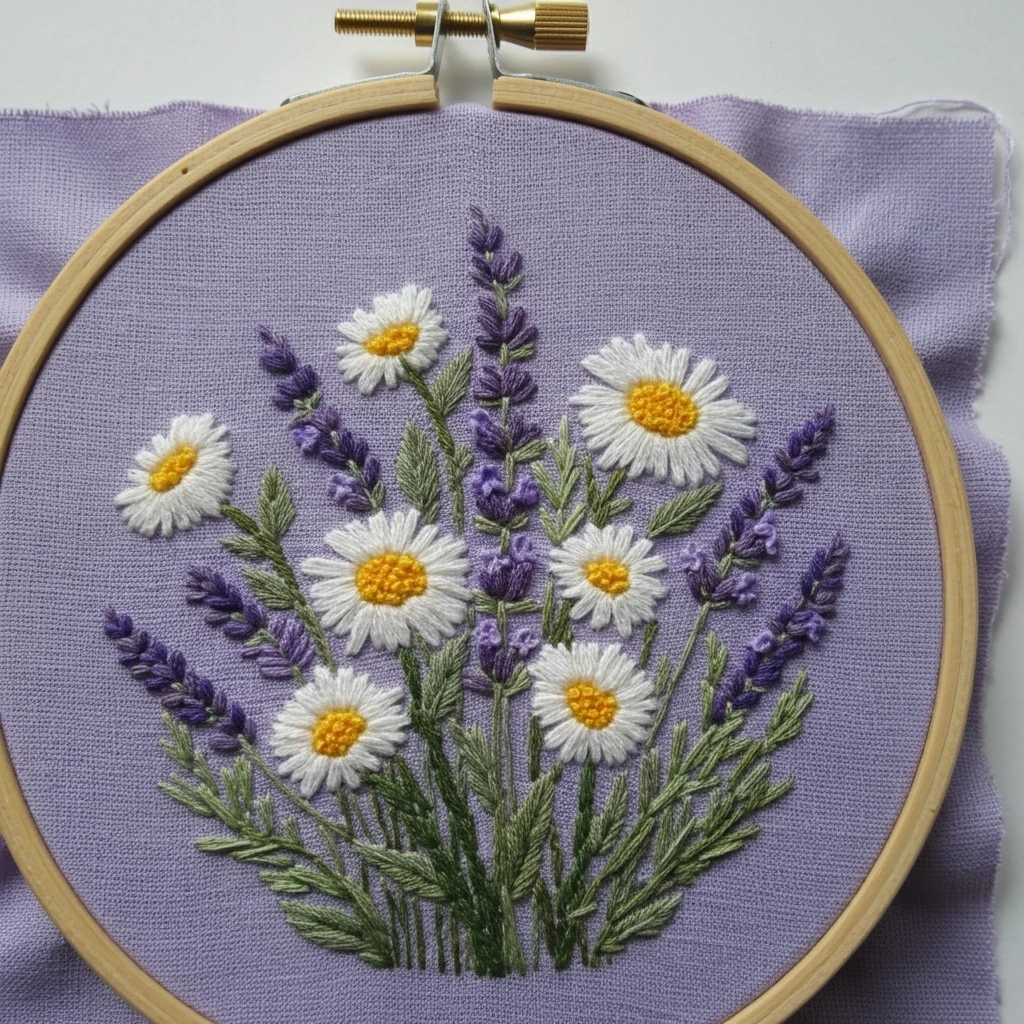
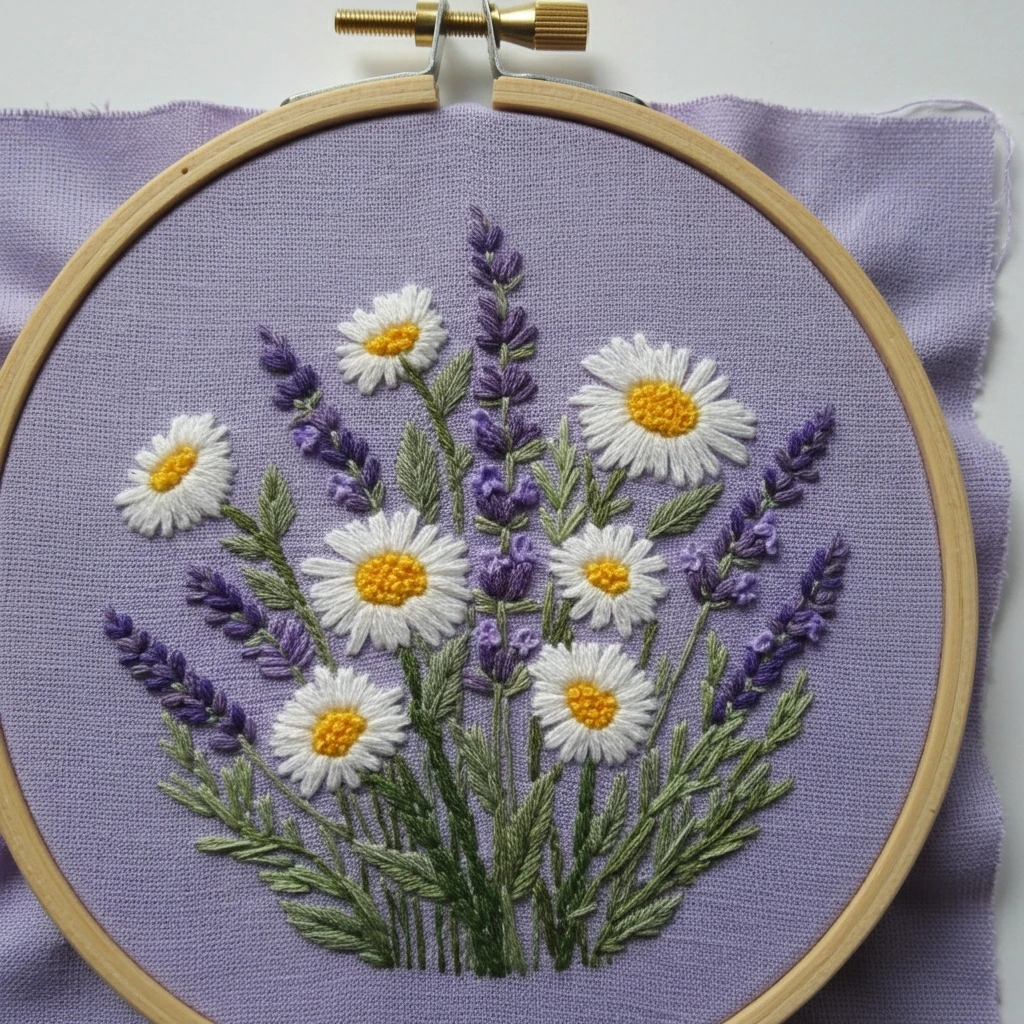
A fresh beginner-friendly bouquet stitched on lavender cloth: white daisies with sunny textured centers rise through purple lavender spikes, soft olive leaves, and fine grass stems. The palette keeps the flowers bright and cheerful while using layered greens and violets for depth.
Color read from the artwork
The design relies on a calm lilac background, clean white daisy petals, golden yellow centers, deep violet lavender blossoms, and a range of muted greens. To keep the bouquet dimensional, use very pale warm whites for petals, two yellows in the centers, three purples for lavender spikes, and at least three greens for leaves, stems, and shadowed base areas.
Stitch map by design element
Thread-count and blending guide
Recommended strands
Petals: 2 strands for satin or long-and-short stitch; 1 strand for final white accents. Centers: 2 strands for compact knots, 3 strands if you want a chunkier raised center. Stems: 1-2 strands depending on line weight. Leaves: 2 strands for fishbone leaves and 1 strand for vein details.
Needle and fabric
A size 7 or 8 embroidery needle is comfortable for 2 strands, while a size 9 needle works well for one-strand details. A medium-weight cotton, linen, or linen blend in lilac or pale lavender suits the reference and supports the dense knot centers.
Blending ideas
For leafy transitions, combine one strand 472 with one strand 469. For lavender buds, blend one strand 210 with one strand 209 on the outermost buds, then use solid 333 only for the deepest accents. Avoid overblending the daisies; their strength comes from crisp white petals against purple cloth.
Outlining details
Most shapes do not need heavy outlines. If a daisy petal disappears into the background, add a tiny split-stitch shadow in 822 at the base only. For lavender spikes, a fine 3345 or 469 stem line should be stitched before the buds so the blossoms sit neatly on top.
Shading and texture suggestions
Make the daisies airy
Leave slight spaces between some petals and vary petal lengths. Add the palest white strokes last, especially on the upper right of the flowers, to mimic the fluffy texture seen in the reference.
Keep lavender dimensional
Stagger bud sizes instead of making identical ovals. Use 333 on the underside of every third or fourth bud only; too much dark purple can make the spikes look heavy.
Layer the greens
Work the darkest stems first, then mid-green leaves, then light-green highlights. This order creates the dense garden effect while still keeping individual leaves readable.
Beginner-friendly stitching order
Practical tips for a clean finish
Control bulk
Do not carry dark green or purple threads behind white petals; they may shadow through pale stitches. End and restart threads when crossing open spaces.
Use short satin stitches
If a petal is long, split it into long-and-short rows rather than one long satin span. Shorter stitches resist snagging and sit smoother on fabric.
Protect the lavender cloth
Keep hands clean and avoid over-erasing transfer lines. Pale purple fabric can show hoop marks, so bind the inner hoop or loosen the hoop between stitching sessions.
Balance the bouquet
Step back before finishing the last lavender buds. Add the darkest purples sparingly and distribute yellow centers evenly so one side does not visually outweigh the other.