
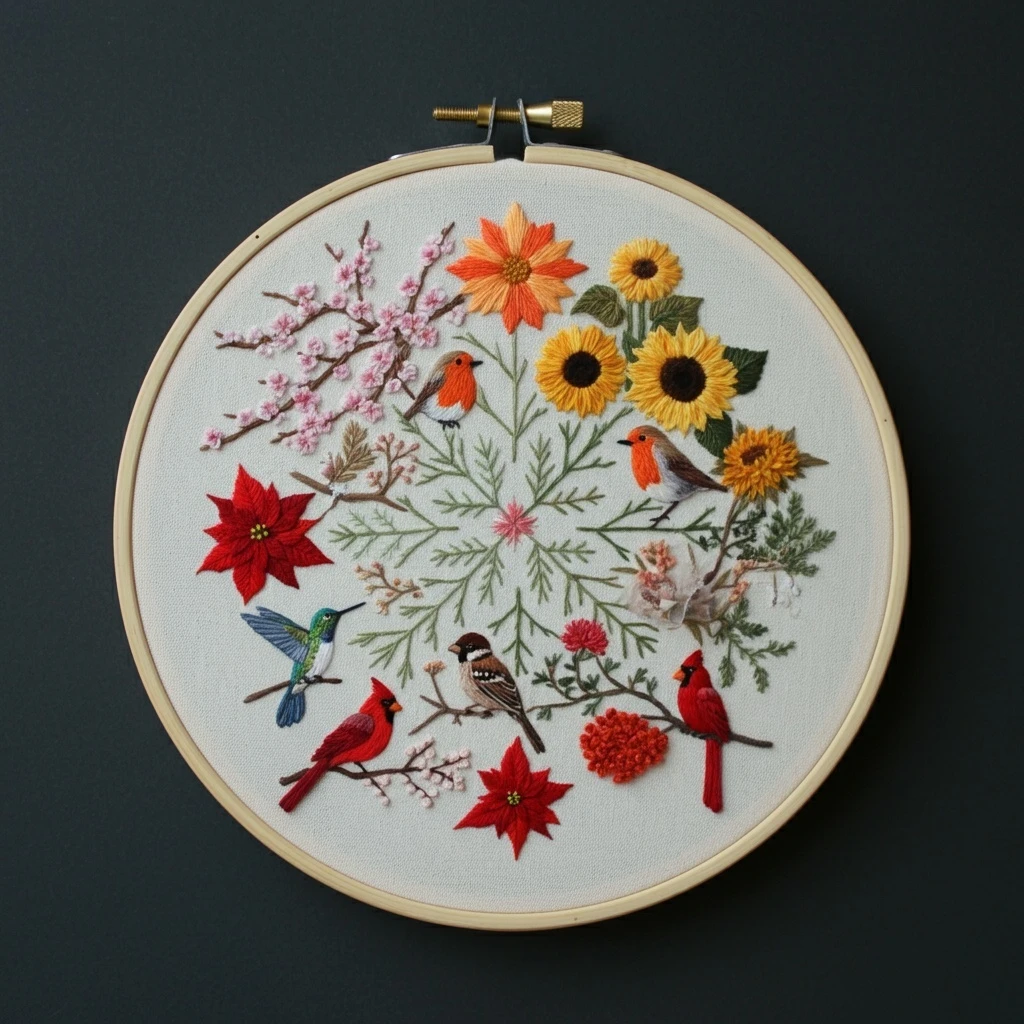
A Year in Stitches: Birds and Seasonal Flowers
A circular, four-season hoop with delicate branchwork, airy green stems, warm sunflowers, red winter poinsettias, spring cherry blossoms, orange-centered daisies, cardinals, robins, a sparrow, and a jewel-toned hummingbird. The design benefits from fine one-strand linework, softly shaded feathers, raised knot clusters, and selective satin stitching for vivid seasonal accents.
Suggested DMC Color Palette
Matched to the birds, cherry blossoms, sunflowers, poinsettias, foliage, branchwork, and pale fabric ground.Motif-by-Motif Stitching Suggestions
Balance tiny bird detail with open botanical linework so the hoop stays light and seasonal.Robins and orange-breasted birds
Use long-and-short stitch with 1 strand for small birds and 2 strands only on the chest. Blend DMC 970 into 720, then add a few 816 feather shadows near the wing. Keep the eye and beak to one tiny 938 or 310 stitch so the face stays crisp.
Cardinals and red winter birds
Fill the body with directional satin or split stitch in 666, following the slope of the bird. Add 816 under the wing, tail base, and lower belly; finish the crest and tail tips with single-strand straight stitches for sharper silhouettes.
Hummingbird
Build the body with 3810 and tiny touches of 3846 if available; use 798 for wing and tail shadows. Work the wings in long straight stitches that radiate from the shoulder, then add one-strand backstitch veins in 798 for a feathered shimmer.
Sunflowers
Stitch petals in 742 with 783 at the base and lower edges. Use two staggered layers of detached chain or satin stitches for fullness. Make the dark centers with dense French knots in 938 and 3371, adding a few 783 knots near the outer ring.
Cherry blossom branch
Work branch lines first in split stitch or stem stitch using 938 blended with 433. Add blossoms with tiny lazy daisy petals in 761, shadow one side with 3688, and dot centers with one wrap of 3688 or 783.
Poinsettias
Use satin stitch or fishbone stitch for each red bract. Start with 666 on the outer half and shade toward the center with 816. Add a small cluster of 783 French knots in the middle, then outline only the deepest petal overlaps.
Evergreen and fern sprays
Use one strand throughout. Stem stitch the main twig in 3362, then place short angled straight stitches in 3052 and 469. Vary lengths so the foliage looks airy rather than comb-like.
Small berries and textured flower clusters
For the orange-red cluster near the lower right, use colonial knots or French knots in 720, 970, and 816. Pack the knots unevenly, with darker knots along the underside to create a rounded pom-pom effect.
Thread Counts, Blends & Texture Plan
Recommended strand choices for readable detail inside a standard hoop design.| Area | Recommended strands | Blending / texture notes |
|---|---|---|
| Fine stems and branch tips | 1 strand | Use stem stitch for the main curve and backstitch for short twigs. Alternate 938 and 433 so branches do not look flat. |
| Small birds | 1 strand for detail, 2 strands for bold body areas | Blend one strand 970 + one strand 720 on robin chests. Use single-strand 938/310 for eyes, masks, feet, and beaks. |
| Cardinal bodies | 2 strands fill; 1 strand outline | Use 666 as the main red. Add 816 in wing breaks, tail undersides, and under the beak; avoid outlining the entire bird in black. |
| Sunflower petals | 2 strands | Blend 742 + 783 for inner petals and pure 742 on tips. Keep each petal stitch directional and slightly separated. |
| Flower centers | 2 strands for knots | Use clustered French knots in 938/3371 with scattered 783. Knot height gives the center dimension without heavy fill. |
| Cherry blossoms | 1 strand petals; 2 strands only for larger blooms | Use lazy daisy, detached chain, or tiny satin petals in 761. Add 3688 at the base of two or three petals only. |
| Foliage and evergreen needles | 1 strand | Use straight stitches at varied angles. Mix 3052, 469, and 3362 from light tips to dark bases. |
| Poinsettia bracts | 2 strands | Use fishbone stitch for natural veins; place 816 along the center vein and under overlapping bracts. |
Shading Guidance
Use small value jumps and directional stitches for painterly seasonal detail.Robin chest blend
970 → 720 → 816
Place 970 at the upper glow, 720 through the strongest orange area, and 816 as tiny lower-edge shadows where the chest meets the wing.
Sunflower blend
742 → 783 → 938 / 3371
Keep petal tips bright, deepen the inner ring with 783, then create the seed head with raised dark knots rather than a flat satin circle.
Cherry blossom blend
3865 → 761 → 3688
Use 3865 for sparkle on a few petal tips, 761 as the main blossom color, and 3688 only at the base or shaded side of selected blooms.
Evergreen blend
3052 → 469 → 3362
Work pale needle tips first, add 469 mid-needles, and use 3362 close to stems or behind birds to push the foliage backward.
Practical Embroidery Tips
Finishing notes for a clean, hoop-ready result with many small motifs.- Stitch the light green radial stems first; they act as a map for the whole wreath-like composition.
- Work background branches before blossoms, then layer petals and knots on top for natural overlap.
- Reserve 2 strands for focal birds and large flowers; most stems, twigs, and tiny feathers should stay at 1 strand.
- Use a smaller needle for knots in sunflower centers and berry clusters so the fabric does not distort.
- For bird feathers, change stitch direction often: wing stitches should angle differently from belly and tail stitches.
- Do not fully outline every petal or leaf. A few selective dark lines keep the piece detailed without becoming cartoon-like.
- Scatter French knots irregularly in flower centers; perfect grids look less botanical.
- After finishing, steam from the back over a towel and allow the hoop to dry fully before final mounting.