
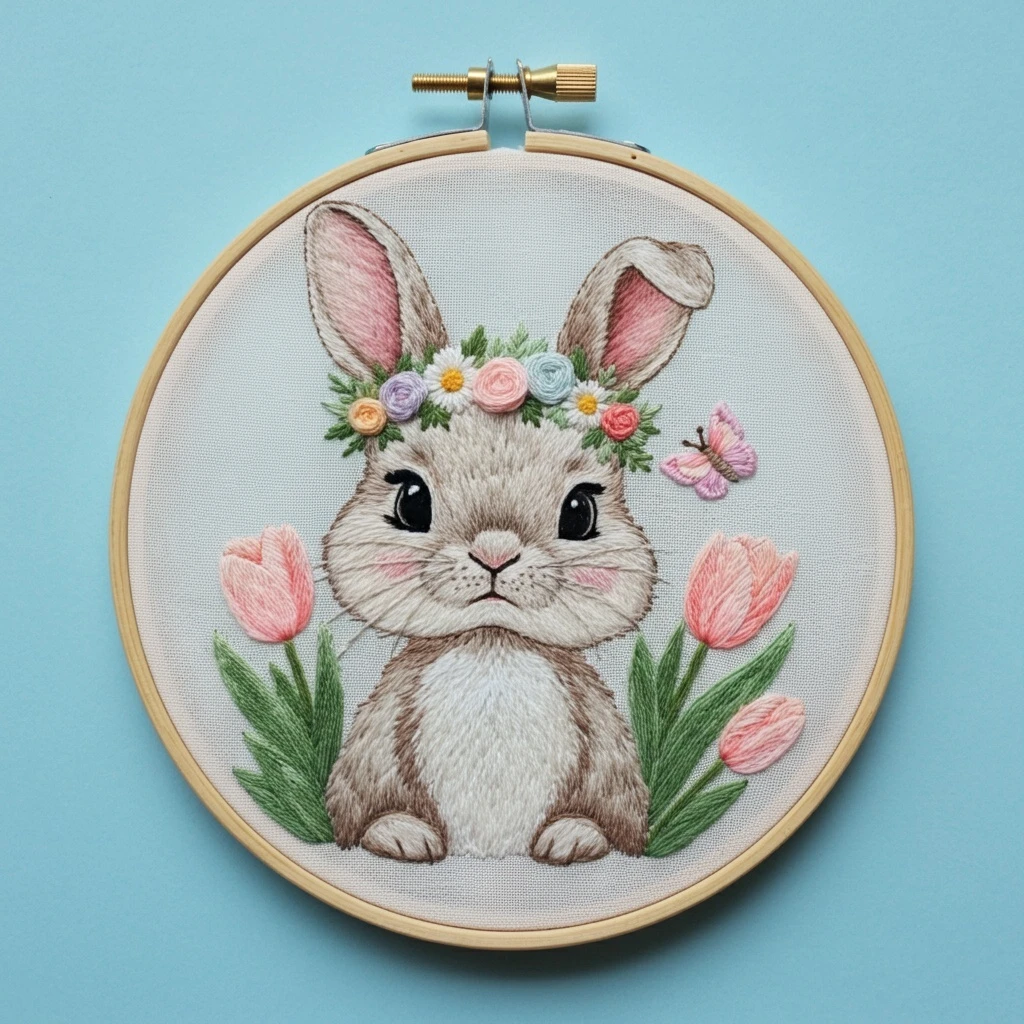
Adorable Bunny with Flower Crown and Tulips
This polished stitching guide converts the design into a soft spring embroidery plan: a creamy white bunny, blush-pink cheeks, a delicate flower crown, fresh tulip colors, and green leaves/stems. The overall style should feel gentle, sweet, botanical, and beginner-friendly while still offering refined shading options.
The image link could not be fully fetched during generation, so the palette is matched to the clearly described design elements in the file name and uses the exact reference URL in the page. The recommendations emphasize believable bunny fur, pastel floral accents, clean tulip shapes, and delicate outlines.
1) Visual color analysis
The design is best interpreted as a spring garden character piece: soft neutrals for the bunny, warm blushes for cheeks and flower centers, tulip reds/pinks for focal blooms, and fresh greens for stems, leaves, and the flower crown. Keep the bunny light and softly shaded so the florals provide the brightest accents.
Bunny body
Use warm whites, cream, pale taupe, and soft gray-beige for a plush look. Avoid stark black outlines except for tiny eye accents.
Flower crown
Pastel rose, peach, lavender, and yellow flower notes look charming against the neutral bunny. Use small stitch clusters rather than heavy filled areas.
Tulips & greenery
Tulips can carry stronger pink-red tones, while leaves and stems should remain natural, balanced, and slightly muted.
2) Suggested DMC color palette
These floss colors give a balanced spring palette with enough light neutrals for the bunny and lively accents for the flower crown and tulips.
| Swatch | DMC | Color name | Suggested use | Notes |
|---|---|---|---|---|
| B5200 | Snow White | Eye catchlights, brightest fur highlights, tiny petal highlights | Use sparingly for sparkle. | |
| 3865 | Winter White | Main light bunny fur | Softer than pure white. | |
| 822 | Beige Gray Light | Warm fur shadows, chest, muzzle transitions | Good bridge shade. | |
| 3864 | Mocha Beige Light | Ear bases, underside shadows, paws | Use lightly on pale fabric. | |
| 648 | Beaver Gray Light | Deeper fur contour and outline-softening | Excellent for gentle definition. | |
| 3799 | Pewter Gray Very Dark | Eyes, deepest nose or whisker points | Use 1 strand only. | |
| 3713 | Salmon Very Light | Inner ears, cheeks, pale flower petals | Perfect blush tone. | |
| 761 | Salmon Light | Flower crown petals, cheeks, tulip highlights | Soft and sweet. | |
| 760 | Salmon | Main pink tulip petals and deeper blossoms | Core floral pink. | |
| 3721 | Shell Pink Dark | Tulip petal shadows and flower crown depth | Use in petal bases. | |
| 3801 | Christmas Red Light | Strongest tulip accents | Use selectively for vibrancy. | |
| 3824 | Apricot Light | Peach blossoms and warm flower centers | Adds sunny warmth. | |
| 3078 | Golden Yellow Very Light | Tiny flower centers and spring highlights | Great for French knots. | |
| 211 | Lavender Light | Optional lavender blossoms in flower crown | Balances pinks and greens. | |
| 3348 | Yellow Green Light | Young leaves, flower crown foliage, tulip leaf highlights | Fresh spring green. | |
| 3052 | Green Gray Medium | Main leaves and stems | Natural muted green. | |
| 3363 | Pine Green Medium | Leaf shadows, tulip stems, crown depth | Use for contrast in greenery. | |
| 839 | Beaver Brown Dark | Soft whisker roots, ground accents, warm linework | Warmer than black. |
3) Stitching suggestions by design element
Use controlled, beginner-friendly stitches with fine strand counts. The bunny should be soft and smooth, while flowers can be more decorative and textural.
Bunny fur and body
- Primary stitch: long-and-short stitch or split stitch fill with 1–2 strands.
- Direction: curve stitches around cheeks, belly, ears, and paws for plush shaping.
- Palette: 3865, 822, 3864, 648.
- Tip: keep the brightest areas open and airy; do not overfill with dark shading.
Flower crown
- Primary stitch: lazy daisy petals, woven wheels, French knots, and tiny satin stitches.
- Centers: French knots in 3078 or 3824.
- Palette: 3713, 761, 760, 211, 3824, 3078.
- Tip: stagger flower sizes to make the crown look natural.
Tulips
- Primary stitch: satin stitch for small tulip petals or long-and-short stitch for larger blooms.
- Petal lines: 1-strand split stitch or straight stitch from base toward tip.
- Palette: 761, 760, 3721, 3801.
- Tip: place darker shades at petal bases and folds, not across the entire flower.
Leaves, stems and accents
- Primary stitch: stem stitch for stems, fishbone stitch for leaves, and detached chain for small foliage.
- Palette: 3348, 3052, 3363.
- Outlines: use 1 strand of 3363 or 839 only where shapes need separation.
- Tip: angle leaf stitches along the central vein for a polished finish.
4) Thread counts, blending and outlining
Fine strand control is the easiest way to make this design look sweet rather than heavy.
Recommended thread counts
- 1 strand: facial features, whiskers, tiny petal veins, leaf veins, and highlight marks.
- 2 strands: main bunny fill, tulip petals, leaves, and most flower-crown shapes.
- 3 strands: only for raised French knots or bold flower centers if the hoop is large.
Best blending ideas
- Bunny fur: 3865 + 822 for soft cream shadows.
- Deeper fur: 822 + 3864, with tiny 648 accents at ear bases and paws.
- Tulips: 761 + 760 for light petals; 760 + 3721 for folds.
- Greenery: 3348 + 3052 for leaf highlights; 3052 + 3363 for shadowed stems.
5) Shading guidance
Keep the bunny softly dimensional and let the floral elements supply most of the color contrast.
For the bunny
Place lightest values on the forehead, muzzle, chest, and tops of paws. Shade inside ears, under the chin, beneath the flower crown, and where limbs overlap. Use scattered short stitches to avoid blocky shadows.
For tulips
Start petals with the lightest pink at the upper edges, then deepen toward the base and overlapping folds. A few vertical 1-strand stitches in 3721 can suggest petal structure without overcomplicating the shape.
For the crown
Use small raised knots and detached petals to create a delicate wreath effect. Keep darker shades tucked behind front petals so the crown looks layered but not crowded.
6) Practical embroidery tips
These details help maintain a clean, polished finish on a cute spring character design.
Use a light transfer
Pale bunny colors can allow marks to show through, so trace lightly and cover lines with stitch direction rather than heavy outline.
Stitch the face early
The expression is the heart of the design. Finish the eye, nose, and cheek placement before filling every surrounding area.
Work from large to small
Complete the bunny body first, then tulips and leaves, and finish with flower-crown knots and tiny highlights.
Keep flowers varied
Mix lazy daisy, French knots, and small satin petals so the crown feels organic rather than repetitive.
Test pinks on fabric
Pink floss can look stronger on cream linen. Test 761, 760, and 3721 together before committing to tulip shading.
Press carefully
Press finished work face down on a towel so French knots, woven flowers, and raised petals keep their dimension.