
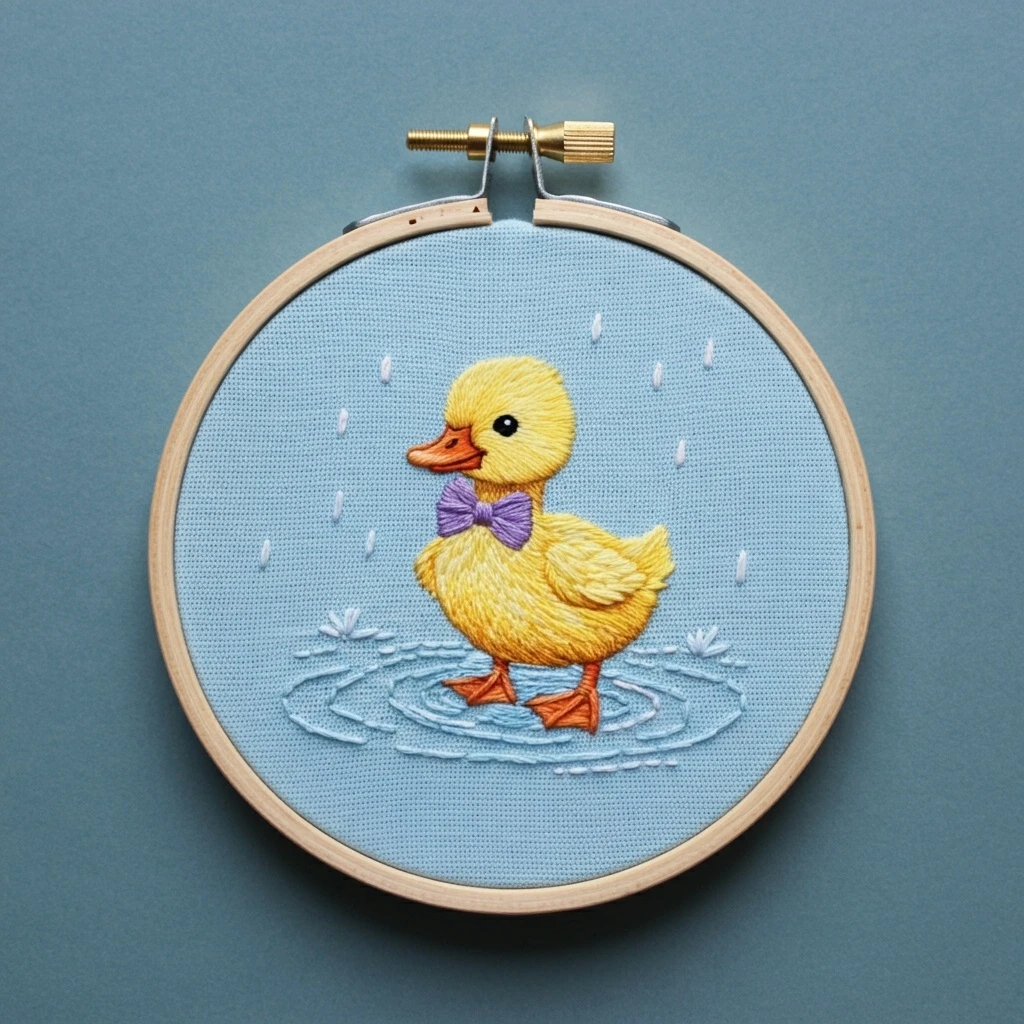
Adorable Duckling in the Rain
This guide translates the reference artwork into a practical embroidery plan with a soft rainy-day color story: misty blue grays, warm buttery yellows, golden ochres, and a few crisp charcoal accents for definition. The overall mood is sweet, gentle, and slightly whimsical, with the duckling as the warm focal point against cool wet-weather surroundings.
The palette below is selected to echo the image’s dominant cool blues and grays while preserving enough sunny yellow and orange to keep the duckling bright, expressive, and dimensional. Stitch suggestions prioritize fluffy texture, delicate raindrops, wet-surface shading, and tidy outlining.
1) Visual color analysis
The reference image reads as a cool, rain-washed composition built around muted blue-grays and soft teal blues, with the duckling introducing warm yellow, gold, and orange notes. The contrast between the cozy duck tones and the damp background is what gives the design its charm.
Dominant mood
Gentle, storybook softness with a cool rainy atmosphere. Use smooth transitions and restrained outlining so the duck remains sweet rather than overly graphic.
Warm focal colors
The duckling’s body and details are best rendered with pale cream, lemon yellow, rich canary, and soft apricot-to-copper accents for the beak and feet.
Best overall approach
Keep the duckling slightly more textured and layered than the background. Let raindrops and wet shadows stay finer and lighter so they support the focal subject without competing with it.
2) Suggested DMC color palette
The following floss choices are visually matched to the artwork. They are intended as practical embroidery equivalents rather than strict digital-to-thread conversions.
| Swatch | DMC | Color name | Suggested use in the design | Notes |
|---|---|---|---|---|
| B5200 | Snow White | Eye highlights, rain sparkle, tiny reflected light on puddles | Use sparingly for the cleanest highlights. | |
| 3823 | Ultra Pale Yellow | Top highlights on the duckling’s fluffy head, chest, and outer feather edges | Excellent first highlight over warmer yellows. | |
| 307 | Lemon | Main light yellow fill on the body and face | Blend with 3823 for soft feathery transitions. | |
| 973 | Canary Bright | Midtone yellow for wings, lower body, and slightly warmer fluffy sections | Use in short staggered strokes for texture. | |
| 3821 | Straw | Deeper golden shading where the duckling tucks inward or casts shadow | Add sparingly to keep the baby-duck feel light. | |
| 3824 | Apricot Light | Beak and feet highlights; warm reflected color near cheeks | Great first layer under stronger oranges. | |
| 741 | Tangerine Medium | Main beak/feet color and warm accents | Works well in satin stitch or padded satin stitch. | |
| 921 | Copper | Small shadow accents at the base of the beak and between toes | Use only in tiny doses for contrast. | |
| 775 | Baby Blue Very Light | Lightest rain, mist, and watery reflections | Ideal for 1-strand detailing. | |
| 3756 | Baby Blue Ultra Very Light | Soft atmospheric blue wash around raindrops or background accents | Beautiful for subtle blending with 775 or 932. | |
| 932 | Antique Blue Medium | Puddle rings, medium rain shadows, cool contouring near the duck | Core rainy-day midtone. | |
| 931 | Antique Blue Dark | Deeper puddle edges, wet background recesses, selective outlining | Use instead of black when you want a softer outline. | |
| 762 | Pearl Gray Very Light | Rain haze, pale shadow under the duck, cooling warm yellows where needed | Good blending bridge between yellow and blue families. | |
| 318 | Steel Gray Light | Soft grounding shadows and wet-surface tonal depth | Useful for subtle contouring around puddles. | |
| 415 | Pearl Gray | Cooler shadow accents and small linework in muted areas | Use with restraint for a soft storybook finish. | |
| 3799 | Pewter Gray Very Dark | Eyes, deepest outline points, tiny contrast marks | Prefer this over 310 for less harsh contrast. | |
| 3348 | Yellow Green Light | Any grass or small surrounding plant accents | Optional but helpful if the composition includes greenery. | |
| 469 | Avocado Green | Deeper greenery shadows or tiny natural grounding elements | Keep secondary to the duck and rain palette. |
3) Stitching suggestions by design element
These stitches are chosen to preserve softness in the main subject while keeping the rainy details light, airy, and readable.
Duckling body & fluffy texture
- Primary stitch: long and short stitch using 1–2 strands for the face, breast, and wings.
- Texture option: turkey work or tiny loose long stitches in very small areas if you want extra fluff on the head or chest.
- Direction: stitch in curved strokes radiating with the form of the body to emphasize roundness.
- Best palette: 3823 → 307 → 973 → 3821.
Beak & feet
- Primary stitch: satin stitch with 2 strands for a smooth finish.
- Detailing: add a line of split stitch or a single narrow backstitch where separation is needed.
- Best palette: 3824 for highlights, 741 for the main tone, 921 for the deepest crease.
- Tip: keep shape edges rounded and clean for a cute, polished expression.
Rain, splashes & droplets
- Primary stitch: straight stitch, tiny seed stitch, or very short detached stitches with 1 strand.
- For splash rings: backstitch, split backstitch, or a fine whipped backstitch.
- Best palette: B5200, 775, 3756, and 932.
- Tip: vary droplet length and spacing so the rain feels natural and lively.
Puddles, shadows & surrounding accents
- Primary stitch: long and short stitch, split stitch fill, or directional satin for smooth puddle areas.
- Edges: use 1-strand stem stitch or backstitch in 931 or 415.
- Best palette: 775, 3756, 932, 931, 762, 318, 415.
- Tip: keep puddle edges softer than the duck outline to preserve focal hierarchy.
4) Thread counts, blending & outlining
Thread weight is especially important in a design like this because the charm depends on softness. Finer strands keep the expression sweet and the rain light.
Recommended thread counts
- 1 strand: facial details, rain, puddle lines, tiny highlights, fine outline corrections.
- 2 strands: most body fill, beak, feet, and visible motif areas.
- 3 strands: only for bold accents or if stitching on a looser weave and you want slightly more raised texture.
Best blending combinations
- Duck highlights: blend 3823 + 307 for soft transitions on the head and cheeks.
- Body depth: blend 307 + 973, then place 3821 selectively in shadow pockets.
- Rainy atmosphere: blend 775 + 3756 for soft mist, or 3756 + 932 for clearer blue shading.
- Wet shadows: mix 762 + 318 to create subtle cool reflected shadow under the duckling.
5) Shading guidance
To keep the duckling round and plush, think in soft curved planes rather than hard shadow blocks. The rain elements should remain cooler and more transparent.
For the duckling
Place the lightest yellows on the forehead, upper cheeks, and upper chest. Deepen the lower belly, wing overlap, and underside with 973 and small touches of 3821. If the form needs extra softness, veil the transition with scattered 3823 stitches.
For a damp, rainy feel
Add cool reflected shadow beneath the body and around puddles using 762 and 318. A trace of 932 can help suggest wetness without making the duck look dirty. Keep these cool tones outside the brightest feather highlights.
For raindrops & water
Make droplets strongest at their center line with 932 and soften outward with 775 or 3756. Add a pinpoint B5200 highlight to only a few droplets or splash arcs so the scene stays airy and not overworked.
6) Practical embroidery tips
These finishing choices help maintain neatness and clarity, especially in a design with small details and lots of delicate weather effects.
Transfer lightly
Use a light transfer method and cover lines promptly. Rain details are delicate, and heavy transfer marks can show through pale blues and yellow highlights.
Stitch the focal subject first
Complete the duckling before the background rain so you can judge how much contrast the weather details really need. This prevents the scene from becoming visually busy.
Keep the face simple
Eyes, beak placement, and cheek contours define the expression. Use minimal lines, tiny stitches, and clean spacing to preserve the adorable character.
Use shorter stitches in curves
On the head, cheeks, and rounded body, shorter directional stitches create a smoother transition and help avoid a streaky appearance.
Test blends first
Before committing, test yellow blends and blue-gray shadow mixes on a scrap of the same fabric. Pale tones can shift noticeably depending on fabric color.
Finish with selective highlights
Add the final white and very pale blue accents last. A few crisp highlights on water and the eye will make the piece feel fresh and lively.