
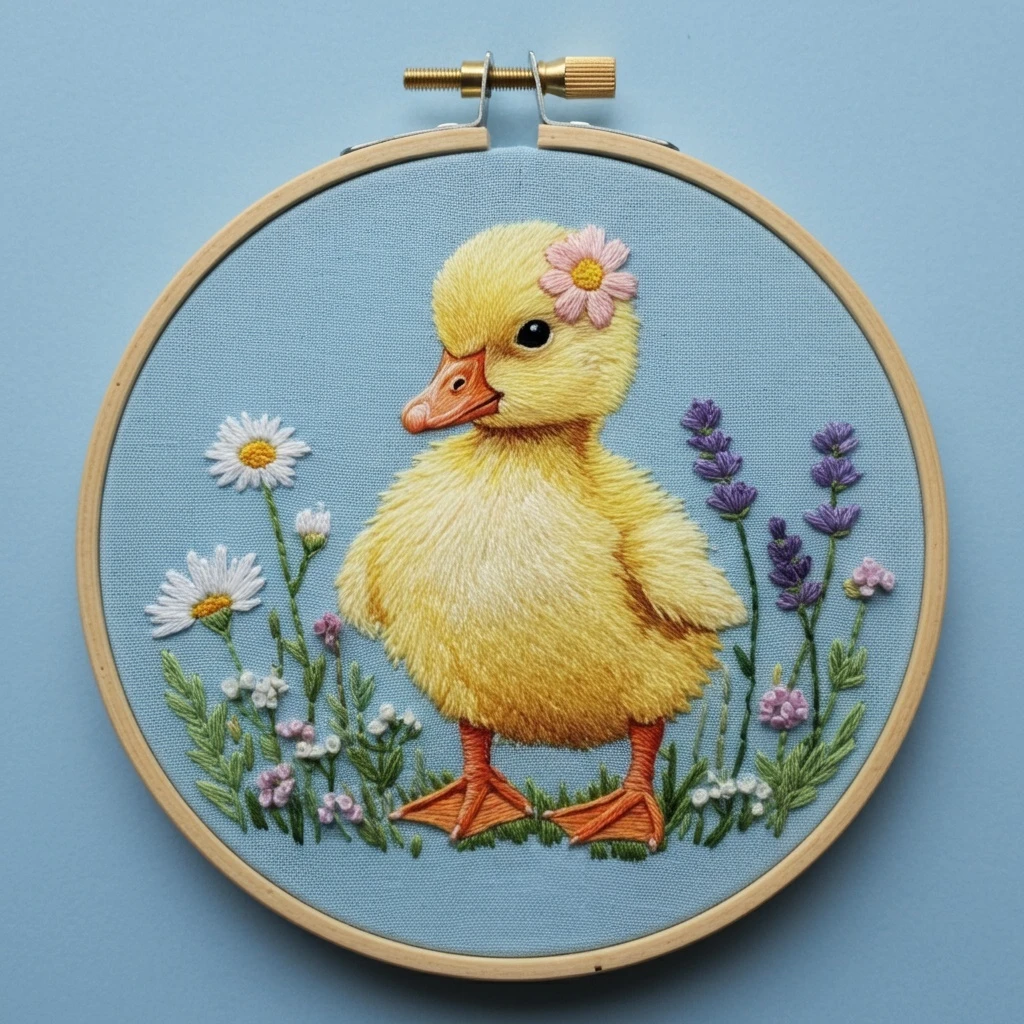
Adorable Duckling in a Flower Meadow
A cheerful spring embroidery guide for a fluffy yellow duckling nestled in meadow grass with tiny seasonal flowers. The recommendations below focus on soft downy texture, a bright beak and feet, delicate flower heads, fresh stems, and a polished hoop-art finish.
Design reference: fluffy yellow duckling sitting among meadow grass, small flowers, and soft spring details.
Suggested DMC Color Palette
Design Element Breakdown
Fluffy duckling
Use one-strand long-and-short stitch with feathery broken edges. Direction matters: work outward from the face, curve around the belly, and follow the wing shape.
Beak and feet
Keep the orange areas smooth and slightly glossy with satin stitch, then define the beak crease and toes with a fine warm copper backstitch.
Meadow flowers
Stitch stems with fine stem stitch and build flowers from lazy daisy petals, French knots, tiny satin petals, and scattered seed stitches.
Stitch & Strand Plan
| Area | Recommended stitches | Strands | Color notes |
|---|---|---|---|
| Head and cheeks | Long-and-short stitch, tiny straight stitches, split stitch guide line | 1 strand | Blend 744 into 743; add 742 sparingly under the cheek and near the neck. |
| Body and belly | Long-and-short stitch, scattered seed stitch for down | 1 strand for texture; 2 strands for small fill patches only | Use 743 as the base, 744 on the raised belly, and 742/977 in the lower shadow. |
| Wing | Fishbone stitch, long-and-short stitch, split stitch feather divisions | 1 strand | Start with 742 at the lower wing, feather 743 through the center, and finish with 744 on the top edge. |
| Eye | Satin stitch, one tiny straight stitch catchlight | 1 strand | Use 3371 for a soft black-brown eye and 3865 for a single bright catchlight. |
| Beak | Satin stitch, split stitch outline, tiny straight stitch nostril | 2 strands fill; 1 strand details | Fill with 741, shade lower beak with 921, and use 3371 only for the smallest nostril point. |
| Feet and toes | Satin stitch, padded satin, backstitch toe lines | 2 strands fill; 1 strand outline | Use 741 for plump toes and 921 along toe separations and where the feet touch grass. |
| Grass and stems | Stem stitch, straight stitch, fly stitch, couching for longer blades | 1–2 strands | Mix 3348, 3347, and 3346 so grass looks varied rather than flat. |
| Leaves | Detached chain, fishbone stitch, small satin stitches | 1–2 strands | Use 3348 for small new leaves and 3347/3346 for darker leaves behind the duckling. |
| Pink and lavender flowers | Lazy daisy, French knots, satin petals, seed stitch clusters | 1–2 strands | Use 957 and 211 as soft flower colors; add 725 centers for warmth. |
| Daisies or pale flowers | Lazy daisy petals, straight stitches, French knot centers | 1 strand petals; 2 strands centers | Use 3865 petals with a touch of 822 or 3841 at the petal base for dimension. |
Blending & Shading Guidance
Duckling down recipe
- Lightly split-stitch the main silhouette with one strand of 743 rather than a dark outline.
- Place the warm shadow zones first: lower belly, underside of wing, neck tuck, and areas near the feet using 742 with small touches of 977.
- Fill the middle body with short 743 strokes, changing direction to follow the curve of the round form.
- Add 744 last as floating highlights on the top of the head, cheek, chest, and raised feather tips.
Meadow depth recipe
Work the darkest grass behind and underneath the duckling first with 3346. Add mid-green 3347 blades around it, then place 3348 stems and leaf tips on top. Keep most flowers in front of the greenery with 957, 211, 3841, and 3865 so they feel sprinkled through the meadow rather than buried.
Outlining Details
Where to outline
- Use one strand of 921 along the beak crease and toe separations.
- Use one strand of 3371 only for the eye, nostril, and the smallest smile or mouth point.
- Use 742 as a soft golden outline at the duckling underside and wing fold.
- Use 3346 selectively at the base of the grass to ground the composition.
Where to avoid outlining
- Avoid a continuous dark outline around the yellow body; it will reduce the soft baby-down effect.
- Do not outline every grass blade. Vary height and spacing for a natural meadow look.
- Keep tiny flowers simple; too much outlining can make them look heavy at small scale.
- Let the lightest yellow strokes break into the fabric edge for a fluffy silhouette.
Practical Embroidery Tips
Needles
Use a size 9–10 crewel needle for one-strand down and flower detail, then a size 7–8 needle for 2-strand satin stitch on the beak and feet.
Fabric tension
Keep the hoop drum-tight before satin stitching the beak. Smooth tension keeps the orange fill even and prevents puckering around the face.
Layer order
Stitch the duckling first, then the grass behind and around it, then flowers, centers, and final highlights. Add the eye after the face is complete.
Flower scale
Use one-wrap French knots for very tiny blossoms and two-wrap knots for flower centers. Oversized knots can overwhelm the duckling.
Soft edges
At the top of the head and belly edge, let individual yellow stitches extend slightly beyond the guide line to mimic fluffy down.
Color balance
Repeat small touches of yellow in flower centers so the meadow colors harmonize with the duckling instead of competing with it.
Quick Working Sequence
- Transfer the design lightly, marking the duckling silhouette, wing, beak, eye, feet, main grass clumps, and flower positions.
- Stitch the duckling shadows first with 742 and small touches of 977, then fill the down with 743 and feather 744 highlights over the top.
- Complete the beak, feet, and eye so the expression is established before the meadow becomes busy.
- Add grass behind the duckling with 3346, then build forward using 3347 and 3348 stems and leaves.
- Stitch flowers with lazy daisy petals, French knots, and small satin stitches; vary pink, lavender, blue, and white blooms.
- Finish with catchlights, flower centers, a few loose seed stitches, and final soft yellow flyaway strokes around the duckling edge.