
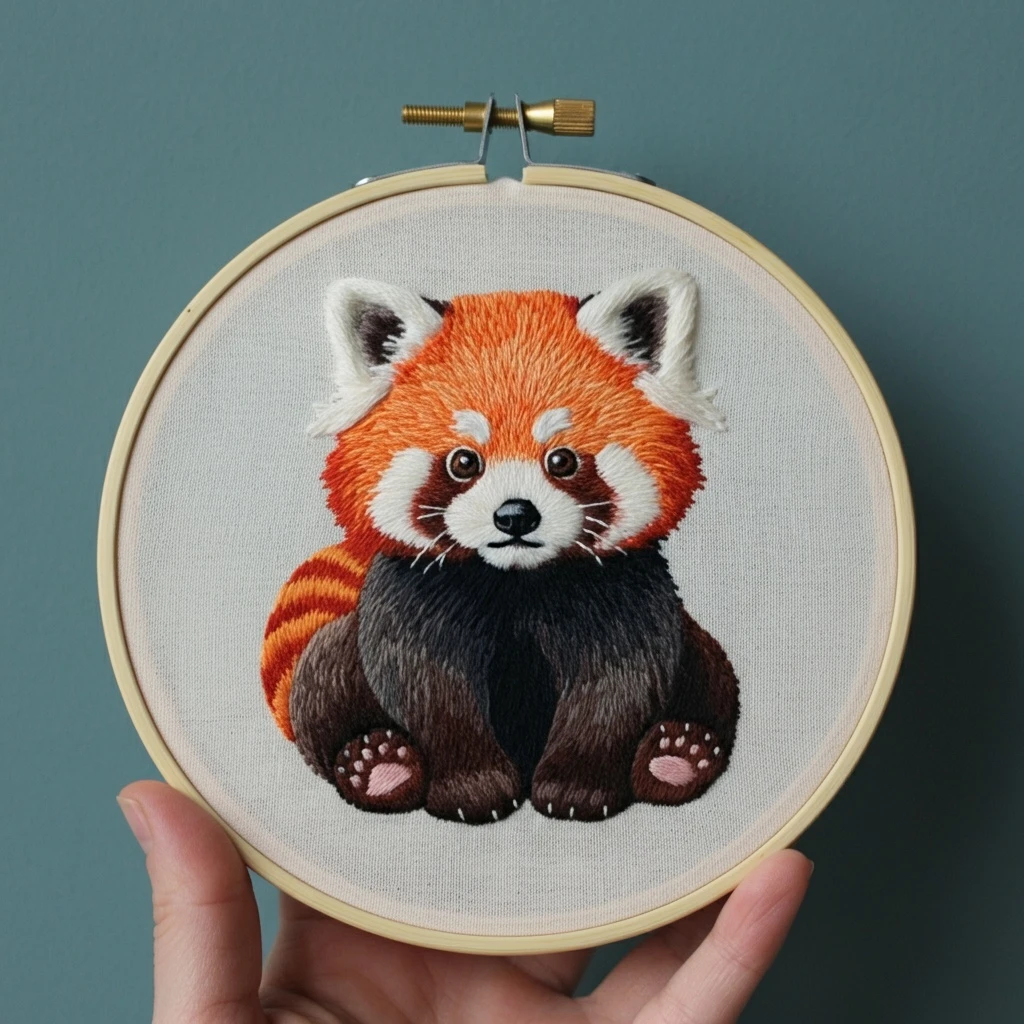
DMC palette & stitching suggestions
Adorable Red Panda Embroidery Art
A polished color and stitch guide for a charming red panda design: glowing russet fur, creamy facial mask, dark paws and ears, soft tail bands, and natural leafy accents stitched with warm woodland dimension.
Design Color Story
This red panda design is all about warm contrast: coppery orange-red fur against a pale cream muzzle and face markings, with deep brown-black ears, nose, eyes, and paws adding definition. The face should stay expressive and soft rather than heavily outlined. The tail can be treated as a small showcase area with alternating russet, honey, and dark cinnamon bands. Leaf or branch details should remain secondary, using mossy greens and small warm brown stems to frame the animal without competing with the fur.
Suggested DMC Floss Palette
Stitch Plan by Design Area
| Area | Recommended stitches | Thread count | Technique notes |
|---|---|---|---|
| Russet face and body fur | Long and short stitch, split stitch guide line, fine straight stitches | 1 strand for realistic fur; 2 strands only for broad base padding | Begin with 435 or 920 in the lighter fur zones, then feather in 921, 919, and touches of 918 where the form turns away from the light. Keep stitch direction radiating from the eyes and muzzle. |
| Cream facial mask and muzzle | Long and short stitch, satin stitch for tiny muzzle areas, seed stitch for fluff | 1 strand for fur texture; 2 strands for compact muzzle fill | Use 3865 at the brightest mask points, 739 for the main cream, and 738 or 841 along the lower muzzle and cheek edges for soft dimension. |
| Eyes, nose, mouth, and paws | Satin stitch, back stitch, split stitch, tiny French knots | 1 strand for lines; 2 strands for nose satin if larger | Work most dark areas in 3371 or 838 first. Add 310 only as a final pinpoint for pupils, nostrils, or sharp mouth corners so the expression remains gentle. |
| Ears and inner ear warmth | Long and short stitch, small satin stitches, directional straight stitches | 1 strand | Shade ear edges with 838 and 3371, warm the inside with 407, and blend back into 919 or 921 to keep the ears plush rather than flat. |
| Striped tail | Long and short stitch, curved satin stitch, split stitch bands | 1-2 strands depending on tail size | Curve each stitch with the tail shape. Alternate 435/920 bands with 921/919, then add small 918 or 838 shadows where bands overlap or tuck under the body. |
| Leaves, stems, and woodland accents | Fishbone stitch, lazy daisy, stem stitch, couching, French knots | 1-2 strands | Keep greenery lighter and more open than the animal. Use 471 as the main leaf tone, 472 for tips, 469 for bases, and 420 for twiggy structure. |
Blending, Outlining & Shading Guidance
Blending ideas
- Main fur blend: combine 920 and 921 for the classic red panda coat, then add 435 on lit edges and 919/918 in shadow.
- Cream mask blend: start with 739, soften with 738, and finish the brightest face markings with 3865.
- Dark paws and ears: blend 838 into 3371 before adding tiny touches of 310, which prevents harsh black patches.
- Tail bands: use a curved blend of 435, 920, 921, 919, and 918 so the tail looks rounded and fluffy.
- Leaf accents: stitch one side of each leaf in 472 and the opposite base in 469 for quick depth.
Outlining details
- Use one strand of 918 or 838 for soft split stitch outlines around the outer body and tail.
- Use 3371 for the nose, eye rims, and paw separation lines; use 310 only for the tiniest final dark accents.
- Do not outline the entire cream mask heavily. Let the color changes between 739, 920, and 921 define the facial pattern.
- Outline leaves selectively with 469 or 936, especially where they cross warm fur.
- For a storybook look, add a very fine back stitch around the tail tip and ear silhouette, but keep the cheeks fluffy and broken.
Practical Embroidery Tips
For the red panda
- Transfer the eyes, nose, muzzle, and face-mask boundaries very cleanly before beginning; these landmarks keep the animal recognizable.
- Stitch the cream mask before the surrounding orange fur so the russet stitches can feather gently into the pale sections.
- Use short, varied one-strand stitches near the face and slightly longer stitches on the body and tail.
- If the orange areas look too flat, scatter single stitches of 435 and 919 across the surface to create fur sparkle and shadow.
- Save the eye catchlights until the very end; one tiny 3865 or B5200 dot can change the entire expression.
For leaves and finishing
- Work stems first, then rear leaves, then front leaves or knots so the botanical details layer naturally.
- Keep foliage in 1 strand when it passes close to the face; use 2 strands only on larger leaves away from the focal point.
- Use a hoop with firm tension because long-and-short fur shading looks cleaner on taut fabric.
- Comb through thread lengths often and use shorter lengths for 918, 3371, and 310 to avoid fuzzy dark stitching.
- Press from the back on a towel after finishing to preserve any raised leaf stitches or French knots.
Recommended Stitching Formula
For the most polished red panda result, use 1 strand long-and-short stitch for fur, 2 strands only for bolder leaves or compact nose satin, and keep dark outlining delicate. The strongest palette is a layered russet family supported by warm cream facial markings and restrained charcoal details.
- Best red panda fur set: 435, 920, 921, 919, 918
- Best face-mask set: 3865, 739, 738, 841
- Best dark accent set: 838, 3371, very small touches of 310
- Best greenery set: 472, 471, 469, 936, 420