
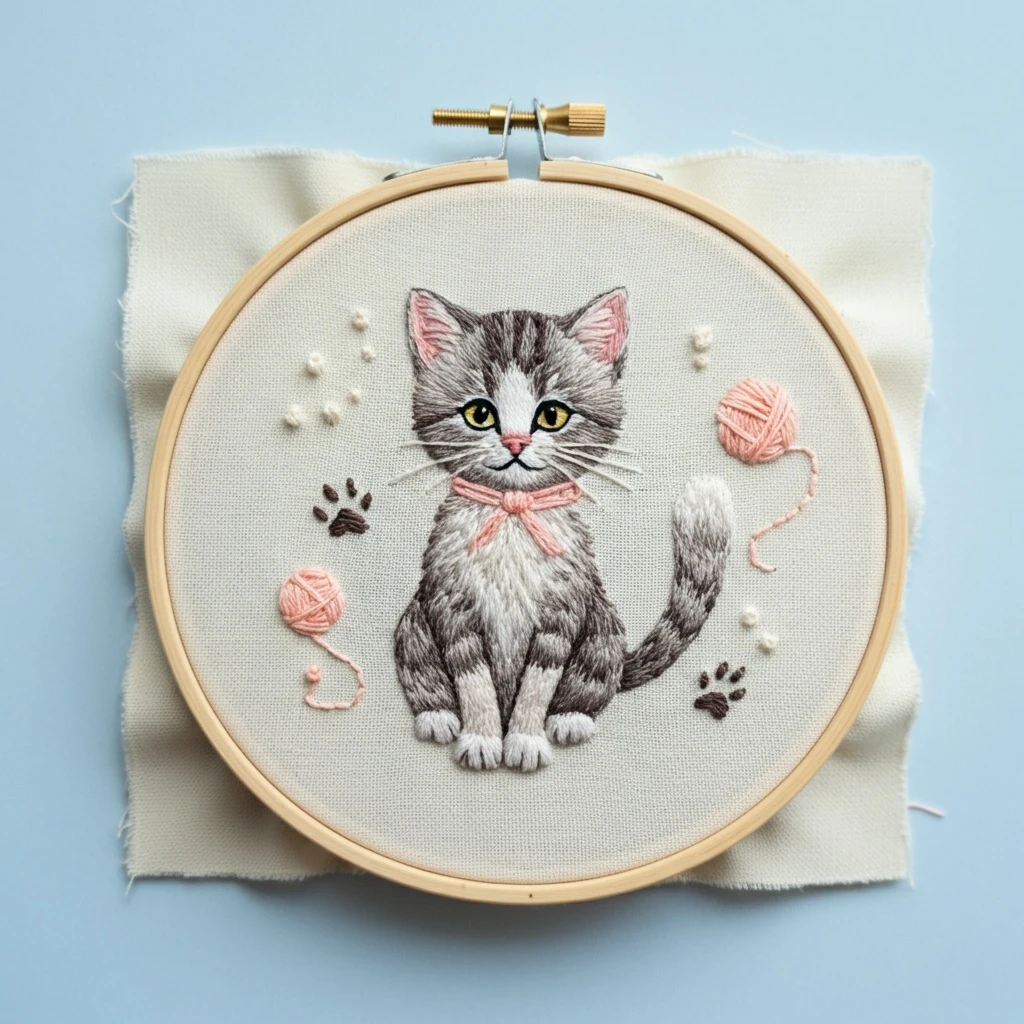
Adorable Tabby Kitten with Yarn
A soft, playful embroidery guide for a gray tabby kitten framed by blush yarn balls, tiny paw prints, cream French-knot accents, golden eyes, pink ears, and a matching bow. The recommendations below are tuned for dimensional fur, delicate whiskers, and rounded yarn texture.
Design reference: gray tabby kitten with pink bow, yarn balls, paw prints, and cream knot details.
Suggested DMC Color Palette
Design Element Breakdown
Kitten fur
Use directional long-and-short stitch in tiny, tapered strokes. Keep the forehead strokes vertical, cheek strokes radiating outward, chest strokes downward, and tail strokes following the curve.
Pink bow & yarn
Build the bow with satin stitch and split-stitch ribs. For yarn balls, use curved stem stitch or couching so the thread paths look wrapped rather than flat.
Paws, knots & extras
Dark paw prints work best in satin stitch with one strand of split stitch around each pad. Cream decorative dots can be plump French knots or colonial knots.
Stitch & Strand Plan
| Area | Recommended stitches | Strands | Color notes |
|---|---|---|---|
| Face and head fur | Long-and-short stitch, split stitch guide lines, tiny straight stitches | 1 strand for fur; 2 strands only for a few shadow anchors | Blend 3799 → 414 → 318 → 762. Keep strokes short around eyes and muzzle. |
| Body, chest, legs | Long-and-short stitch, staggered seed stitches for fluff | 1 strand | Use 3865 and 762 for chest; add 414 and 3799 in narrow vertical tabby marks. |
| Tail | Curved long-and-short stitch, split stitch stripe borders | 1 strand | Work around the tail curve. Alternate medium-gray blocks with dark crescent shadows. |
| Eyes | Satin stitch, tiny backstitch outline, single straight-stitch glint | 1–2 strands | Use 743 for iris, 310 for pupil, 3865 for catchlight. Add a fine black upper eyelid. |
| Ears and nose | Satin stitch, fishbone stitch, small straight stitches | 1 strand | Use 3713 and 761 for inner ears; add 352 sparingly in folds and nose underside. |
| Bow | Satin stitch, split stitch, backstitch, tiny French knot for center | 2 strands fill, 1 strand details | Use 761 as the main shade, 3713 on top edges, 352 along fold creases. |
| Yarn balls and trailing threads | Whipped stem stitch, couching, curved backstitch | 2–3 strands for balls; 1–2 strands for tails | Vary 3713, 761, and 352 to create wrapped arcs and soft shadows. |
| Paw prints | Satin stitch or padded satin, backstitch edges | 2 strands | 3371 gives a softer handmade look than pure black; add 310 only at deepest tips. |
| Cream decorative dots | French knots or colonial knots | 2 strands, one or two wraps | Use 3865 for bright dots; Ecru/822 for quieter background dots. |
| Whiskers | Single long straight stitches, couching if needed | 1 strand | Use 762 or 3865. Keep them loose and smooth; do not over-tighten long strands. |
Blending & Shading Guidance
Fur blending recipe
- Outline the kitten very lightly with one strand of 414 or 318 using tiny split stitches. Avoid heavy black lines around the whole body.
- Place the darkest tabby stripes first with 3799 and a few touches of 3371/310 at the deepest points.
- Fill around the stripes using 414, then feather 318 over the edges so the stripes look embedded in the fur.
- Add 762 and 3865 last on the muzzle, chest, paws, and tail tip with airy strokes that sit on top of the darker fur.
Soft pink dimension
For the bow and yarn balls, use 761 as the dominant pink. Add 3713 where light would catch the upper left curves and 352 in the lower curves, inner bow folds, and the yarn strand dips. To create a subtle blended thread, thread the needle with one strand 761 plus one strand 3713 for the bright yarn arcs, or one strand 761 plus one strand 352 for the underside arcs.
Outlining Details
Where to outline
- Use one strand of 3799 for the upper head silhouette, ear tips, and selected tail stripe edges.
- Use 3371 for paw prints and mouth details so they read warm and soft.
- Use 310 only for pupils, eye rims, and the tiniest mouth crease.
- Use 761 or 352 as a fine backstitch along bow folds and yarn tails.
Where to avoid outlining
- Avoid a continuous black outline around the kitten; it can flatten the fur.
- Do not outline every individual fur stroke. Let thread direction create the form.
- Keep whisker stitches unoutlined and slightly raised for a delicate finish.
- Let the ivory chest fade into the linen with broken, feathery edges.
Practical Embroidery Tips
Needles
Use a size 9–10 crewel needle for one-strand fur work and a size 7–8 needle for 2–3 strand yarn texture and knots.
Fabric tension
Hoop the linen drum-tight before stitching the long whiskers. Re-tighten before satin stitching the eyes and bow to keep edges crisp.
Layer order
Stitch background knots and paw prints after the kitten body, but finish whiskers near the very end so they remain clean and bright.
Yarn balls
Draw a few curved guide arcs inside each ball. Stitch in alternating directions so the ball looks wrapped, not filled in rows.
Eyes
Keep both pupils symmetrical and leave or add a tiny white highlight in the same position on each eye for a lively expression.
Fur realism
Use shorter stitches than you think you need. Dense, tiny one-strand strokes create a soft kitten texture without bulk.
Quick Working Sequence
- Transfer the design lightly; mark only main fur direction lines, stripe blocks, eyes, bow, yarn balls, paw prints, and knots.
- Stitch the kitten’s darkest stripe map first with 3799 and 3371, then fill fur from dark to light using one strand.
- Complete the eyes, nose, mouth, and inner ears while the face area is still easy to access.
- Work the chest, paws, and tail highlights with 762 and 3865, preserving soft broken edges.
- Stitch the bow in smooth satin and split stitches, then build yarn balls with curved wrapped stitches.
- Add paw prints, cream knots, yarn tails, and finally the whiskers with one long, confident strand.