
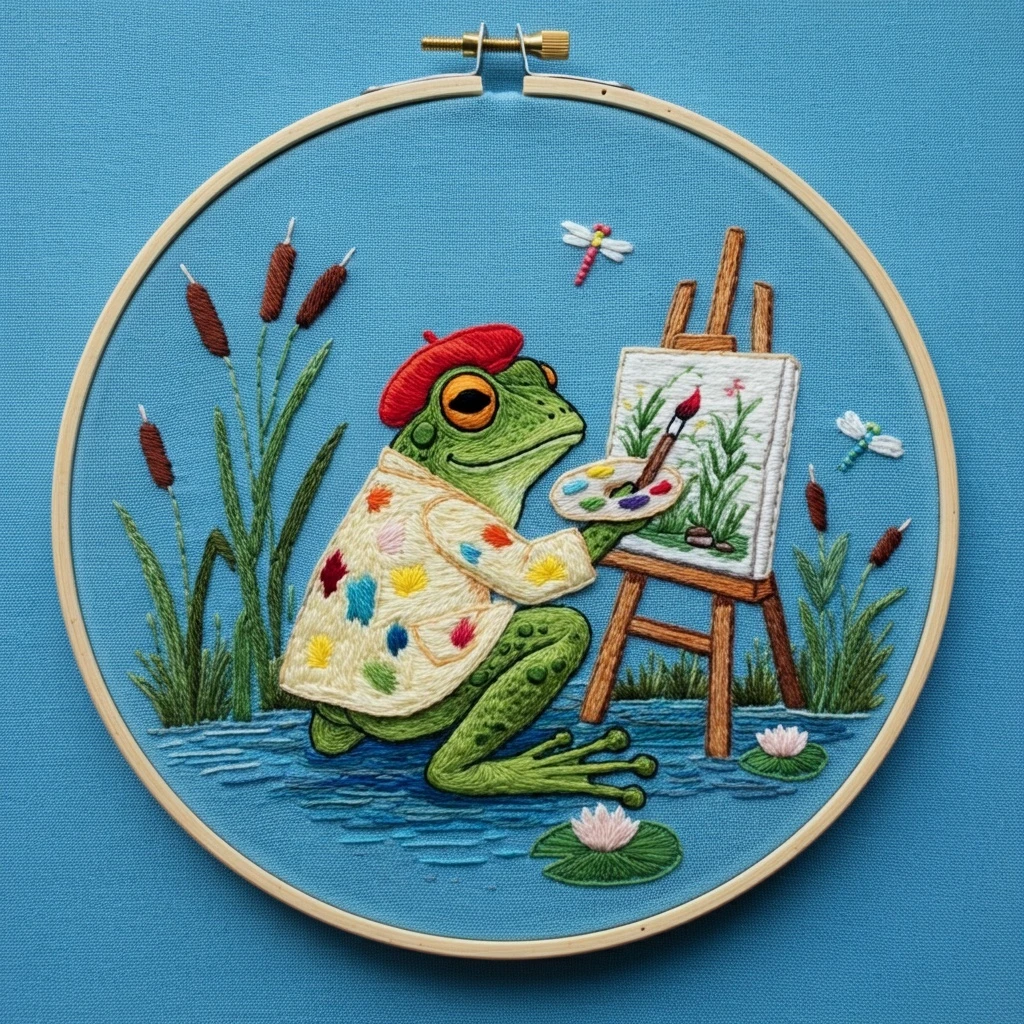
Artistic Frog Painting a Pond Scene
DMC palette and stitch-planning notes estimated from the visible embroidery preview: a cheerful green frog in a red beret and cream paint coat, seated in blue water among cattails, water lilies, dragonflies, reeds, and a miniature easel.
Likely DMC Color Palette
Palette matched from the reference image. Percentages are visual estimates of stitched color presence, not exact thread usage. The bright blue fabric supplies much of the sky background, so the floss palette focuses on the frog, pond, reeds, artist details, and decorative accents.
| Detected Color | DMC | Thread Name | Coverage | Where It Appears |
|---|---|---|---|---|
| #54A9C2 | 3845 / 3846 | Bright Turquoise Medium / Light | Fabric tone | Blue cloth background and small reflections. Use only for repairs, sky-colored gaps, or subtle water highlights if your fabric is less vivid. |
| #0F647B | 3765 / 3809 | Peacock Blue Very Dark / Turquoise Very Dark | 11% | Deep pond ripples under the frog, lower water edge, and shadowed horizontal water strokes. |
| #2F93AA | 3844 / 3843 | Bright Turquoise Dark / Electric Blue | 8% | Mid-blue water lines, highlights around lily pads, and tiny blue paint marks on the palette. |
| #31551D | 3347 / 904 | Yellow Green Medium / Parrot Green Very Dark | 12% | Deep frog shadows, lily pad outlines, reed bases, spots, toes, and contour lines. |
| #5F8734 | 3364 / 3052 | Pine Green / Green Gray Medium | 14% | Main frog body, legs, face planes, lily pads, and midtone reed leaves. |
| #8AA858 | 3053 / 907 | Green Gray / Parrot Green Light | 9% | Frog cheek highlights, belly transitions, lighter leg planes, and lifted edges of lily pads. |
| #CF171F | 321 / 666 | Red / Bright Red | 7% | Painter's beret, red paint daubs, paintbrush tip, and a few flower/dragonfly details. |
| #871728 | 816 / 815 | Garnet / Garnet Medium | 3% | Beret shadow folds, dark red paint spot, brush tip depth, and shaded flower centers. |
| #EFE7C7 | 746 / 712 | Off White / Cream | 13% | Artist coat, canvas surface, pale easel highlights, and light areas of the palette. |
| #D4C59B | 738 / 739 | Tan Very Light / Tan Ultra Very Light | 6% | Coat shadows, canvas edge, hoop-colored warmth, and soft folds in the painter's jacket. |
| #B76B36 | 433 / 434 / 435 | Brown Medium to Very Light | 9% | Easel legs, brush handle, cattail stems, canvas frame, and warm wooden details. |
| #6B2C1B | 938 / 898 / 919 | Coffee Brown Ultra Dark / Terra Cotta Red Copper | 5% | Cattail heads, easel shadows, brush detail, frog eye pupil shadows, and darkest warm outlines. |
| #F1B9C8 | 818 / 819 / 776 | Baby Pink / Light Pink | 4% | Water lily petals, soft paint smudges on the coat, and tiny floral accents on the painted canvas. |
| #F1C72D | 444 / 307 / 742 | Lemon Dark / Lemon / Tangerine Light | 3% | Yellow paint dabs, lily centers, frog eye ring, and cheerful accents on the palette and coat. |
| #FFFFFF | Blanc / 3865 / 3756 | White / Winter White / Baby Blue Ultra Very Light | 4% | Dragonfly wings, bright canvas highlights, eye glints, water sparkles, and final crisp accents. |
| #4B2A7F | 550 / 552 | Violet Very Dark / Violet Medium | Accent | Purple paint spot on the palette and tiny contrast accents in the paint blobs. |
Stitching Suggestions
This design benefits from painterly texture: smooth frog shading, raised beret and cattail forms, airy reed strokes, rippled water lines, and tiny bright accents that make the art-studio details readable.
| Element | Stitch Type | Thread Count | Notes |
|---|---|---|---|
| Frog face and body | Long and short stitch over split-stitch guide lines | 2 strands fill, 1 strand contours | Shade from 3347/904 in the deepest edges to 3364/3052 midtones and 3053/907 on the cheek, belly, knees, and toe tips. |
| Frog spots and bumps | French knots, padded satin dots, or tiny seed stitches | 1-2 strands | Use darker green knots for raised skin texture. Add a lighter half-stitch on the upper side of a few bumps for dimension. |
| Red beret | Padded satin stitch with stem-stitch fold lines | 2 strands satin, 1 strand fold detail | Pad lightly first, then cover with curved satin stitches. Work 321/666 on the crown and 816/815 under folds and around the lower rim. |
| Painter's coat | Long and short stitch, split stitch, and small straight paint marks | 2 strands coat, 1-2 strands paint dabs | Keep the coat creamy with 746/712, then shadow seams with 738/739. Add paint spots last so they sit on top of the coat. |
| Paint palette and brush | Satin stitch, backstitch, French knots | 1 strand details, 2 strands broad shapes | Use rounded satin blobs for paint colors. Outline palette holes and brush handle with a sharp one-strand brown backstitch. |
| Easel and canvas | Stem stitch, split stitch, satin stitch, laid fill | 2 strands wood, 1 strand canvas details | Stitch wood grain in 433/434 with 938 shadows on the right side of legs. Keep the canvas pale and lightly textured, not overfilled. |
| Reeds and cattails | Fishbone stitch, stem stitch, satin stitch cattails | 1 strand leaves, 2 strands cattails | Use long tapered leaves in mixed greens. Work cattails as small padded satin ovals, darker on one side for roundness. |
| Pond water | Horizontal straight stitch, running stitch, stem stitch ripples | 1 strand for ripples, 2 strands for dark water bands | Layer deep blue-green ripples first, then add lighter turquoise and white highlights sparingly. Leave fabric visible between lines. |
| Water lilies and pads | Fishbone leaves, satin petals, French knot centers | 1-2 strands | Outline lily pads in dark green, fill with directional fishbone, and use pale pink satin petals with yellow knots in the centers. |
| Dragonflies | Detached chain wings, straight stitch bodies, tiny knots | 1 strand only | Keep these delicate. Use Blanc/3756 for wings, red or turquoise bodies, and a single knot for the head so they do not overpower the frog. |
Blending & Shading Guidance
Frog Green Blend
- Deep contour: 3347 or 904 along the throat, underside of the legs, toes, and spots.
- Main body: 3364 blended into 3052 for the frog's face, back, and legs.
- Highlights: 3053/907 on the cheek, upper eye ridge, belly edge, knees, and toe pads.
- For smooth transitions, blend one strand 3364 + one strand 3053 in the broad cheek and belly zones.
Water & Sky Relationship
- Let the blue ground fabric act as open sky and negative space around the hoop.
- Use 3765/3809 only where the frog casts shadow into the water.
- Add 3844/3843 as short broken ripples, not solid fill.
- Finish with a few one-strand Blanc/3756 sparkle strokes near lily pads and toes.
Warm Artist Details
- Use 321/666 for the beret's lit plane, with 816/815 tucked under folds.
- Blend 433 + 434 for the easel and brush handle; add 938 only where pieces overlap.
- For the cream coat, use 746/712 as the base and 738/739 for pockets, cuffs, and lower folds.
- Add paint daubs after the coat is finished so each color remains clear and crisp.
Miniature Canvas Scene
- Work the canvas with very light single-strand strokes to avoid bulk.
- Use tiny green straight stitches for reeds and single French knots for flowers.
- A few pale blue and white horizontal lines suggest water without crowding the small area.
- Outline the canvas edge in 738/739, then add the wood frame in 433/434.
Outlining Details
The preview uses many small story elements, so outlines should be fine and selective. Use darker lines to clarify shapes, but keep most edges soft enough to preserve the painterly look.
- Use 1 strand of 3347/904 around the frog's jaw, belly fold, spots, knees, and toes. Avoid heavy black outlines; dark green keeps the frog natural.
- Use 938 or 898 for the frog's smile, eye pupils, brush handle edge, cattail shadows, and easel overlaps.
- Use 738/739 for subtle coat seams and canvas edges where a brown outline would feel too strong.
- Use 3765/3809 under the frog and lily pads to anchor them in the pond water.
- Use Blanc/3756 sparingly for dragonfly wings, eye glints, paint shine, and final water sparkles.
Where to Start
Begin with the frog's face and body so the personality is established early. Stitch the red beret next, then the cream coat and palette. Add the easel/canvas, reeds, cattails, lily pads, and water ripples around the figure. Save dragonflies, paint daubs, French knots, eye glints, and white highlights for the final pass.
Practical Embroidery Tips
Fabric & Transfer
- A medium sky-blue cotton or linen gives the design its cheerful open background.
- Use a transfer method that remains visible on blue fabric, such as white transfer paper or a water-soluble light marker.
- Mark the hoop circle, frog eye line, canvas rectangle, and waterline first to keep the composition balanced.
Thread Management
- Use 2 strands for major fills and 1 strand for facial detail, reeds, dragonflies, canvas painting, and water ripples.
- Use shorter lengths for red and dark brown floss to prevent fuzzy edges around the beret and cattails.
- Keep carry threads away from the pale coat and canvas so dark colors do not shadow through.
Texture & Dimension
- Pad the beret and cattails lightly to make them look plush and rounded.
- Use French knots for frog bumps, flower centers, and thick paint blobs on the coat.
- Keep the water mostly line-based; too much solid fill can flatten the pond and hide the fabric color.
Finishing
- Steam from the back into a towel so padded stitches, knots, and raised cattails are not crushed.
- Trim and secure small accent threads carefully, especially on dragonflies and paint spots.
- A natural wood hoop suits the easel tones and keeps the playful pond scene warm and handmade.
Encouraging Finish
This frog design will feel most polished when the textures are varied: smooth shaded greens for the frog, plush red satin for the beret, broken horizontal lines for water, crisp warm wood for the easel, and tiny knots for paint, flowers, and frog skin. Work in layers, keep the mini details single-stranded, and let the bright blue fabric show through as part of the design.
Image colors were estimated from the supplied preview and matched to close DMC equivalents. Always compare floss under your actual lighting before stitching the final version.