
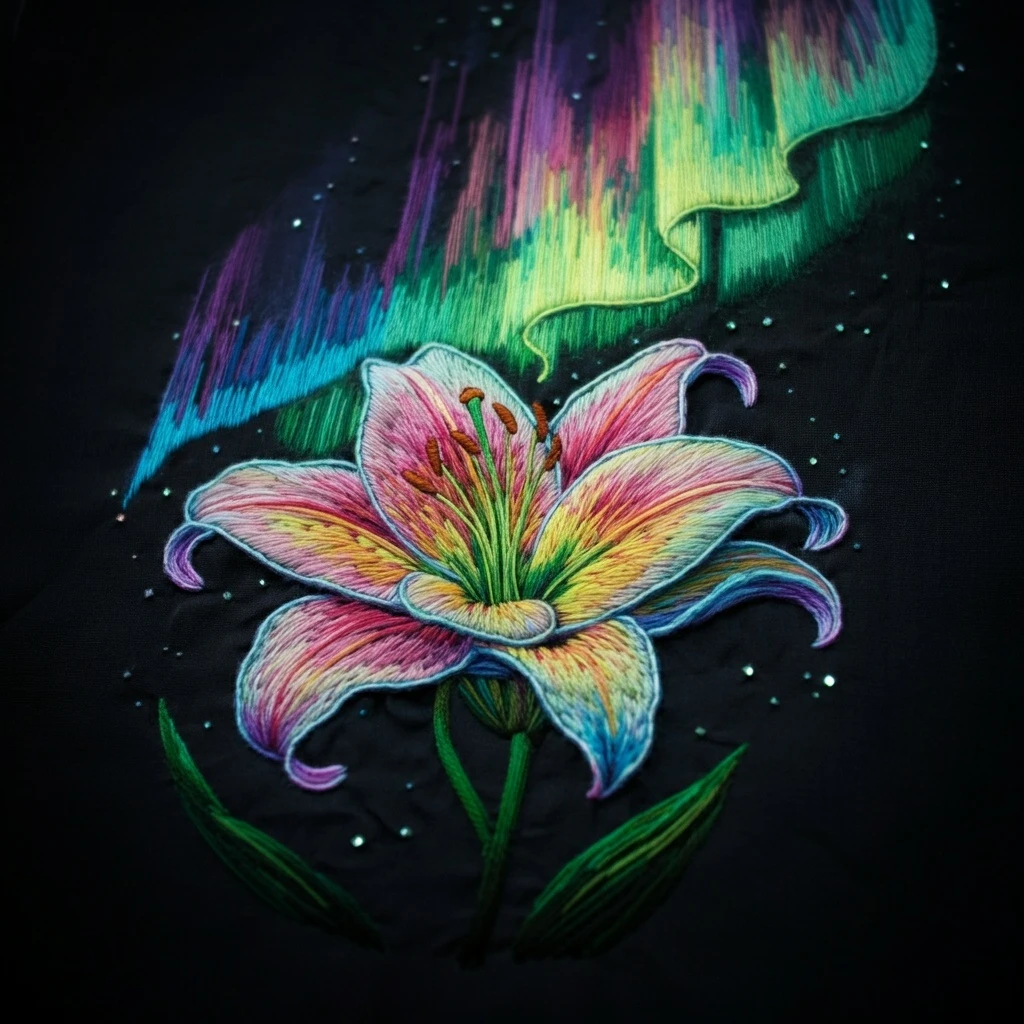
Aurora Lily Vibrant Night Bloom
A dramatic embroidery plan for a glowing lily beneath northern-light curtains: black ground fabric, luminous teal and green sky ribbons, rose-pink petals washed with yellow light, violet curled tips, bright stamens, and deep emerald leaves. The finished effect should feel painterly, electric, and dimensional.
Design Read
This artwork relies on high contrast and long directional color transitions. The black fabric acts as the night sky, while the lily and aurora are built with layered, streak-like stitches that mimic colored light.
Radiant lily petals
The petals combine pale pink, rose, coral, lemon yellow, teal shadows, and violet curled tips. Use long-and-short stitching from petal base to rim so every petal looks veined and glowing.
Aurora backdrop
The sky has vertical green, mint, aqua, blue, and magenta light streaks. Keep the stitches uneven and slightly transparent so the background remains dark and atmospheric.
Botanical structure
The central stamens, dark stems, and narrow leaves anchor the composition. Use crisp outlines and stronger thread counts here to contrast with the softer blended petals.
Core DMC Color Palette
These DMC cotton floss colors match the dominant visual families: night black, aurora teal/green, lily pinks, yellow glow, violet edges, and deep leaf greens.
Stitch Map by Design Area
| Area | Recommended stitches | Thread count | How to work it |
|---|---|---|---|
| Lily petals | Long-and-short stitch, split stitch guide lines, tiny satin strokes | 1 strand for shading; 2 strands for main fill | Work from the throat outward, following each petal’s curve. Blend pale pink into rose, then layer yellow and aqua highlights as separate directional streaks. |
| Petal veins | Fine stem stitch, split stitch, straight stitch | 1 strand | Use 3806, 3685, 3078, and occasional 3846. Keep veins tapered and broken instead of drawing hard continuous lines. |
| Curled petal tips | Satin stitch, whipped backstitch, couching on tight curves | 1–2 strands | Outline the turned rims with 333 or 340, then add a fine 3846 or 3849 highlight along the outermost edge for the neon effect. |
| Flower throat | Radiating straight stitches, long-and-short stitch, tiny seed stitches | 2 strands; 1 strand for overlay | Build the center with 913, 955, and 3078. Add darker 699 at the deepest base to make the stamens stand forward. |
| Stamens and anthers | Stem stitch, satin stitch, French knots, padded satin | 1 strand stems; 2 strands anthers | Use 699/913 for filaments and 976 with a touch of 3826 or 947 for pollen tips. Small padded satin makes the anthers raised. |
| Aurora curtains | Long vertical stitches, long-and-short stitch, couching for the sweeping lower edge | 1 strand for distant streaks; 2 strands for bright bands | Start with 3808 and 333 shadows, then layer 3846, 3849, 955, and 913 in uneven vertical falls. Do not fully fill the black fabric. |
| Stars and specks | French knots, tiny straight stitches, seed stitch | 1 strand | Use B5200, 747, 3849, and very sparse 955. Place most dots away from the flower so they do not compete with the bloom. |
| Leaves and stems | Fishbone stitch, stem stitch, split stitch, long straight stitches | 2 strands for leaves; 1 strand for veins | Use 699 and 500/890 for shadow, then add 913 and 955 highlights on the upper leaf edges facing the aurora. |
Blending & Shading Plan
The design should look embroidered like colored light. Use gradual changes, but leave small dark gaps between some stitches to preserve the night-bloom atmosphere.
Petal blends
- Soft pink base: 963 into 3716 for pale petal body.
- Rose depth: 3716 into 3806, then 3685 only in lower folds.
- Golden center: 3078 radiating from the throat into the petals.
- Cool rim light: 3849 or 3846 along outer edges and curled tips.
- Violet shadow: 340 into 333 on the turned petal points.
Aurora blends
- Teal base: 3808 with 3846 for saturated blue-green sections.
- Mint glow: 3849 into 955 for the brightest curtain edge.
- Green body: 913 layered below 955 for natural movement.
- Magenta/violet light: 3685, 340, and 333 in thin vertical accents.
- Dark control: leave some black fabric exposed between light streaks.
Outlining, Texture & Finishing Details
Petal outlines
Use split stitch in 3849 for highlighted edges and 333 or 939 only for the deepest underside curves. Avoid outlining every petal in black; the glow should define the form.
Raised center
Add slight padding under the anthers with small straight stitches, then cover with satin in 976. A final French knot can create a pollen-dot finish.
Leaf texture
Work leaves with a central split-stitch vein, then angle fishbone stitches outward. Add fine 955 highlights only on the aurora-facing ridges.
Aurora edge
Couch a sweeping line of 955 or 3849 along the lower wave of the aurora, then break it with vertical fall stitches so it feels like moving light.
Star field
Use uneven spacing and mixed dot sizes. Keep the brightest star knots around the open sky, not directly over the lily petals.
Black fabric care
Transfer with a fine white water-soluble pencil or chalk marker. Test removal first, and avoid heavy hoop marks by wrapping the inner hoop.
Practical Embroidery Tips
Order of stitching
- Mark only the main petal edges, stamens, aurora sweep, and leaf stems.
- Stitch the aurora first so its long strokes can sit behind the flower.
- Fill the leaves and stems next to establish the plant structure.
- Work petals from back petals to front petals, following each petal’s grain.
- Add petal rim highlights, stamens, stars, and metallic accents last.
Tension & strand notes
- Use 1 strand for most gradients; switch to 2 strands only where stronger coverage is needed.
- Keep long stitches slightly relaxed on dark fabric to prevent puckering.
- Shorten stitches around curled tips so curves stay smooth.
- Use a laying tool or needle tip to keep satin stitches parallel on the petal rims.
- Brush away lint often; bright floss on black fabric shows stray fibers easily.