
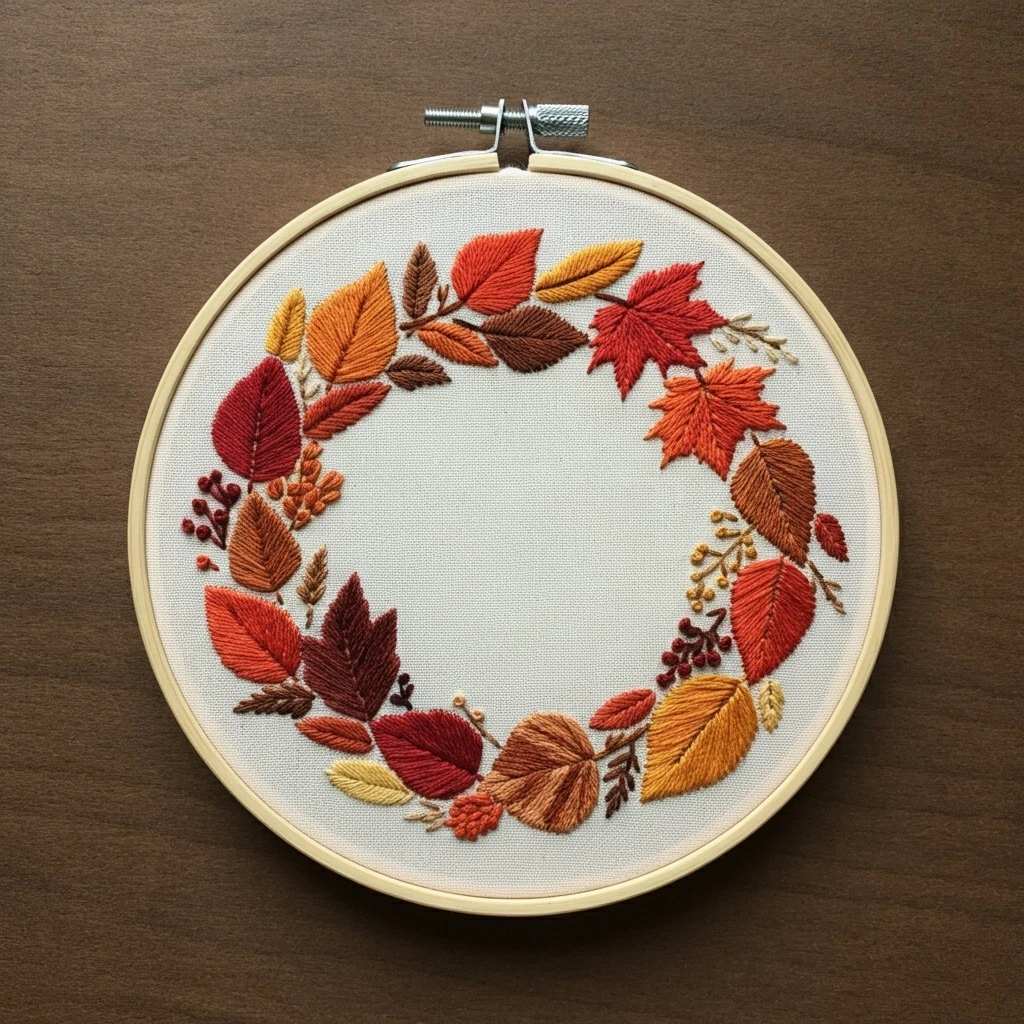
DMC palette & hand embroidery notes
Autumn Wreath
A warm, polished guide for stitching a circular autumn wreath with layered maple-style leaves, wheat-gold accents, berry dots, curled stems, and a balanced seasonal rhythm. The palette uses russet orange, pumpkin copper, golden straw, warm walnut, faded olive, and cranberry red to keep the wreath rich but still graceful on linen.
Design read
This design is built around a wreath silhouette, so the most important visual goal is movement. Keep stems and tendrils turning in one direction, then let leaf clusters overlap lightly so the hoop feels full without becoming crowded.
Use the strongest copper and rust shades for the largest leaves, place golden tones on outer tips and upper curves, and reserve berry reds for small punctuation marks. Olive and brown threads should support the shape quietly rather than dominate the wreath.
Suggested DMC palette
Use these flosses as a practical autumn-wreath palette. The notes explain where each color works best in the leaves, stems, berries, and fine finishing details.
Stitch map
| Area | Recommended stitches | Working notes |
|---|---|---|
| Wreath stems | Stem stitch, split stitch, couching | Use 2 strands for the main ring. Follow the curve smoothly and break long stems into short arcs so the circle stays even. |
| Maple-style leaves | Fishbone stitch, satin stitch, long-and-short stitch | Fill from the center vein outward. Blend 921, 922, 918, 920, and 783 for pointed leaves with natural color variation. |
| Small oval leaves | Detached chain, fly stitch, lazy daisy | Use 1 or 2 strands depending on size. Olive leaves in 3051 and 3012 give the warm palette a calmer base. |
| Berries | French knots, colonial knots, padded satin dots | Work berries in 815 and 816 with 2 strands. Add one tiny 739 stitch to selected dots for shine. |
| Wheat and seed sprigs | Straight stitch, fly stitch, seed stitch | Use 783 and 3820. Keep sprigs airy so they frame the wreath rather than filling every gap. |
| Leaf veins and tendrils | Back stitch, straight stitch, whipped back stitch | Use 1 strand for refined detail. Darker veins should be short and selective, especially on small leaves. |
Thread-count guidance
- Main circular stems: 2 strands in 801 or 975 for a clear wreath structure.
- Large leaves: 2 strands for satin, fishbone, or long-and-short fills; use shorter stitches near pointed tips.
- Small leaves and sprigs: 1 strand for fine stems and 2 strands for little detached-chain leaves.
- Berries: 2 strands for French knots; wrap twice for small berries and three times for larger focal dots.
- Highlights and veins: 1 strand keeps the finishing details crisp and prevents the wreath from looking heavy.
- Fabric choice: oatmeal linen, cream cotton, warm beige, or pale flax will make the copper and cranberry shades glow.
Blending ideas
- Blend one strand 921 with one strand 783 for glowing orange-gold leaf fills.
- Blend one strand 918 with one strand 920 for deep russet leaf bases.
- Blend 975 with 801 for soft brown stems that are visible but not harsh.
- Blend 3012 with 3820 for faded sage-gold leaves around the outer wreath.
Outlining details
- Use broken outlines on leaves rather than tracing every edge continuously.
- Choose 918 for warm leaf outlines and 801 for stems; avoid black, which can flatten the autumn softness.
- Back stitch the central vein first on large leaves, then fill toward the outer points.
- Add tiny 938 stitches only where stems tuck under leaves or berries overlap.
Texture suggestions
- Alternate fishbone leaves with lazy-daisy leaves for a hand-gathered wreath look.
- Use French knots in clusters of three to make berries feel natural.
- Add seed stitches between larger leaves to suggest tiny dried flowers.
- Leave small fabric gaps between elements so the circular form stays elegant and breathable.
Shading plan & practical stitching tips
| Step | What to do | Why it helps |
|---|---|---|
| 1. Establish the circle | Stitch the main stem ring in 975 and 801, following the curve with small, even stem stitches. | A clean circular base keeps the wreath balanced before decorative elements are added. |
| 2. Place the largest leaves | Add the biggest copper and russet leaves at three or four balanced points around the wreath. | Repeating focal leaves around the circle creates rhythm and prevents one area from feeling too heavy. |
| 3. Build midtone foliage | Fill in with 921, 922, 920, 783, 3051, and 3012, alternating warm and muted leaves. | Color variety gives the wreath depth while the muted greens calm the brighter oranges. |
| 4. Add berries and seeds | Work French knots in 815 and 816, then add small wheat stitches in 783 and 3820. | Small round and linear textures make the wreath feel abundant and handmade. |
| 5. Finish with highlights | Add 739 and 3820 sparingly on leaf tips, berry tops, and wheat ends; then refine a few veins with 1 strand. | Final light stitches make the design polished without overfilling the open spaces. |