
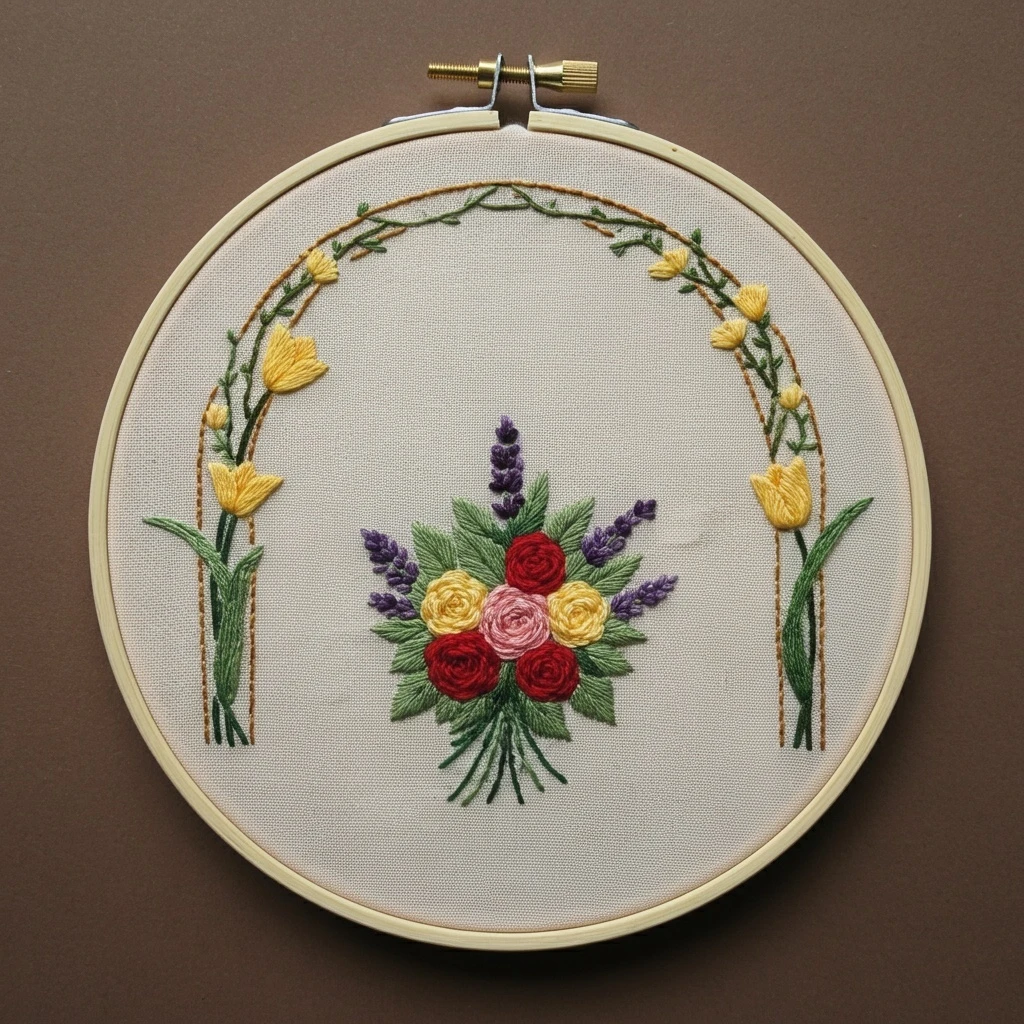
DMC palette & hand embroidery notes
Autumnal Floral Mandala
A polished stitching guide for a symmetrical hoop-art mandala filled with warm autumn flowers, layered leaves, berry dots, curling stems, and ornamental petal repeats.
Color story
This design reads as a decorative autumn mandala: a balanced center flower, repeating petal forms, leafy flourishes, and small berry-like dots. The palette should feel warm and botanical, with golden yellows for lift, pumpkin and copper for the main flower bodies, burgundy for depth, moss greens for leaves, and dark bark brown for crisp ornamental structure.
Bright petal tips, small highlight stitches, and sunlit dots around the mandala ring.
Main golden-orange flower areas and transitions between yellow and pumpkin tones.
Pumpkin petals, leaf lobes, and warm focal accents in the outer mandala.
Copper shadows on petals and maple-like leaves; excellent for autumn depth.
Deep flower bases, berry centers, and rich shadow stitches under overlapping motifs.
Burgundy seed dots, dramatic petal centers, and tiny contrast knots.
Sunlit leaf veins, small filler leaves, and soft green breaks among orange motifs.
Leaf undersides, darker stems, and grounding stitches beside warm flowers.
Curving stems, tendrils, and muted brown-orange details in the wreath structure.
Clean outlines, central guide marks, fine branchwork, and selected negative-space edges.
Soft neutral highlights, pale seed heads, and subtle shading on tan petals.
Tiny sparkle stitches, flower-eye highlights, and spacing accents on dark fabric areas.
Stitch map by design element
| Design area | Suggested stitches | Thread count | Practical notes |
|---|---|---|---|
| Central flower and inner petals | Satin stitch, long-and-short stitch, split stitch outline | 2 strands for fill, 1 strand for outline | Work opposite petals in the same order to preserve symmetry. Angle satin stitches from petal base to tip. |
| Outer floral repeats | Fishbone stitch, detached chain, padded satin | 2 strands; 3 strands only for bold raised petals | Alternate 741 and 721, then add 742 at petal tips for a warm glow. |
| Autumn leaves | Fishbone stitch, fly stitch, straight stitch veins | 2 strands for leaves, 1 strand for veins | Use 734 on upper leaf veins and 3011 near the base to keep foliage dimensional. |
| Curving stems and mandala scrolls | Stem stitch, whipped back stitch, couching | 1-2 strands depending on curve thickness | Use shorter stitches around curves; long stitches can flatten the ornamental rhythm. |
| Berries, seeds, and dot accents | French knots, colonial knots, seed stitch | 2 strands wrapped once or twice | Cluster 902 and 3777 near warm leaves; add occasional 746 dots for highlight. |
| Fine outlines and final definition | Back stitch, split back stitch, tiny straight stitches | 1 strand | Outline only key edges. Too much dark outline can make the mandala look rigid. |
Blending, shading & texture suggestions
Warm petal blends
- Blend 742 + 741 for light golden petal tips.
- Blend 741 + 721 for the main orange body of large petals.
- Blend 721 + 920 at petal bases and where shapes overlap.
- Place a few single-strand 3777 stitches under petals for a natural terracotta shadow.
Leaf and stem depth
- Use 734 for fresh olive highlights on leaf centers.
- Use 3011 on the lower half of leaves and under curled tips.
- Stem stitch in 975, then add a single-strand 898 line on one side for definition.
- For a softer look, replace dark outlines on leaves with 3011 instead of 898.
Beginner-friendly stitching sequence
Hoop, fabric & thread-count guidance
Recommended setup
- Fabric: natural linen, cotton-linen blend, or tightly woven cotton in cream, oatmeal, or warm beige.
- Needle: size 7 embroidery needle for 2 strands; size 8 or 9 for fine 1-strand outlines.
- Hoop tension: keep the fabric drum tight so satin petals stay smooth and the mandala circle does not distort.
Thread-count rules
- 1 strand: outlines, veins, delicate scrollwork, inner details.
- 2 strands: most petals, leaves, stems, and visible decorative lines.
- 3 strands: only for raised focal accents, chunky knots, or very bold outer petals.
Extra practical tips
Keep the mandala crisp
- Use shorter satin stitches on curved petals to avoid gaps.
- Rotate the hoop often so your stitch angle follows the petal shape.
- Trim thread tails closely on the back so pale highlights stay clean.
Make it richer
- Add a few couching stitches in 975 along long stems for a vine-like texture.
- Scatter 742 seed stitches between motifs to suggest pollen or golden dust.
- Use 902 knots only at repeating points so the burgundy accents feel intentional.