
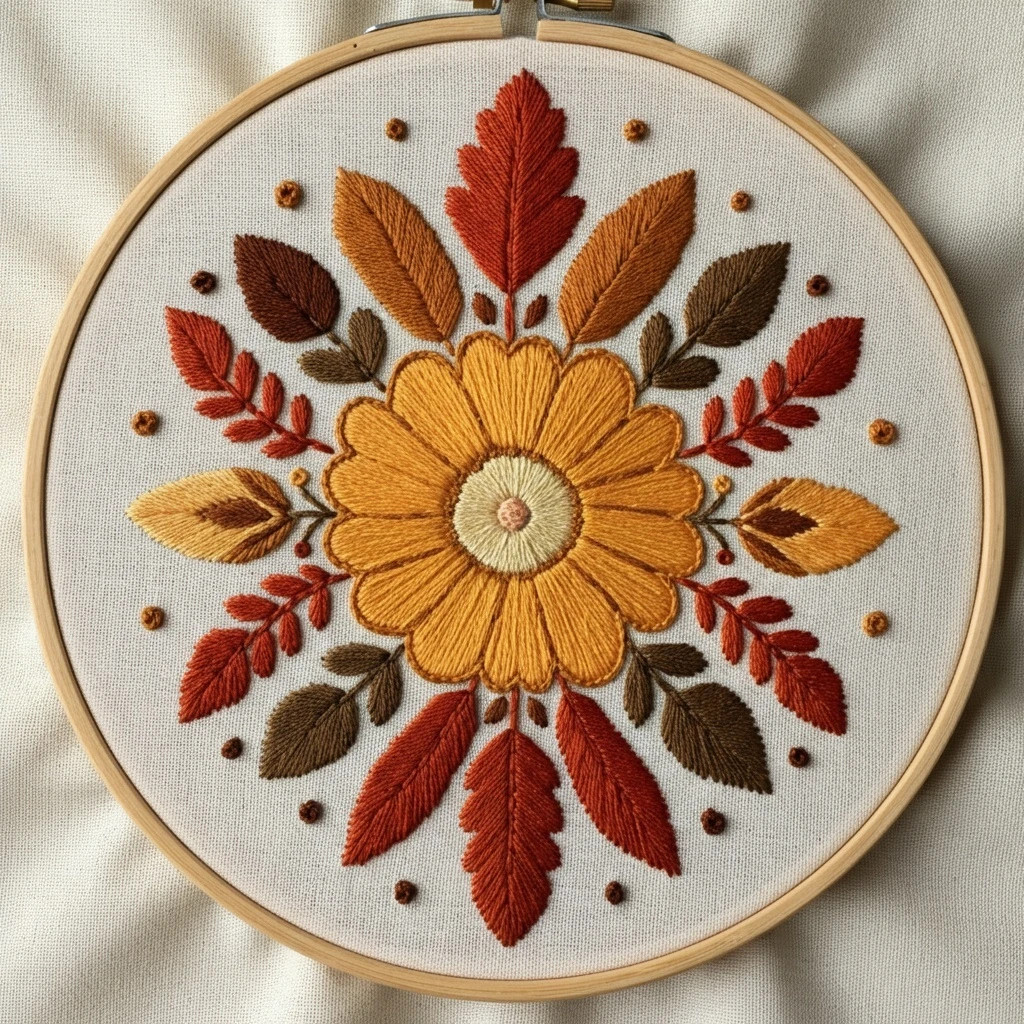
DMC palette & hand embroidery notes
Autumnal Mandala
A polished stitching guide for a balanced hoop-art mandala with warm autumn petals, leafy points, seed-like dots, curling stems, and ornamental repeats arranged around a calm center.
Color story
This design reads as an autumn mandala rather than a natural bouquet: the colors need to repeat in a deliberate rhythm. Use pumpkin orange and golden yellow as the visual heartbeat, terra cotta and burgundy for depth, olive greens for leafy contrast, and dark coffee brown for the delicate ornamental framework.
Bright tips on petals, small sparkle stitches, and highlight dots around the circular repeats.
Primary golden-orange fill for petals, teardrops, and sunny central details.
Pumpkin leaf lobes, larger mandala shapes, and stronger warm mid-tones.
Copper shading near petal bases, curled leaf edges, and autumn shadow transitions.
Deep petal bases, inside curves, and warm shadow stitches under overlapping motifs.
Burgundy seed dots, tiny flower centers, and restrained accent knots for contrast.
Main leaf fills and balanced green touches between the orange motifs.
Sunlit leaf veins, small sprigs, and soft highlights on green sections.
Leaf undersides, darker stems, and shadowed spaces behind bright petals.
Curving stems, tendrils, and muted brown-orange linework around the mandala.
Fine outlines, center anchors, and crisp detail only where definition is needed.
Tiny highlight stitches, pale seed glints, and breathing space in dense warm areas.
Stitch map by design element
| Design area | Suggested stitches | Thread count | Practical notes |
|---|---|---|---|
| Center medallion | Satin stitch, woven wheel, split stitch outline | 2 strands for fill, 1 strand for outline | Start in the center so every outer repeat can be measured against a clean focal point. |
| Large petal and teardrop repeats | Long-and-short stitch, satin stitch, padded satin | 2 strands; 3 strands only for raised focal petals | Angle stitches toward the center for a radial flow. Keep matching petals stitched in the same direction. |
| Leaf points and botanical sprigs | Fishbone stitch, fly stitch, straight stitch veins | 2 strands for leaf bodies, 1 strand for veins | Use 733 or 734 first, then add 3011 near bases or lower edges for depth. |
| Curving stems and scroll lines | Stem stitch, whipped back stitch, couching | 1-2 strands depending on line weight | Shorten stitches around tight curves to keep the circular layout smooth. |
| Dots, berries, and seed accents | French knots, colonial knots, seed stitch | 2 strands with one or two wraps | Repeat knot sizes consistently around the circle; use 902 for emphasis and 742 for warmth. |
| Final definition | Back stitch, split back stitch, tiny straight stitch | 1 strand | Outline selectively. Too much dark thread can overpower the soft autumn rhythm. |
Blending, shading & texture suggestions
Warm mandala blends
- Blend 742 + 741 for glowing petal tips and tiny golden highlights.
- Blend 741 + 721 for the main pumpkin-orange sections.
- Blend 721 + 920 where petals tuck behind leaves or overlap the center.
- Add single-strand 3777 at the base of large shapes for subtle terra-cotta depth.
Green and brown structure
- Use 733 for most leaves so the design does not become too dark.
- Add 734 along upper leaf veins for light and lift.
- Reserve 3011 for underside shadows and deeper inner curves.
- Work stems in 975, then add a thin 898 edge only on important focal lines.
Beginner-friendly stitching sequence
Hoop, fabric & thread-count guidance
Recommended setup
- Fabric: cream linen, cotton-linen blend, or tightly woven cotton in oatmeal, ivory, or warm beige.
- Needle: size 7 embroidery needle for 2 strands; size 8 or 9 for fine 1-strand outlines and veins.
- Hoop tension: keep fabric drum tight so satin stitches stay smooth and circular motifs do not distort.
Thread-count rules
- 1 strand: outlines, veins, center marks, tiny scrolls, and delicate details.
- 2 strands: most petals, leaves, seed knots, and visible decorative lines.
- 3 strands: use sparingly for padded focal petals, chunky knots, or bold outer accents.
Extra practical tips
Keep the circle balanced
- Mark the vertical and horizontal center lines lightly before stitching.
- Use the same number of stitches on matching petals whenever possible.
- Rotate the hoop instead of twisting your wrist; this keeps radial stitch angles clean.
Add handmade texture
- Use a few seed stitches in 742 between warm shapes for golden speckles.
- Whip selected stem stitches with 975 to create a raised vine effect.
- Place off-white highlights only after all warm colors are complete so they stay crisp.