
Beginner Birdhouse and Garden
A cheerful starter palette for a simple garden hoop: painted birdhouse blues, warm roof and wood notes, sunny flowers, fresh green leaves, and soft neutrals that keep the whole piece bright, friendly, and easy to stitch.
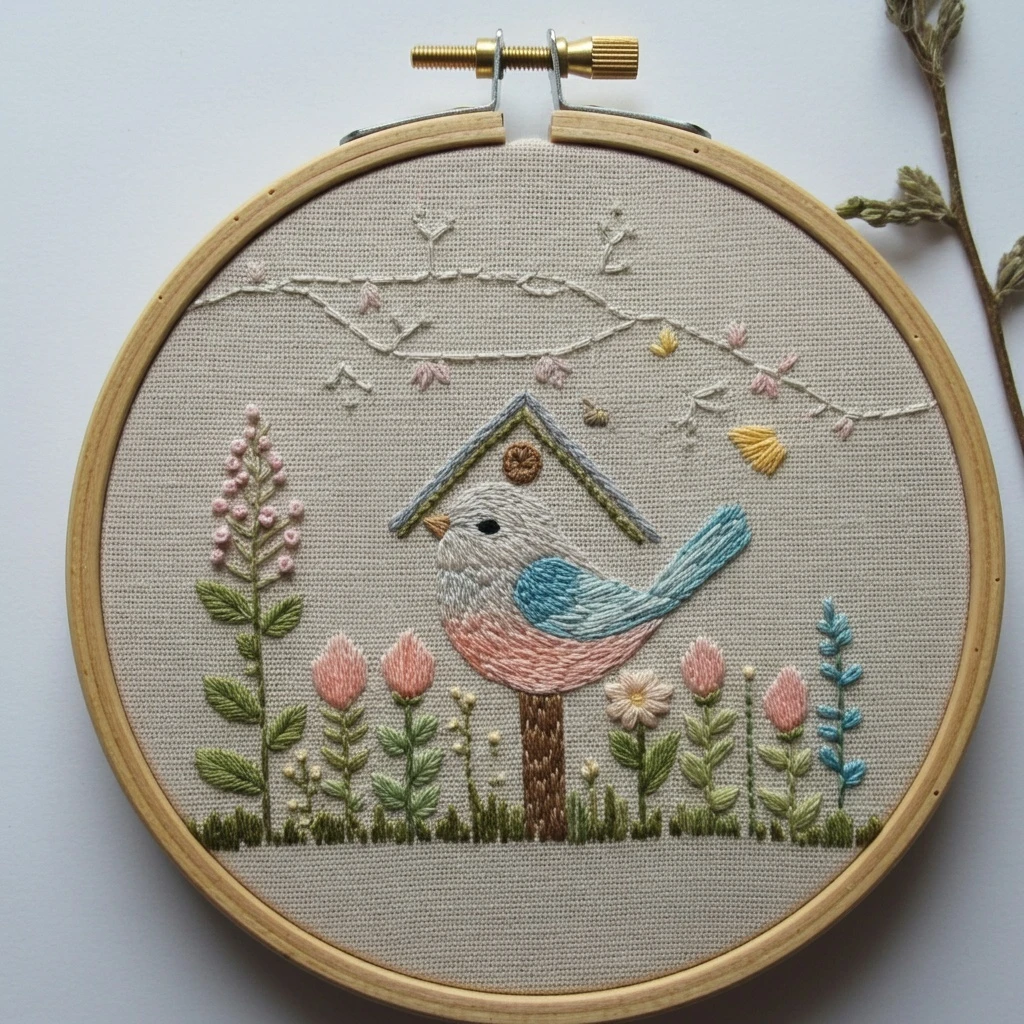
Suggested DMC Palette
These colors give the birdhouse a handmade garden feel while keeping the number of floss choices manageable for new stitchers.
Thread Count Guide
Use fewer strands for outlines and tiny details, and a little more thread only where you want strong color coverage.
| Area | Strands | Why |
|---|---|---|
| Birdhouse outline | 2 strands | Clear and forgiving for beginners without overwhelming the small shape. |
| Painted panels | 2–3 strands | Use 2 strands for tidy satin stitches or 3 for faster, fuller coverage. |
| Roof and post | 2 strands | Keeps wood grain readable while allowing layered brown highlights. |
| Stems and leaf veins | 1–2 strands | 1 strand for delicate veins, 2 strands for main stems. |
| Flower centers | 2–3 strands | French knots or colonial knots look rounder with extra thread. |
Blending Ideas
Weathered blue wood: blend one strand 3752 with one strand 932 for a softly painted birdhouse panel. Add a few 931 stitches only at edges and under the roof.
Warm roof texture: alternate 3826 and 434 in short stitches, then place 898 sparingly in the deepest underside and around the birdhouse opening.
Garden flowers: pair 347 petals with 742 or 307 centers. For tiny blooms, use one lazy daisy loop per petal so the flowers stay simple.
Fresh leaves: fill leaves with 470 and add a single 936 vein. This gives dimension without complicated shading.
Stitch Types by Design Element
The design works best with a small set of reliable beginner stitches. Keep stitch lengths short around curves and use the same direction on matching shapes.
Use for the birdhouse outline, roof edge, perch, stems, and any simple drawn lines. Short stitches help corners stay neat.
A smooth option for the birdhouse edges or thicker stems when you want a softer, rope-like line.
Fill the birdhouse panels, small roof sections, leaves, and larger petals. Keep stitches parallel for a polished finish.
Perfect for simple petals and leaf shapes. Anchor each loop with a tiny straight stitch in the same color.
Add flower centers, seed dots, and small garden texture. Wrap twice for small knots, three times for bolder dots.
Use for grass blades, wood grain, tiny highlights, and quick filler marks around the base.
Outlining & Shading Notes
Outline the birdhouse with 2 strands of 931 or 898 depending on how strong you want the edge. For a softer look, outline blue panels with 932 and reserve 898 only for the round entrance hole.
Shade under the roof with short stitches in 434 and a few touches of 898. Add 3752 along the upper side of the blue panels for a gentle highlight.
For leaves, stitch the main shape first in 470, then add one center vein in 936. Avoid heavy outlines on every leaf; a few dark veins are enough to create depth.
Texture Suggestions
Make the birdhouse feel wooden by adding scattered short straight stitches in 3826 and 434, following the direction of the roof or panel boards.
Cluster French knots around flower centers and near the ground line to suggest seeds, pollen, and tiny garden buds.
Use uneven grass stitches at the base: some short, some tall, some angled. This gives movement without requiring complex filling.
Beginner-Friendly Stitching Order
- Transfer the design lightly and mark the birdhouse edges, flower stems, and largest leaves clearly.
- Back stitch the birdhouse outline, roof, perch, and main stems before filling any areas.
- Fill birdhouse panels with satin stitch or neat rows of long-and-short stitch in 3752 and 932.
- Add roof and wood texture with 3826, 434, and a few dark 898 accents.
- Stitch leaves and stems next so the flower heads can sit cleanly on top.
- Finish flowers with lazy daisy petals, satin petals, and French-knot centers.
- Review the hoop from arm’s length and add only a few final highlights; overfilling can make beginner designs look crowded.
Quick Reference Plan
| Design part | DMC choices | Best stitches | Finish note |
|---|---|---|---|
| Birdhouse panels | 3752, 932, 931 | Satin stitch, split stitch outline | Keep the highlight side lighter and the lower side darker. |
| Roof and perch | 3826, 434, 898 | Back stitch, straight stitch | Add tiny wood-grain marks after the main outline. |
| Flowers | 347, 742, 307, 3865 | Lazy daisy, satin stitch, French knots | Use knots last so they stay raised and clean. |
| Leaves and stems | 470, 936 | Back stitch, lazy daisy, satin stitch | Use dark green as a vein rather than a full outline on every leaf. |