
Beginner Daisy Leaves
A light, cheerful beginner palette for a simple daisy-and-leaves hoop: creamy white petals, warm golden centers, fresh greens, soft stem shadows, and a few gentle blush neutrals to keep the floral shapes airy and handmade.
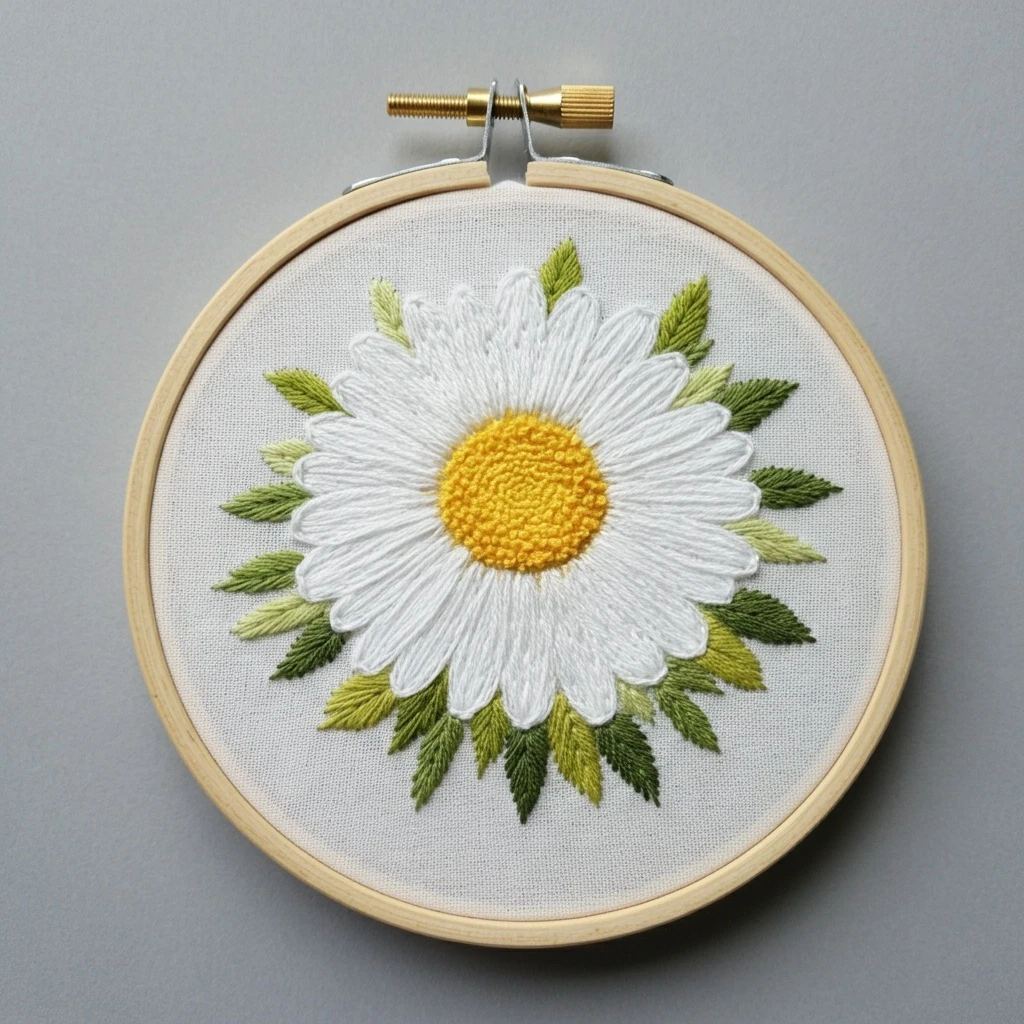
Suggested DMC Palette
Use these DMC colors as practical matches for the main visual areas. Keep the petals clean and pale, then let the centers and leaves carry most of the contrast.
Thread Count Guide
This design suits a beginner because the shapes are small and readable. Keep most stitching light, and add thickness only where texture is useful.
| Area | Strands | Why |
|---|---|---|
| Daisy petal outlines | 1–2 strands | 1 strand gives delicate detail; 2 strands are easier and bolder for beginners. |
| Petal fills | 2 strands | Enough coverage for satin or long straight stitches without bulky ridges. |
| Flower centers | 2–3 strands | French knots need body so the yellow centers look raised and textured. |
| Stems | 2 strands | Clean lines that remain visible beside pale petals. |
| Leaf veins and tiny details | 1 strand | Prevents the leaf interiors from looking crowded. |
Blending Ideas
Soft petals: blend one strand B5200 with one strand 3865 for petals that look bright but still natural on off-white fabric.
Petal shadow: add a few 1-strand stitches of 822 or 950 at the base of each petal, especially where petals tuck under the yellow center.
Leaf variation: alternate 470 and 469 on neighboring leaves rather than filling every leaf the same way. Add 936 only to one side of the vein.
Seeded centers: work most knots in 307, scatter a few 3820 knots, and place only two or three 783 knots on the lower edge for depth.
Stitch Types by Design Element
Choose simple stitches that make the daisy shapes neat while giving the leaves enough movement and texture.
Use for slim stems, curved flower outlines, and leaf silhouettes. Short stitches make rounded petals easier to control.
A softer option for petal outlines and main stems when you want a smooth, rope-like botanical line.
Best for filling small petals and simple leaves. Angle stitches from the petal tip toward the center for a natural flow.
Excellent for small leaves, tiny side petals, and beginner-friendly floral accents. Couch the loop with a tiny straight stitch.
Perfect for daisy centers. Keep knot size consistent by using the same strand count and wrap count across each flower.
Use for leaf veins, petal highlight lines, and small seed marks radiating from the center.
Outlining & Shading Notes
Use a light hand with outlining. For daisies, full dark outlines can make petals feel flat, so outline only the outer curve or one side of each petal with 3865, 822, or a single strand of 642. Keep the brightest white on the petal tips and place warm shadows closer to the center.
For leaves, shade one side of the central vein with 469 or 936 and leave the opposite side in 470. This simple split-value method gives dimension without requiring advanced long-and-short shading.
Texture Suggestions
Raised yellow centers are the main texture feature. Cluster French knots tightly in the middle, then loosen spacing near the edge so the center looks rounded. On petals, use smooth satin stitches or long straight stitches; avoid too many tiny stitches because they can make white petals look fuzzy.
For leaves, mix satin stitch with one or two straight vein stitches. If the pattern includes several leaves, vary the direction of the stitches so the greenery feels organic rather than repetitive.