
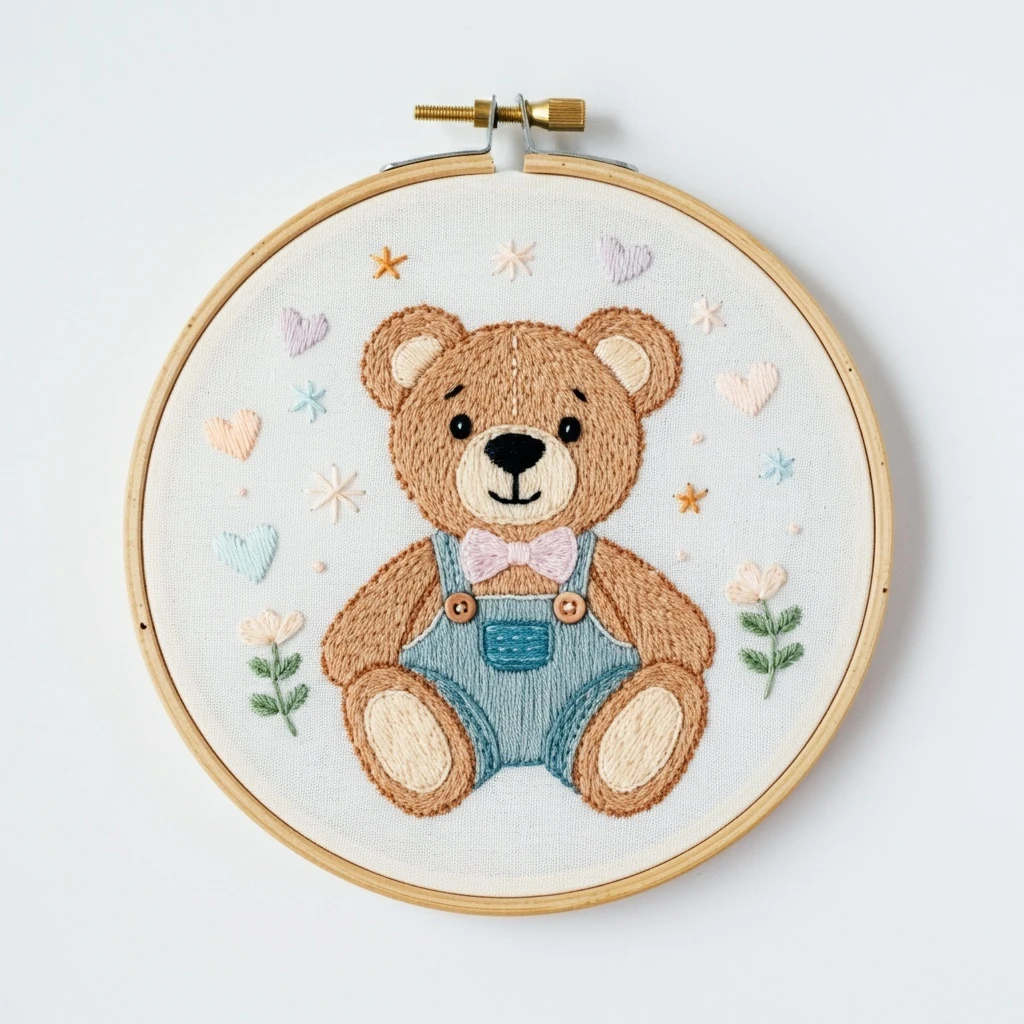
DMC Palette & Stitch Guide
Beginner Friendly Teddy Bear
A soft, approachable embroidery plan for a teddy bear hoop design, built around warm honey browns, gentle cream highlights, rosy cheek accents, and simple textured stitches that are forgiving for new stitchers.
Design & Color Read
The design is best treated as a cozy teddy-bear portrait: rounded ears and paws, a plush face, soft muzzle, small dark facial details, and delicate decorative accents. The overall mood is gentle and handmade, so the palette should stay warm rather than harsh.
Use medium golden browns as the main teddy fur, darker cocoa for creases and edges, cream for the muzzle and light-catching areas, and tiny amounts of blush for cheeks or inner ears. If the pattern includes floral sprigs, ribbons, or leaves, keep them muted so they frame the bear without overpowering the face.
Suggested DMC Floss Palette
These shades are chosen to echo a plush teddy bear with soft dimension. Exact colors may be adjusted for your fabric tone, but keep the value steps clear: light muzzle, mid fur, darker shadow, and crisp facial detail.
Stitch Map & Thread Counts
| Area | Recommended stitches | Strands | Practical notes |
|---|---|---|---|
| Teddy outline | Back stitch or split back stitch | 2 strands | Use DMC 801 or 433. Split back stitch gives a softer plush edge than a hard line. |
| Main fur | Long-and-short stitch, split stitch rows, or small seed stitches | 2 strands | Follow the curve of the face and body. Keep stitches short near the nose and ears for better shape. |
| Muzzle and paw pads | Satin stitch with split-stitch border | 2 strands fill, 1-2 border | Use DMC 746 or 422. Pad the center with one layer of straight stitches before satin for a raised plush look. |
| Eyes and nose | Satin stitch, tiny straight stitch highlight, French knot option | 1 strand highlight, 2 strands dark | Stitch facial details last. Place both eyes before filling to keep the expression even. |
| Cheeks and inner ears | Tiny seed stitches, whipped back stitch, or very light satin | 1 strand | Use blush colors sparingly. A few scattered stitches look sweeter than a heavy patch. |
| Leaves or sprigs | Lazy daisy, fly stitch, stem stitch | 2 strands | Use muted greens so the bear remains the focus. |
Blending, Shading & Texture Suggestions
Soft Fur Blends
- Blend one strand DMC 434 with one strand DMC 422 for lighter fur transitions.
- Blend one strand DMC 434 with one strand DMC 433 under the chin, ears, and paws.
- Use isolated DMC 801 stitches only where the design needs a crease or deep shadow.
Beginner-Friendly Texture
- Instead of dense full coverage, scatter short split stitches in the direction of the fur.
- Use seed stitches on the body to suggest plushness without needing perfect shading.
- Keep the muzzle smoother than the body so the bear’s face reads clearly.
Outlining & Finishing Details
For a clean beginner result, outline major shapes with a controlled back stitch, then fill inside the boundaries. Around the face, use smaller stitches than on the body; short stitches make curves smoother and prevent the expression from looking heavy.
- Nose: fill with DMC 3371 or 801 in tiny satin stitches; add one small DMC 746 highlight stitch if desired.
- Mouth: use one strand of 3371 in a gentle back stitch or stem stitch; avoid pulling too tight.
- Ear shadows: add 433 around the inner lower edge, then soften with a few 422 or blush stitches.
- Hoop presentation: press from the back on a towel and avoid flattening any padded satin sections.
Beginner Practical Tips
- Use a 6-inch hoop for comfortable tension and re-tighten the fabric before filling large areas.
- Cut floss lengths around 14-16 inches to reduce tangling, especially with browns used for dense fur.
- Separate all six strands first, then recombine the number needed; this makes stitches smoother.
- Start with stems, leaves, or simple outline areas if you want a warm-up before the face.
- Check the bear’s face from arm’s length before knotting off the eyes and mouth; small adjustments matter most there.