
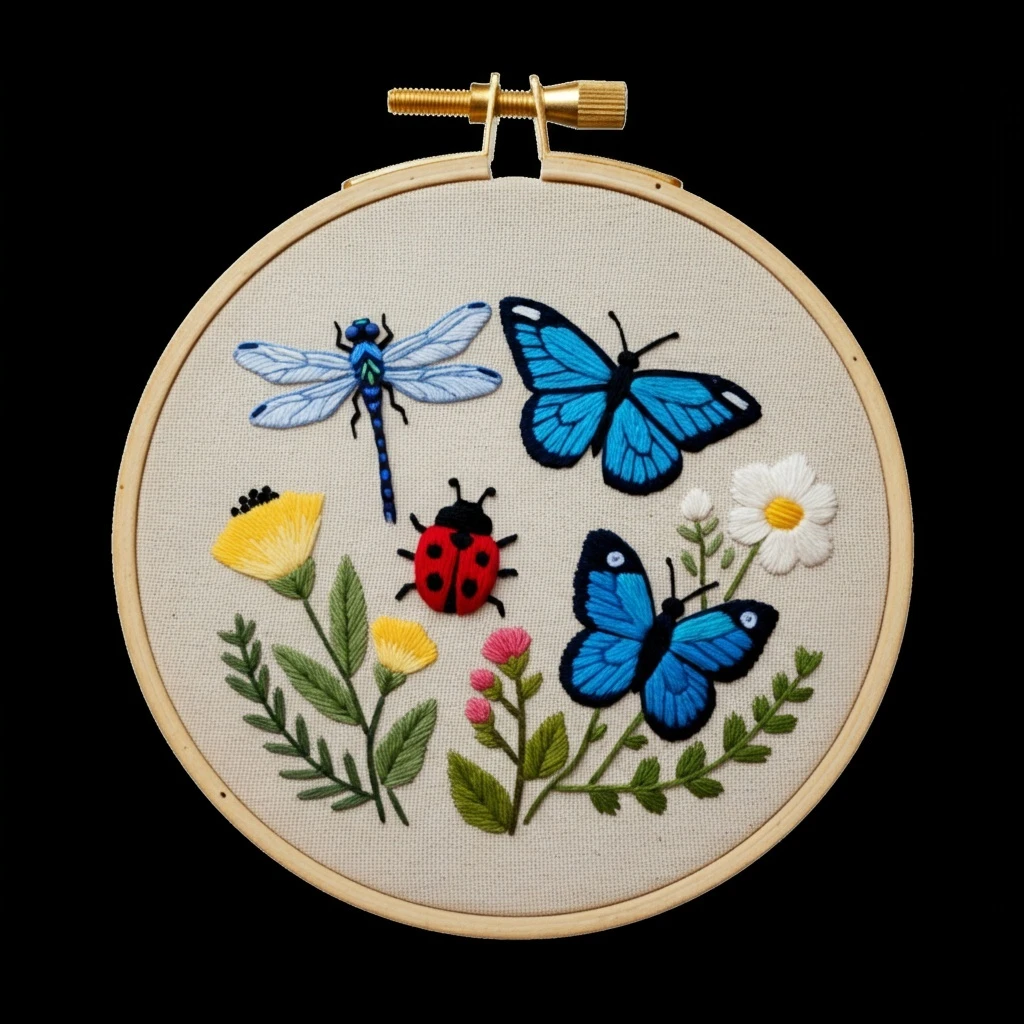
Beginners Embroidered Insects and Flowers Hoop
A cheerful beginner hoop with small garden insects, simple wildflowers, curved greenery, and playful details. The palette keeps the design bright and friendly while giving enough contrast for tiny wings, legs, flower centers, stems, and petals to read clearly on fabric.
Suggested DMC Color Palette
These floss choices are selected for a garden hoop with yellow, pink, purple, blue, green, white, brown, and black accents. Swap one flower shade at a time if you want a softer pastel or brighter summer look.
DMC 310 Black
Tiny insect legs, antennae, eyes, and the sharpest wing/body accents. Use sparingly so the beginner design stays light.
DMC 3371 Black Brown
Warm dark outlines for beetle bodies, butterfly thorax, flower centers, and stem shadow where black would feel too harsh.
DMC 898 Very Dark Coffee Brown
Soft earth tone for seed heads, small insect body segments, and grounding details around the bouquet base.
DMC 3820 Dark Straw
Golden flower disks, bee stripes, pollen dots, and sunny highlights in yellow petals.
DMC 743 Medium Yellow
Bright daisy-style petals, small star flowers, and cheerful top highlights on bee wings or pollen.
DMC 922 Light Copper
Orange-red petals, ladybird warmth, and warm accents in small blossoms.
DMC 3722 Medium Shell Pink
Soft pink flowers and petal shading where the design needs a gentle beginner-friendly color pop.
DMC 3689 Light Mauve
Pale petal tips, blossom filler, and delicate highlights blended with pinks.
DMC 552 Medium Violet
Small purple wildflowers, butterfly wing marks, and cool contrast among the warm florals.
DMC 340 Medium Blue Violet
Cool blue-lavender petals, wing glints, and airy contrast for tiny insects.
DMC 3846 Light Bright Turquoise
Dragonfly or butterfly wing sparkle; use one strand for a translucent stitched look.
DMC 581 Moss Green
Main stems, leaf veins, and curved botanical lines around the hoop.
DMC 469 Avocado Green
Darker leaves, lower stem shadows, and alternating greenery tones.
DMC 772 Very Light Yellow Green
Soft leaf highlights and tender new shoots; excellent for tiny lazy-daisy leaves.
DMC 3865 Winter White
Wing highlights, pale daisy petals, and shine marks on beetles or small blossoms.
Stitch Map by Design Area
| Area | Recommended stitches | Thread count | Practical notes |
|---|---|---|---|
| Flower stems and curved sprays | Stem stitch, split stitch, back stitch | 2 strands; 1 strand for tiny offshoots | Work from the base outward so the curves stay smooth. Rotate the hoop rather than twisting your wrist. |
| Daisy petals and simple blossoms | Lazy daisy, satin stitch, straight stitch | 2 strands for petals, 3 for fuller flower heads | Keep petal tension loose enough that the stitches sit rounded, not pinched. |
| Flower centers and pollen dots | French knots, colonial knots, tiny seed stitches | 2 strands; 2 wraps for most knots | Use DMC 3820 or 898 for centers, then add a few 743 knots as bright pollen highlights. |
| Leaves and small greenery | Fishbone stitch, lazy daisy, fly stitch, straight stitch | 2 strands; 1 strand for veins | Alternate DMC 581 and 469 so the greenery does not look flat. Add 772 to the upper edge of a few leaves. |
| Bee, beetle, butterfly, and tiny insects | Back stitch, satin stitch, split stitch, long straight stitch | 1 strand for legs/antennae; 2 strands for bodies | Stitch the body first, then legs and antennae last. This keeps delicate dark details crisp. |
| Transparent wings | Long-and-short stitch, open straight stitches, couching | 1 strand in 3846, 340, or 3865 | Leave a little fabric showing between wing stitches for a light translucent effect. |
| Outer hoop balance and filler marks | Seed stitch, detached chain, small straight stitches | 1-2 strands | Use filler sparingly; beginners get a cleaner finish by leaving breathing room around the motifs. |
Blending & Shading Ideas
- Soft flower shading: Blend one strand DMC 3722 with one strand 3689 for pink petals that look dimensional without complex color changes.
- Sunny yellow centers: Work the center with 3820, then place a few 743 French knots toward the light side for sparkle.
- Green variation: For larger leaves, stitch one half in 581 and the other in 469, then add one-strand 772 veins.
- Insect shine: Add a single tiny stitch of 3865 or 3846 on a dark body to suggest a glossy shell or wing highlight.
- Gentle outlines: Replace pure black with 3371 on flower centers and stems when the motif feels too bold.
Texture Suggestions
Beginner-Friendly Working Order
- Transfer cleanly: Mark the insects lightly so the legs and antennae do not become thick or smudged before stitching.
- Start with stems: Stitch all green lines first. This anchors the composition and lets flowers sit naturally on top.
- Add flower petals: Work one flower type at a time so thread changes stay simple and consistent.
- Finish insects last: Tiny dark details look best when added after surrounding flowers are complete.
- Check spacing: Step back every few motifs. This design should feel lively but not overfilled.
Thread-count guide: Use 2 strands for most beginner stitches, 1 strand for miniature insect details and leaf veins, and 3 strands only for bold flower centers or thicker petal fills. If the fabric puckers, shorten the stitch length and loosen the pull slightly.
Outlining, Finishing & Practical Tips
- Use back stitch for neat outlines around insects and small petals; use split stitch where a softer botanical line is desired.
- Keep knots on the back small, especially behind pale wings and white petals where shadow can show through.
- For French knots, hold the working thread taut while pulling the needle through so the knot sits round and close to the fabric.
- When stitching legs, use one long straight stitch per leg rather than trying to outline both sides.
- Press from the back on a folded towel after stitching to protect raised knots and petal texture.
- Test dark colors on a fabric scrap if your fabric is very light; 3371 can be gentler than 310.
- Use a sharp embroidery needle for tiny insect details and a slightly larger needle for 3-strand flower sections.
- Leave a narrow unstitched margin near the hoop edge so the finished piece looks airy and intentional.