
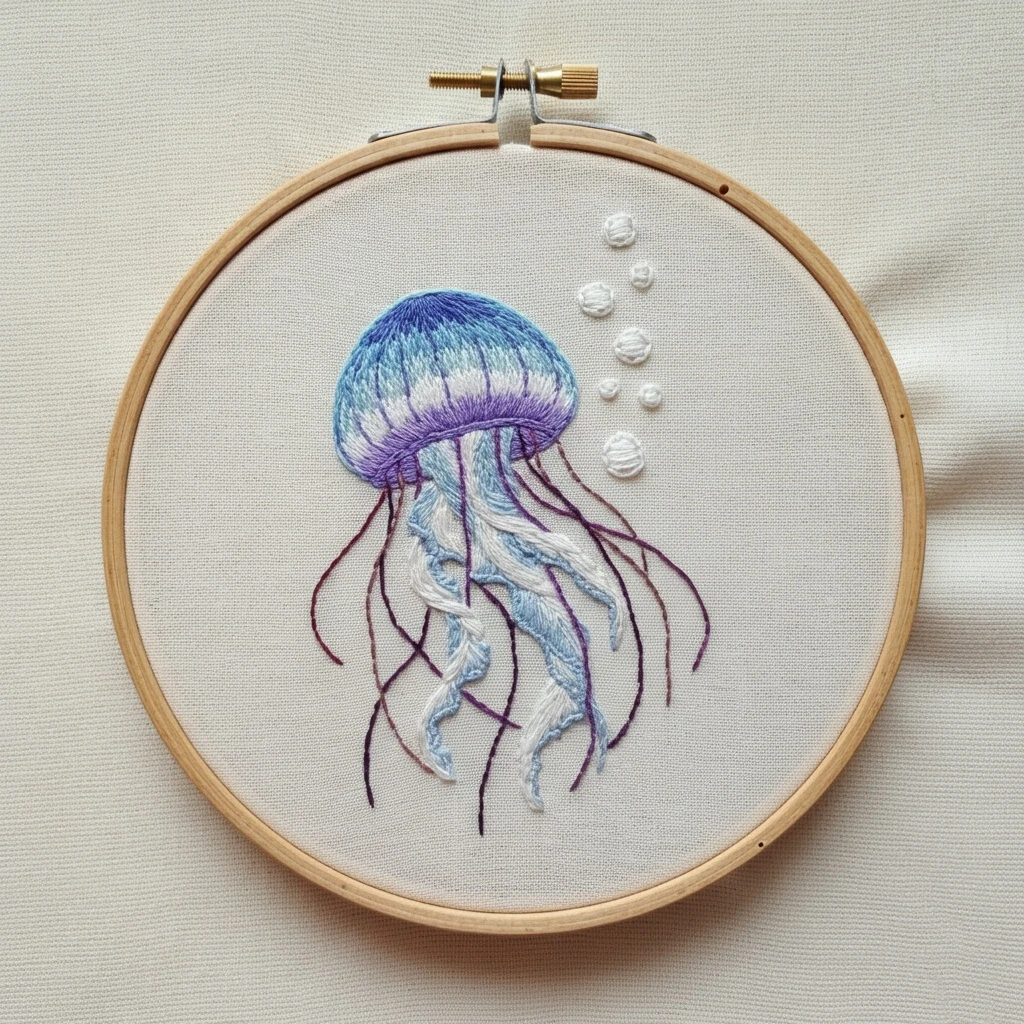
Blue and Purple Jellyfish
A cool ocean palette built around a translucent jellyfish bell, flowing tentacles, violet shadows, and airy water movement. The design works best when the body is kept light and glassy while the tentacles carry most of the line rhythm and color drama.
Suggested DMC Color Palette
Use the lighter blues and lavenders for the transparent bell, deeper violets for underside shadows, and navy/blue-gray sparingly for definition. Keep the palette luminous by avoiding heavy black except for tiny eye-line or deepest accent marks if the pattern includes them.
Stitch Map by Design Area
Translucent bell
- Use split stitch or very short stem stitch for the outer dome so the outline stays smooth.
- Fill with spaced long-and-short stitch using 1 strand of 747, 828, and 211.
- Leave small fabric gaps between fill rows to preserve a watery transparent look.
Scalloped underside
- Work the lower ruffle with chain stitch or back stitch in 209 blended with 3843.
- Add tiny straight stitches in 333 only at the deepest dips.
- Keep curves consistent by stitching from the center outward on each side.
Flowing tentacles
- Use stem stitch for graceful lines; it naturally follows curves.
- For wispy tentacles, use 1 strand; for main tendrils, use 2 strands.
- Switch colors mid-line by ending one thread under the previous stitch and restarting with a new shade.
Water texture & bubbles
- Use French knots or colonial knots in B5200, 964, and 747.
- Scatter knots unevenly so the background feels organic, not dotted in rows.
- Use single straight stitches for light current marks around the tentacles.
Thread Count & Blending Guide
| Area | Strands | Best approach |
|---|---|---|
| Outer bell line | 2 strands | Split stitch in 3843, then add a few 1-strand B5200 highlights along the top curve. |
| Bell shading | 1 strand | Feathered long-and-short stitches: 747 at the center, 828 toward the edge, 211 in shadow pockets. |
| Main tentacles | 2 strands | Stem stitch using 209, 3843, or a blended needle of one strand each for blue-violet variation. |
| Fine tendrils | 1 strand | Back stitch or whipped back stitch; keep tension loose so the lines do not pucker. |
| Deep accents | 1 strand | Use 333 or 823 sparingly at line crossings, underside folds, and the darkest tips. |
Practical Stitching Sequence
Shading, Texture & Beginner Tips
Make the bell look glassy
Do not fully satin-fill the dome unless the pattern specifically calls for it. Short, spaced stitches in pale blue and lavender create a translucent effect and are easier for beginners to control.
Prevent tentacle puckers
Use shorter stitch lengths on tight curves and avoid pulling the thread hard. If a tentacle is very long, break it into two or three smooth sections.
Create gentle movement
Alternate stem stitch direction subtly between neighboring tentacles. This small change catches light differently and gives the floating lines a lively ocean drift.
Keep dark colors elegant
Deep navy and blue-violet are best as accents. Use them for tiny shadows, not broad outlines, so the design remains soft and luminous.
Quick Reference
Core palette B5200, 747, 828, 3843, 798, 211, 209, 333, 964, 3810, 318, 823.
Core stitches Split stitch, stem stitch, back stitch, long-and-short stitch, chain stitch, French knots, straight stitch.
Best beginner strategy Keep the bell pale, stitch the tentacles slowly with relaxed tension, and add darker colors only after the lighter shading is complete.