
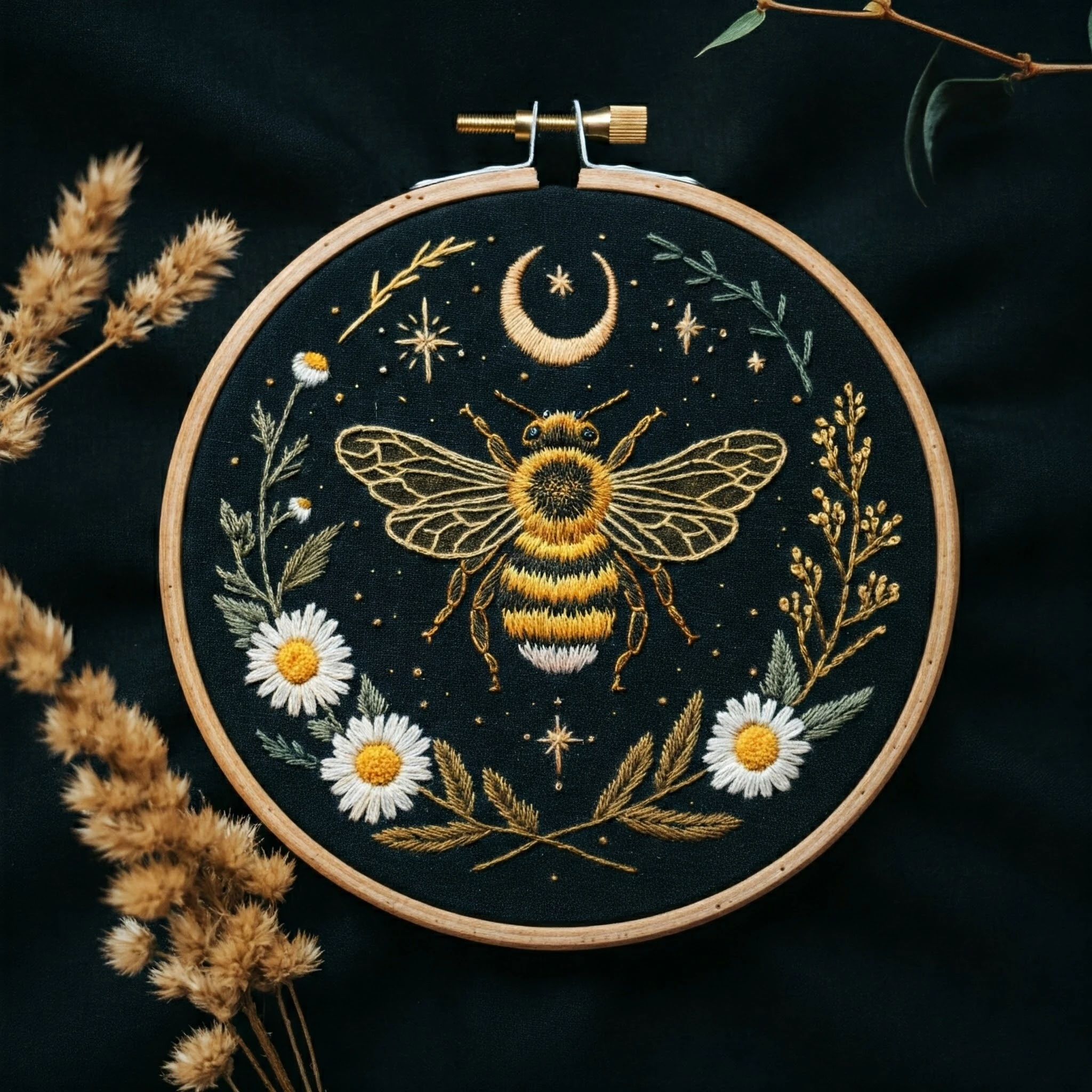
Celestial Bee Daisy
This dreamy embroidery concept combines a small striped bee, open daisy petals, golden floral centers, and celestial details such as stars, moons, or tiny sparkling accents. The stitched result should feel bright and whimsical, balancing clean daisy shapes with soft bee texture and a subtle night-sky glow woven through the composition.
Polished DMC Color Palette
This palette keeps the design airy and luminous: warm honey golds for the bee and daisy centers, creamy whites for petals and moonlit highlights, soft greens for stems and leaves, and a few cool sky and lavender accents for celestial sparkle.
Stitch Map by Design Element
Thread Count & Blending Guide
Fine details
Use 1 strand for antennae, legs, wing veins, petal edge corrections, tiny stars, and small outline work. One strand keeps the design light and polished.
Main fills
Use 2 strands for bee stripes, daisy petals, leaf fills, and most flower centers. Two strands offer smooth coverage without making the petals bulky.
Raised accents
Use 2–3 strands for French knots in daisy centers and slightly raised celestial dots. Reserve three strands for only the most prominent knots.
Shading, Outlining & Texture Suggestions
Soft bee texture
- Use irregular long-and-short stitch edges where black and yellow bands meet.
- Place brighter yellow on the top curve and darker honey tones underneath.
- Use 3371 instead of solid black on some edges for a softer fuzzy finish.
- Keep legs and antennae very fine so they do not overpower the flowers.
Dimensional daisy petals
- Start petals slightly darker at the center and brighten them toward the tips.
- Vary petal length a little so the daisy feels more natural and less rigid.
- Outline only selected petals if needed; too much outline can make the flowers stiff.
- Use 746 when a warmer cream petal suits the palette better than a stark white.
Celestial sparkle
- Cluster a few star stitches around the bee or flowers rather than spreading them evenly.
- Mix seed stitches, small knots, and tiny four-point stars for variety.
- Use blue and lavender as supporting accents, not the dominant celestial color.
- Add a couple of cream highlight stitches beside golden motifs to suggest glow.
Outlining approach
- Outline after filling so the shapes sit neatly on top of the stitched areas.
- Use 310 for the bee’s sharpest details and darker greens for leaf outlines.
- Use split stitch for curves and back stitch for tiny straight details.
- Keep the overall look selective and airy instead of heavily outlined.
Beginner-Friendly Stitching Order
- Transfer lightly: mark the bee body and wings, daisy circles, main petal directions, stems, leaves, and the largest celestial shapes. Add tiny stars and dots later by eye.
- Stitch the daisies first: work flower centers, then petals, so the flowers establish the composition.
- Add stems and leaves: build the greenery around the flowers with medium and light green values.
- Work the bee body: stitch the yellow sections first, then black sections, keeping the transitions soft and fuzzy.
- Add the wings: keep them pale and light so they sit naturally over the body without becoming heavy.
- Finish with celestial accents: add stars, dots, moons if present, final highlights, and the finest outline details last.
Practical Tips for a Clean Finish
Fabric & hoop
Warm cream cotton, linen, or cotton-linen makes the golds glow and keeps the white daisy petals from disappearing. Maintain firm hoop tension so the long petal stitches stay smooth.
Needle choice
Use a sharp size 7–9 embroidery needle for one- and two-strand work. For larger French knots in flower centers, use a slightly larger needle to keep the wraps even.
Managing white and black floss
Do not carry dark floss behind white petals or pale wings. Likewise, keep white threads clean by using shorter lengths and avoiding handling them with dusty hands or a marked transfer surface.
Keeping the design balanced
After stitching the main bee and daisies, step back before adding more stars or dots. A few well-placed celestial accents create charm; too many can distract from the floral focal points.