
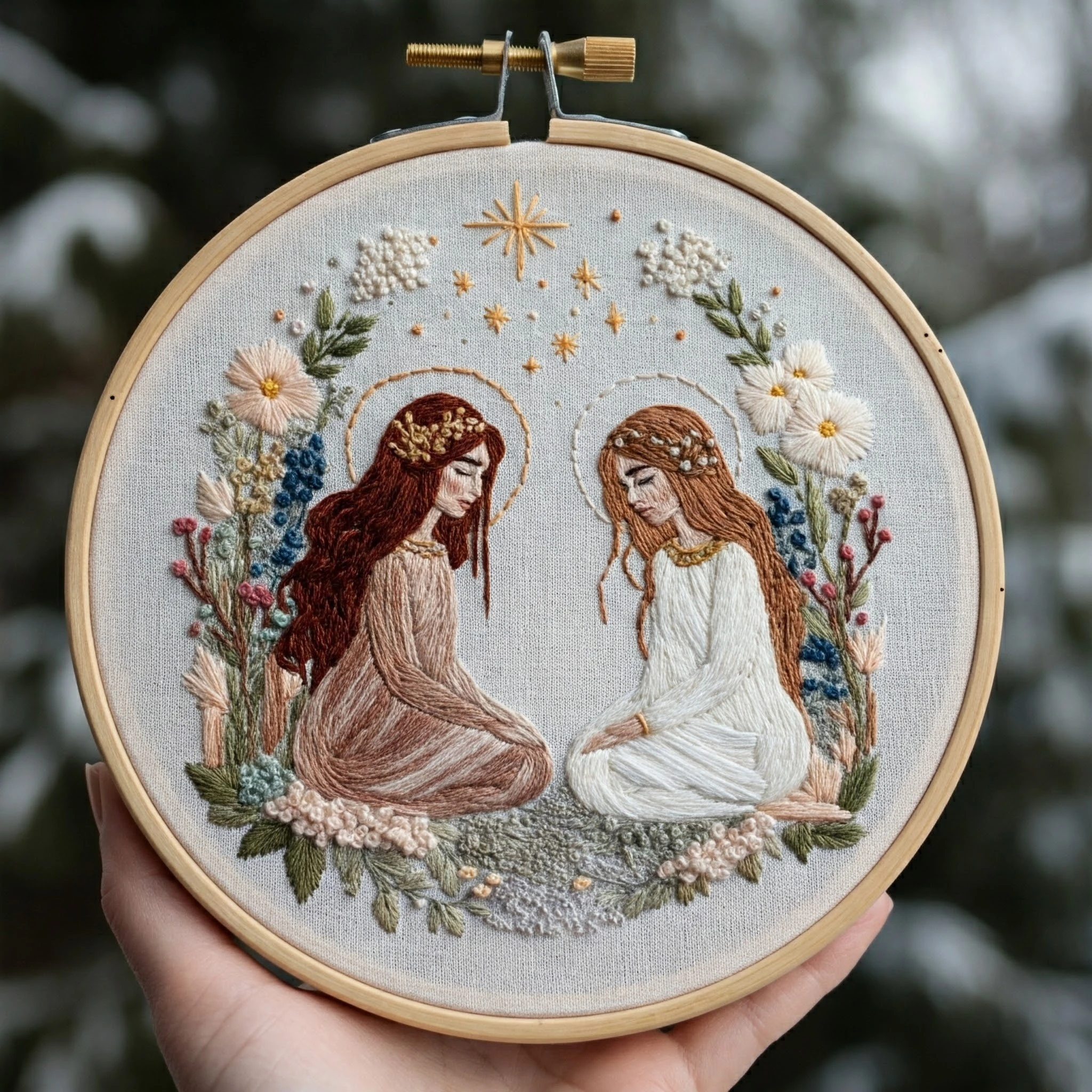
Celestial Sisters
This celestial sisterhood design blends paired feminine figures, moonlit profiles, flowing hair or garments, and starry accents that connect the two forms. The stitched version should feel balanced and intimate: soft skin shading, graceful mirrored outlines, distinct but harmonious hair tones, warm golden stars, and lavender-blue celestial glow that ties both sisters together.
Polished DMC Color Palette
This palette balances warm portrait tones, soft rose accents, deep hair and outline shades, lavender-blue night glow, and gold celestial details. Use the same highlight family across both sisters for unity, while varying hair and garment shades slightly to keep each figure distinct.
Stitch Map by Design Element
Thread Count & Blending Guide
Portrait precision
Use 1 strand for eyes, brows, lips, nose lines, star rays, connecting threads, and tiny hair highlights. This prevents the faces from becoming heavy or overdrawn.
Main fills
Use 2 strands for skin shading, hair masses, garment folds, moon fills, and larger celestial shapes. Two strands provide coverage while still blending smoothly.
Raised sparkle
Use 2–3 strands for French-knot stars, jewelry dots, and selected halo accents. Use three strands only for the brightest focal sparkles between the sisters.
Shading, Outlining & Texture Suggestions
Balancing two figures
- Stitch the same element on both sisters before moving on: skin first, then hair, then garments.
- Use shared highlight colors to unify the pair, but vary shadow placement for individuality.
- Keep facial features small and calm so neither figure dominates the composition.
- Step back often to check that both silhouettes feel equally weighted.
Soft portrait shading
- Use very short stitches around facial curves and longer stitches on neck or shoulder areas.
- Keep the strongest skin shadows limited to under the chin, nose, lips, and hairline.
- Add blush with only a few 3722 or 761-like rose stitches; too much can look patchy.
- Place final face lines after all fill stitches are finished.
Hair and garment movement
- Follow the direction of the drawn lines; stitch direction creates the sense of flow.
- Group hair into sections instead of filling one large flat mass.
- Use lavender and blue highlights only where moonlight would catch the top strands.
- Keep garment fold lines curved and soft rather than sharply outlined.
Celestial sparkle
- Place the brightest stars between or around the sisters to emphasize connection.
- Mix knots, tiny crosses, and short straight stitches for varied star texture.
- Use 3865 sparingly as the brightest star point or eye catchlight.
- Leave open fabric around stars so the celestial field stays airy.
Beginner-Friendly Stitching Order
- Transfer carefully: mark the two face outlines, hair flow lines, garment shapes, moon or star positions, and only the key facial features. Keep transfer marks faint around skin areas.
- Stitch skin areas first: complete both sisters’ skin shading before adding eyes, lips, or hair outlines.
- Add hair sections: work from darkest hair shadows to moonlit highlights, following each figure’s hair direction.
- Stitch garments and veils: use soft lavender, cream, and blue-gray values to create gentle folds and unity.
- Add celestial motifs: complete moons, stars, connecting lines, and jewelry-like dots after the figures are established.
- Finish with expression and sparkle: add facial details, tiny star knots, final highlights, and outline corrections last.
Practical Tips for a Clean Finish
Fabric & hoop
Warm cream cotton, linen, or cotton-linen complements portrait tones and lets gold and lavender celestial details glow. Keep the hoop drum-tight so face shading and long hair stitches stay smooth.
Needle choice
Use a sharp embroidery needle size 7–9 for one- and two-strand portrait work. For three-strand star knots, switch to a slightly larger needle so wraps pull through without puckering.
Facial feature control
Use one strand and the smallest possible stitches for eyes, mouths, and brows. A single long dark stitch can change the expression, so build features slowly and lightly.
Preventing show-through
Do not carry dark hair floss behind pale skin, moon, or garment areas. End dark threads cleanly and restart nearby to keep the lighter sections fresh.