
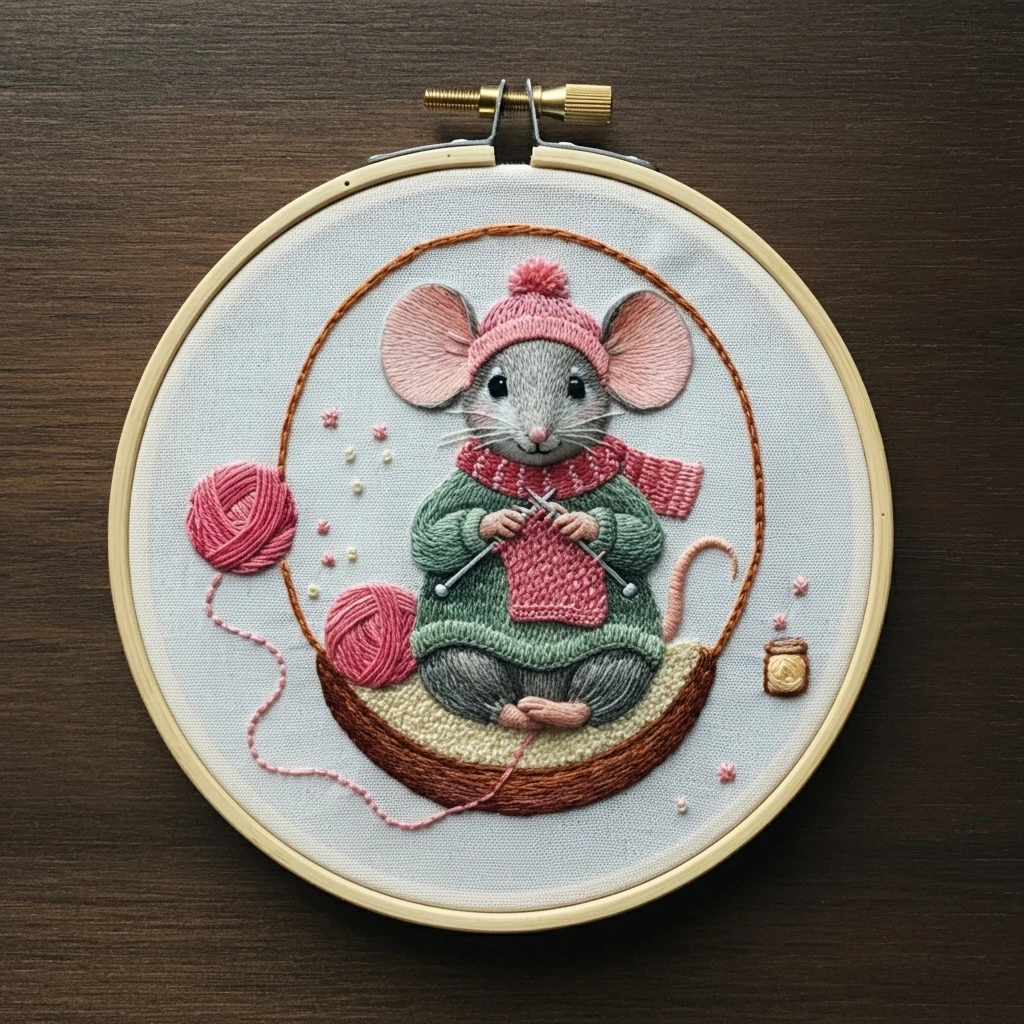
Cozy Knitter Mouse
This gentle embroidery design features a tiny mouse in a cozy knitting moment, with soft gray-beige fur, pink ears and paws, a yarn ball, knitting needles, and warm handmade textile details. The stitched version should feel tender and tactile: delicate mouse features, rounded ears, a thin tail, curved yarn strands, tiny needle lines, and colorful wool texture that looks snug without overwhelming the small character.
Polished DMC Color Palette
This palette balances soft mouse neutrals with cheerful yarn colors and warm wooden knitting needles. Keep the mouse subtle and fine, then use the yarn and knitted piece for richer color and texture.
Stitch Map by Design Element
Thread Count & Blending Guide
Fine mouse details
Use 1 strand for whiskers, eye, nose, mouth, tail, toe lines, needle tips, loose yarn strands, and final outline corrections. This keeps the tiny character delicate.
Main cozy fills
Use 2 strands for mouse fur, ears, yarn ball arcs, knitted rows, basket texture, and larger scarf or sweater sections. Two strands gives soft coverage without bulk.
Raised yarn texture
Use 2–3 strands for selected yarn-ball ridges, French-knot buttons, or chunky knit accents. Use three strands sparingly so the mouse stays small and readable.
Shading, Outlining & Texture Suggestions
Soft mouse fur
- Use short stitches that follow the rounded head, belly, and back curves.
- Keep darker gray under the chin, inside ears, beneath paws, and along the tail underside.
- Use cream only on the muzzle, belly, and tiny highlights so the mouse stays soft.
- Stitch whiskers last with light tension to avoid puckering the face.
Yarn-ball texture
- Work yarn arcs in curved rows rather than straight lines.
- Use darker shades where strands tuck behind the ball and lighter shades on upper arcs.
- Vary the arc length slightly so the yarn looks wound, not striped.
- Leave a few tiny gaps or overlaps to suggest loose strands.
Knitted fabric effect
- Use small V stitches or chain stitch rows to imitate knit loops.
- Keep stitch rows parallel and evenly spaced for a tidy handmade textile look.
- Use one darker line at folds and one lighter line on the upper edge.
- Do not over-texture very small knitted pieces; a few rows are enough.
Outlining approach
- Use soft gray for mouse outlines, darker yarn shades for yarn separation, and warm brown for needles.
- Avoid heavy black outlines except for the smallest eye or nose detail.
- Use split stitch for rounded mouse curves and stem stitch for yarn and needles.
- Add final outlines before whiskers, eye glints, and bright yarn highlights.
Beginner-Friendly Stitching Order
- Transfer lightly: mark the mouse body, ears, paws, tail, face, yarn ball, knitting needles, knitted panel, and any basket or prop details. Save loose yarn strands for later.
- Stitch the mouse base: fill fur shadows first, then mid-gray body areas, then pale muzzle, belly, ear, and paw highlights.
- Add face details: stitch the eye, nose, mouth, whiskers, and tiny paw or toe lines with one strand.
- Build the yarn ball: stitch curved yarn arcs in dark, mid, and light tones, following the round shape.
- Add knitting needles and fabric: stitch needles cleanly over or beside yarn, then add knit rows, V stitches, or scarf stripes.
- Finish with cozy accents: add loose yarn strands, basket texture, buttons, highlights, and final outline corrections last.
Practical Tips for a Clean Finish
Fabric & hoop
Warm cream, natural linen, pale oatmeal, soft taupe, or light gray cotton-linen suits this cozy craft palette. Keep the hoop drum-tight so the thin tail, needles, and yarn strands stay smooth.
Needle choice
Use a sharp embroidery needle size 7–9 for one- and two-strand stitching. A size 9 needle is ideal for whiskers, eye detail, loose yarn strands, and fine knitting-needle lines.
Keeping the mouse sweet
Use minimal facial stitching. A tiny eye, small nose, pale muzzle, and delicate whiskers create more charm than dense shading on the face.
Avoiding yarn clutter
Choose one main yarn color family and one accent. Too many colors in the yarn ball can distract from the mouse’s expression and knitting pose.