
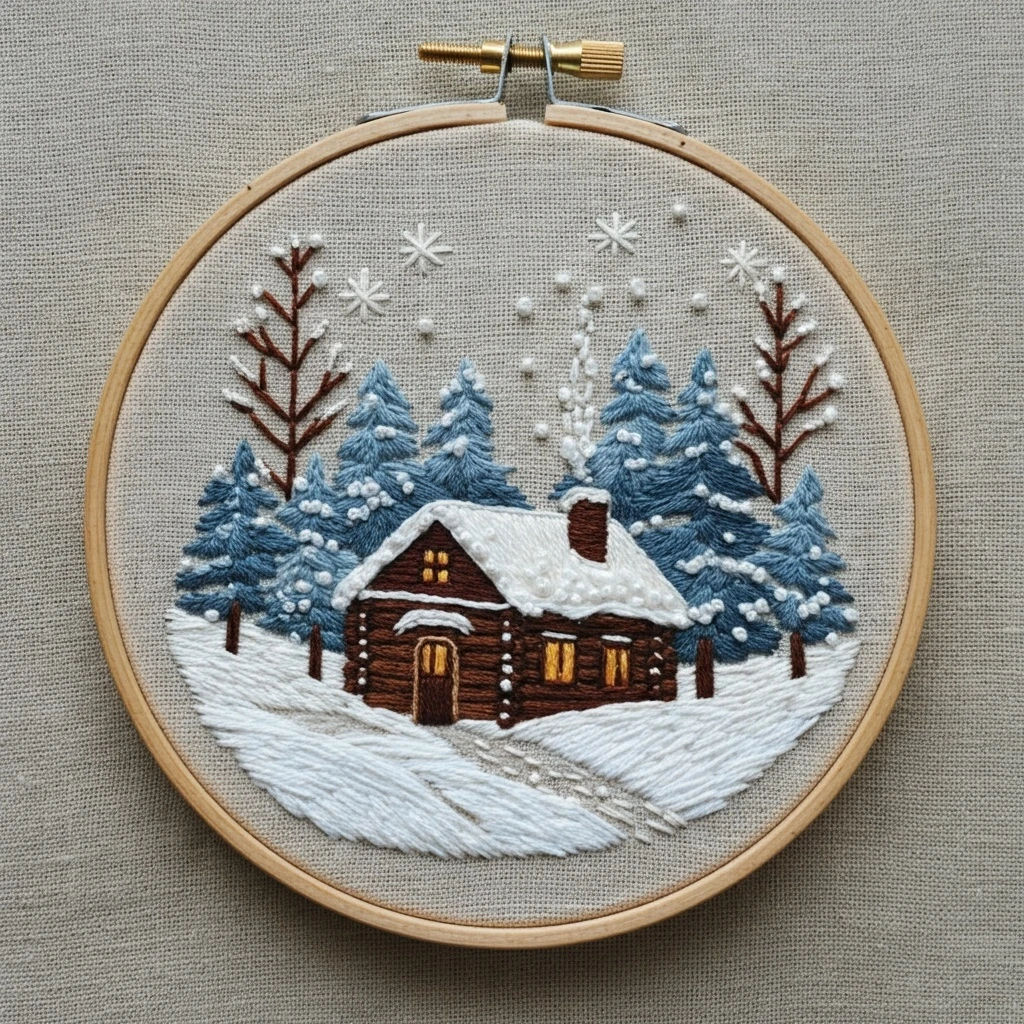
Cozy Winter Cabin

Cozy Winter Cabin — DMC Palette & Stitching Guide
Cozy Winter Cabin Embroidery
DMC palette & winter cabin stitching notes

Cozy Winter Cabin

This cozy winter cabin design centers on a warm wooden cabin tucked into a snowy landscape, with pine trees, roof snow, gentle blue shadows, and glowing window details. The embroidery should feel crisp but inviting: rustic wood grain, dark evergreen silhouettes, soft snowdrifts, cool icy shading, and tiny warm yellow highlights that make the cabin feel lived-in on a quiet winter day.

Polished DMC Color Palette

This palette balances warm cabin browns with cool snow blues and deep forest greens. Use wood and window colors as the focal warmth, then keep snow areas pale and dimensional with cream, white, beige-gray, and icy blue shadows.

DMC 938
Coffee Brown Ultra Dark
Deep log gaps, door shadow, roof underside, chimney shadow, and strongest cabin outlines.
DMC 898
Coffee Brown Very Dark
Dark cabin corners, log separations, shaded eaves, tree trunks, and path shadows.
DMC 801
Coffee Brown Dark
Cabin outlines, roof trim, window frames, lower log shadows, and rustic detail.
DMC 433
Brown Medium
Main cabin logs, door boards, tree trunks, porch rail, and warm wood mid-tones.
DMC 434
Brown Light
Log highlights, roof ridge warmth, window trim accents, and firelit wood edges.
DMC 437
Tan Light
Pale wood glints, porch boards, path warmth, and small sunlit cabin strokes.
DMC 783
Topaz Medium
Warm window glow, lantern shadows, candlelit reflections, and golden cozy accents.
DMC 3821
Straw
Brightest window centers, tiny lantern light, warm sparkle, and final glow points.
DMC 746
Off White
Warm snow highlights, roof snow, window halo, smoke, and soft cream transitions.
DMC 3865
Winter White
Bright snow caps, roof edge sparkle, frosty tree tips, and crisp final highlights.
DMC 822
Beige Gray Light
Soft snow shadow, smoke shading, roof snow depth, and neutral drift transitions.
DMC 644
Beige Gray Medium
Deeper drift shadows, snow under the cabin, path dips, and muted winter depth.
DMC 775
Baby Blue Very Light
Icy roof edges, pale sky accents, snowbank glints, and frosted branch tips.
DMC 932
Antique Blue Light
Cool snow shadows, distant sky, window glass, and gentle blue-gray drift lines.
DMC 931
Antique Blue Medium
Deeper blue snowbank shadows, background haze, and cool separation around trees.
DMC 823
Navy Blue Dark
Optional deep winter sky, shaded window interior, or strongest cool shadow accents.
DMC 895
Hunter Green Very Dark
Deepest pine silhouettes, inner evergreen shadows, and dark forest bases.
DMC 3362
Pine Green Dark
Main evergreen trees, shaded boughs, and tree outlines around the cabin.
DMC 3363
Pine Green Medium
Lighter pine branches, mid-tone needles, and softened forest areas.
DMC 3052
Green Gray Medium
Muted pine highlights, winter foliage, mossy ground edges, and softer greenery.
DMC 3053
Green Gray
Light pine tips, frosted foliage, and subtle green highlights over snow.
DMC 816
Garnet
Optional red door accent, berries, scarf detail, or tiny holiday contrast.
DMC 321
Red
Bright berries, wreath bow, tiny door accent, or warm festive detail.
DMC 413
Pewter Gray Dark
Smoke shadow, stone path marks, chimney detail, and tiny cool structural accents.

Stitch Map by Design Element

Cabin logs
Use stem stitch, split stitch, back stitch, or short straight stitches in horizontal rows. Place 938 and 898 in the deepest gaps, 801 in shaded separations, 433 as the main wood, and 434 or 437 on a few upper edges.
Roof snow
Stitch the roof slope first with 801 and 433, then layer snow over it with 746, 822, 775, and 3865. Use short satin stitches or split-stitch rows that follow the roof angle.
Windows and door
Use one-strand back stitch for frames in 801 or 938. Fill glowing windows with 783 and 3821, add 746 around the pane for reflected warmth, and place a tiny 3865 glint last.
Pine trees
Use fly stitch, fern stitch, stacked straight stitches, or fishbone-style boughs. Work from top down with 895 and 3362, then add 3363, 3052, and small 3865 stitches on snow-touched tips.
Snowdrifts
Use running stitch, split stitch, seed stitch, and tiny straight stitches in 3865, 746, 822, 775, 932, and 931. Curve the shadow lines gently so the snow feels rounded.
Smoke and chimney
Use one-strand stem stitch or broken back stitch in 822, 775, 932, and 746 for smoke. Keep the curl open and pale; the chimney can be shaded with 801, 433, 413, and 938.
Tiny winter accents
Use French knots, star stitches, or tiny satin dots for berries, snow sparkle, path stones, or a wreath. Try 321/816 for berries, 3865 for sparkle, 413 for stones, and 3821 for warm glints.

Thread Count & Blending Guide

Fine winter detail

Use 1 strand for window frames, smoke curls, chimney lines, pine tip snow, door trim, tiny berries, path marks, and final outline corrections.

Main structure

Use 2 strands for cabin logs, roof, pine boughs, snowbank curves, trunks, and larger drift lines. Two strands keeps the scene clear without overcrowding small features.

Raised accents

Use 2–3 strands for selected snow knots, berry knots, foreground path stones, or window-glow dots. Use three strands sparingly so the winter scene stays delicate.

Blending idea: Blend 801 with 433 for cabin depth, 433 with 434 for warm wood highlights, 895 with 3362 for dark pine silhouettes, 3363 with 3052 for softer boughs, 3865 with 746 for warm snow caps, and 775 with 932 for icy shadows.

Shading, Outlining & Texture Suggestions

Warm cabin texture

  • Stitch the cabin before foreground snow so drifts can overlap the base naturally.
  • Keep darkest browns in log gaps, eaves, door edges, and lower corners.
  • Use short broken highlights on log tops rather than continuous pale stripes.
  • Add golden window stitches sparingly so the light feels cozy and focused.

Snow that stays dimensional

  • Let pale fabric act as part of the snow; do not fill every white area.
  • Use blue and beige-gray only along drift curves, tree bases, and roof shadow edges.
  • Place winter white last on the brightest roof caps and frosty branch tips.
  • Keep snowbank lines soft and curved rather than straight and heavy.

Forest depth

  • Use the darkest greens behind the cabin and medium greens on visible bough tips.
  • Vary tree height, trunk thickness, and branch length for a natural forest feel.
  • Add only a few white snow stitches to each pine so the trees do not look dotted.
  • Leave narrow gaps between trees so the cabin silhouette remains readable.

Outlining approach

  • Use dark brown for cabin edges, dark green for pine silhouettes, and blue-gray for snow shadows.
  • Avoid heavy black outlines; this winter scene looks softer with tonal definition.
  • Use split stitch for cabin curves, back stitch for frames, and running stitch for snow drift lines.
  • Add final outlines before snow sparkle, window glints, and tiny berries.

Beginner-Friendly Stitching Order

  1. Transfer lightly: mark the cabin, roof snow, windows, door, main pine trunks, snowbank curves, smoke curl, and small accent placements.
  2. Stitch background pines: complete the tallest dark trees first, then add medium boughs and a few snow tips.
  3. Build the cabin: stitch log rows, roof, door, trim, window frames, and warm pane fills.
  4. Add roof and ground snow: layer cream, white, beige-gray, and blue stitches to shape the roof cap and snowdrifts.
  5. Place smoke and path details: add pale smoke, stone marks, ground shadows, or a simple path if shown in the artwork.
  6. Finish with sparkle: add window glints, branch snow, tiny berries, bright white highlights, and final correction stitches last.

Practical Tips for a Clean Finish

Fabric & hoop

Natural linen, pale oatmeal, soft gray, cool blue, or warm cream cotton-linen works well. A slightly tinted fabric helps white snow stitches stand out without heavy filling.

Needle choice

Use a sharp embroidery needle size 7–9 for one- and two-strand stitching. A size 9 needle is useful for window panes, smoke curls, pine-tip snow, and tiny berry knots.

Keeping it cozy

Let the warm window glow be the emotional center. A few small yellow stitches can make the whole cabin feel inviting against the cool snow.

Avoiding bulky snow

Snow looks best when stitched lightly. Use fabric as the base, add soft shadow lines for shape, then finish with a few bright white strokes on top.

Best beginner shortcut: use fly stitch for pines, back stitch for cabin logs and windows, satin stitch for the roof snow, running stitch for snowdrifts, and French knots for berries or sparkle.
Best polish upgrade: layer the scene back to front: distant trees, cabin structure, roof snow, foreground snowbanks, then window light, smoke, and snow sparkle last.
Designed as a practical DMC floss and stitch-planning companion for the Cozy Winter Cabin embroidery artwork.

Leave a Reply

Your email address will not be published. Required fields are marked *