
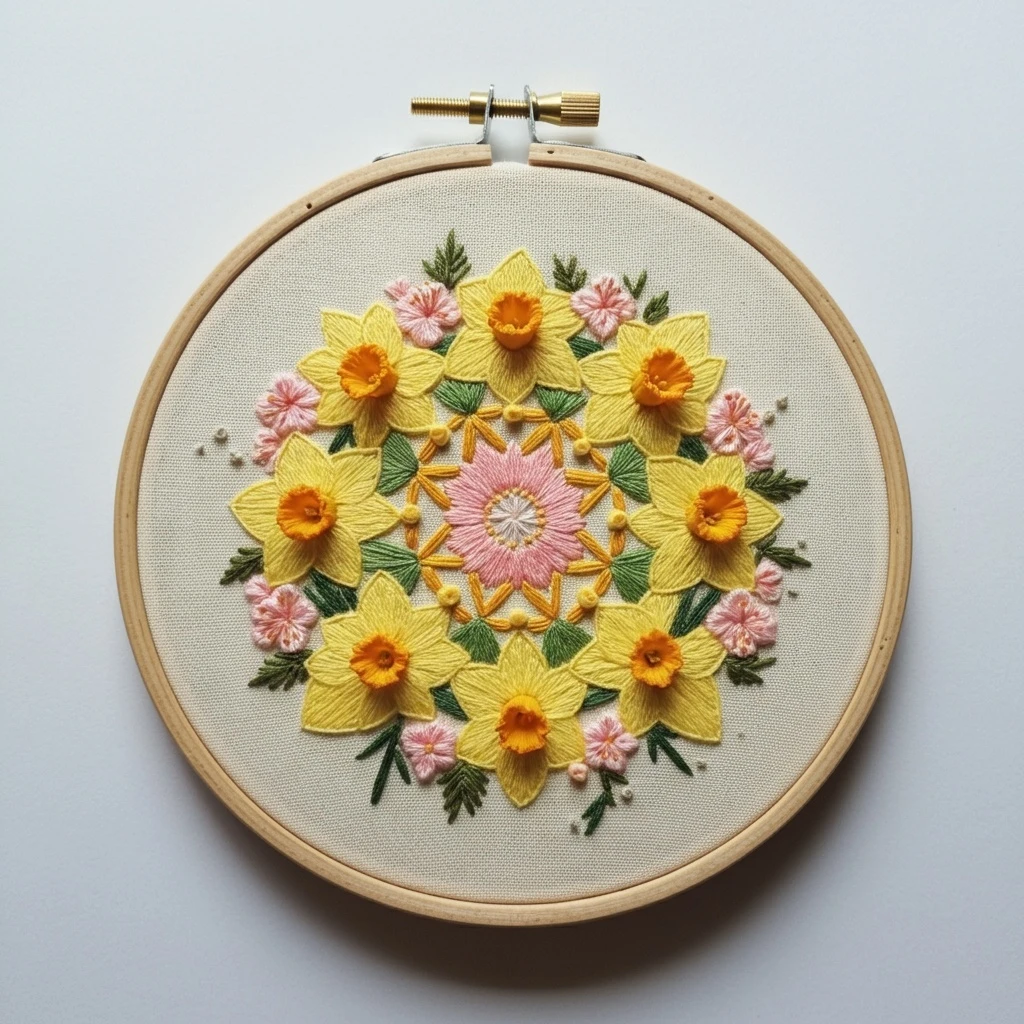
Daffodil Mandalas Floral Medallion
A cheerful circular hoop design built from golden daffodils, soft pink filler blossoms, leafy green geometry, and a warm mandala center. The sample reads as fresh spring embroidery with satin-filled petals, raised trumpet centers, tidy leaf segments, and delicate bead-like accents around the medallion.
Suggested DMC Floss Palette
Stitch Plan by Design Element
| Area | Recommended stitches | Thread count & notes |
|---|---|---|
| Daffodil petals | Long and short stitch, satin stitch, split-stitch edge | Use 2 strands for fill. Work from petal tip toward center, changing direction slightly with each petal vein. |
| Trumpet cups | Padded satin, buttonhole ring, French knots | Pad with 2 strands of yellow first, then cover with 2 strands orange. Add 1-strand dark orange knots inside. |
| Pink blossoms | Lazy daisy, straight stitch spokes, small French knot centers | Use 2 strands dusty rose; add a single darker stitch at the base of each petal for depth. |
| Mandala center | Satin rays, whipped backstitch circle, couching for golden spokes | Keep thread tension even. Use 1 strand for circular outlines and 2 strands for radial fills. |
| Leaves & sprigs | Fishbone stitch, fly stitch, stem stitch | Use 2 strands medium green for leaves, 1 strand dark green for crisp central veins and needle-like sprigs. |
| Accent dots | French knots, colonial knots, tiny seed stitches | Use 1 or 2 wraps. Keep dots irregular but balanced around both sides of the medallion. |
Order of Stitching
Texture & Shading Guidance
Use stitch direction as the main shading tool. Daffodil petals should radiate from base to tip, while the trumpet centers should curve around the cup. Let the darkest orange sit inside the cup and under the ruffled edge. Leaves look best when split into two fishbone halves with a thin dark vein down the center.
For a dimensional medallion, keep the pink center flat and smooth, then raise the golden spoke ring with couched or whipped stitches. This contrast makes the center feel decorative without becoming bulky.
Beginner-Friendly Practical Tips
- Use a sharp embroidery needle for satin areas and a slightly larger needle for padded orange centers.
- Separate all six strands before recombining; this makes blended yellows lie smoother.
- Keep large satin stitches under 12 mm. For longer petals, use long-and-short instead of one long satin span.
- Rotate the hoop often so your hand naturally follows the petal or mandala direction.
- Outline daffodil petals with a fine split stitch before filling if you want a crisp beginner-friendly boundary.
- Use 1 strand for delicate outlines, 2 strands for most fills, and 3 strands only for bold raised knots.
- Place French knots last; they can catch working thread if added too early.
- Check the circular balance by stitching matching flowers opposite each other before filling every detail.
- For a softer look, replace dark green outlines with DMC 3011 on outer foliage.
- Press finished embroidery face down on a towel to protect padded cups and knots.