
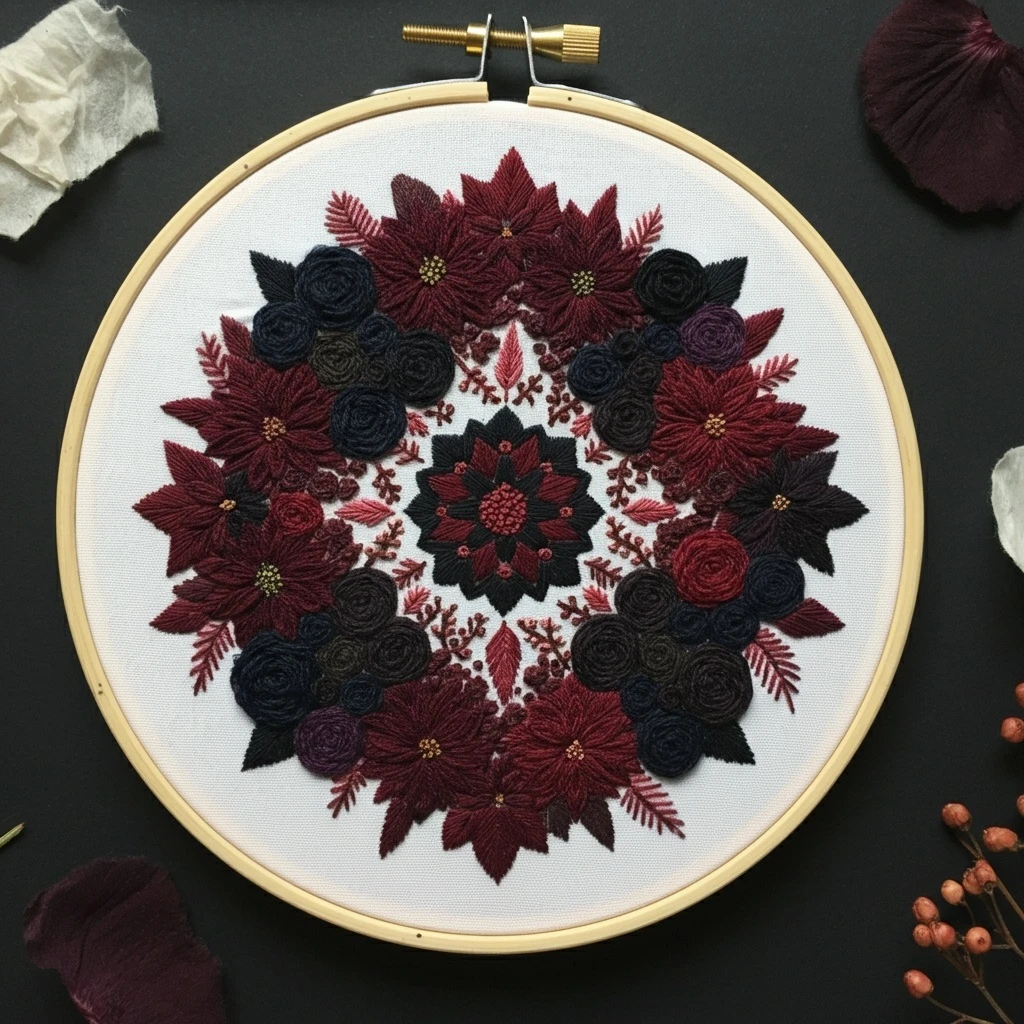
Dark Floral Mandala
A moody hoop design built from deep burgundy flowers, near-black rosettes, plum accents, small berry sprigs, fern-like leaves, and warm gold centers arranged in a balanced circular wreath.
What to notice in the reference
- Large poinsettia-style petals use wine-to-garnet shading with darker vein lines.
- Rose clusters are very dark navy, charcoal, espresso, and plum, so texture matters more than bright contrast.
- The central mandala needs crisp dark outlines, controlled satin fill, and tiny warm highlights.
- Fine red sprigs and fern stitches keep the circle airy and stop the palette from feeling flat.
Polished DMC color palette
The design reads as dark romantic florals on pale fabric. Use the deepest colors for structure first, then layer wine, red, olive, and gold details on top so the mandala keeps its dramatic contrast.
Primary shade for the almost-black rosettes and some shadowed leaves; softer than pure black and ideal for spiral texture.
Use sparingly for the central mandala outline, deepest petal notches, and tiny separating lines between crowded flowers.
Main color for the burgundy petals, outer blooms, and rich shaded areas where the flowers tuck behind rosettes.
Blend with 814 through petal centers and on berry stems for a slightly warmer red without becoming bright.
Use for bold red roses, petal base shadows, and accent veins on the larger flower heads.
A controlled highlight for small inner petals, rose rims, and selected fern strokes so the red details remain visible.
Best for the purple rosette accents and cool shadows where wine flowers need extra depth.
Good for espresso-toned roses, hidden leaf shadows, and grounding stitches that are warmer than navy-black.
Use in tiny French knots and leaf shadows around flower centers to echo the muted olive dots in the reference.
Warm flower centers and a few tiny light-catching knots; keep these dots small so they sparkle rather than dominate.
Optional hoop-tone neutral for transfer marks, subtle seed details, or testing contrast on cream fabric.
Not a stitched feature unless needed; use only for tiny correction stitches or to brighten negative spaces on darker fabric.
Stitch map for the mandala
Work from the center outward and keep the hoop orientation fixed while stitching repeating motifs. Symmetry will look cleaner if every petal, rose, and sprig is handled in the same order around the circle.
| Design area | Recommended stitches | Thread count and notes |
|---|---|---|
| Central black floral mandala | Satin stitch for pointed petals, back stitch or split stitch for crisp outlines, French knots for the dotted red center. | Use 2 strands for satin fill, 1 strand for outlines, and 2 wraps for knots. Stitch opposite petals in pairs to keep tension balanced. |
| Large burgundy blooms | Long-and-short stitch, fishbone stitch on pointed petals, and fine straight stitches for vein lines. | Use 2 strands for petal fill. Add 1-strand darker veins in 814 or 902 after the fill is complete. |
| Dark rosettes | Woven wheel roses, whipped back stitch spirals, or tightly curved stem stitch. | Use 3 strands for plump foreground roses and 2 strands for smaller background spirals. Mix 939, 3371, and 154 to avoid a flat black mass. |
| Fern sprigs and narrow leaves | Detached chain, fly stitch, straight stitch fronds, and fishbone stitch for the larger dark leaves. | Use 1 strand for fine red fronds and 2 strands for leaf bodies. Keep the stitch angle consistent around the circle. |
| Berry sprays and small dots | French knots, colonial knots, seed stitch, and short back stitches for stems. | Use 1 strand for stems, 2 strands for knots. Place knots after nearby petals are finished so they stay raised. |
| Flower centers | French knots clustered in circles, seed stitch, or tiny satin dots. | Use 729 with occasional 730. Vary knot wraps from 1 to 2 for a natural beaded center. |
Shading and blending plan
Wine flower depth
Start petals with DMC 814 at the base and between overlaps, blend into 815 through the middle, then add narrow 777 strokes only on petal tips or raised ridges. Use the bright red as a highlight, not a full fill.
Moody rose clusters
For the nearly black roses, alternate 939, 3371, and 154 between adjacent spirals. The color shift is subtle, but it helps separate each rose in the dense lower-left and right clusters.
Center contrast
Outline the central petals with 310 or 939 before filling. Add red satin or straight-stitch insets with 902, then finish with 777 and 729 knots so the center reads clearly from a distance.
Airy sprigs
Use a single strand for the fine wreath details. Dark floral designs can become heavy quickly, so thin red stems, small berry knots, and open spaces are what keep the mandala elegant.
Blend idea: thread one needle with one strand of 814 plus one strand of 815 for a soft wine transition. For cool shadows, pair one strand of 939 with one strand of 154 in a rose spiral or outer leaf.
Beginner-friendly stitching order
Anchor the center
Stitch the central mandala first with 1-strand outlines and 2-strand fills. It becomes the visual ruler for the whole circular layout.
Place the largest petals
Complete all main burgundy flowers next. Keep your petal direction radiating outward from the center for a clean mandala rhythm.
Add rose clusters
Work woven wheels after flat petals are done. This lets the roses sit visibly on top and gives the design its lush texture.
Fill leaves and sprigs
Use fishbone leaves and single-strand fronds to connect gaps. Avoid overfilling the white fabric spaces inside the wreath.
Knot the centers last
Gold and olive knots should be added near the end so they remain clean, raised, and bright against the dark embroidery.
Check the circle
Turn the hoop frequently. If one quadrant feels heavier, add only a few 1-strand sprigs rather than another bulky flower.
Practical tips for a clean finish
Fabric and transfer
- Use tightly woven cotton or linen in off-white to match the reference contrast.
- Transfer with a fine, removable pen; heavy lines can show between the dark but open sprigs.
- Hoop the fabric drum-tight before satin and long-and-short stitching.
Thread handling
- Use shorter lengths, about 14 to 16 inches, because dark floss shows fuzz and wear quickly.
- Railroad satin stitches with your needle tip to keep the thread smooth.
- Let the needle dangle often to untwist the floss, especially while making roses.
Outlining details
- Choose split stitch for graceful petal edges and back stitch for tiny geometric mandala points.
- Outline after filling when you want crisp separation; outline before filling when you need a guide.
- Use 1 strand for outlines so the dark edges do not overpower the flowers.
Texture control
- Reserve 3 strands for raised woven roses only; most other stitches look more refined in 1 or 2 strands.
- Keep knots compact and consistent, especially in the flower centers.
- Press the finished piece face-down on a towel to protect raised roses and knots.