
DMC palette & stitch suggestions
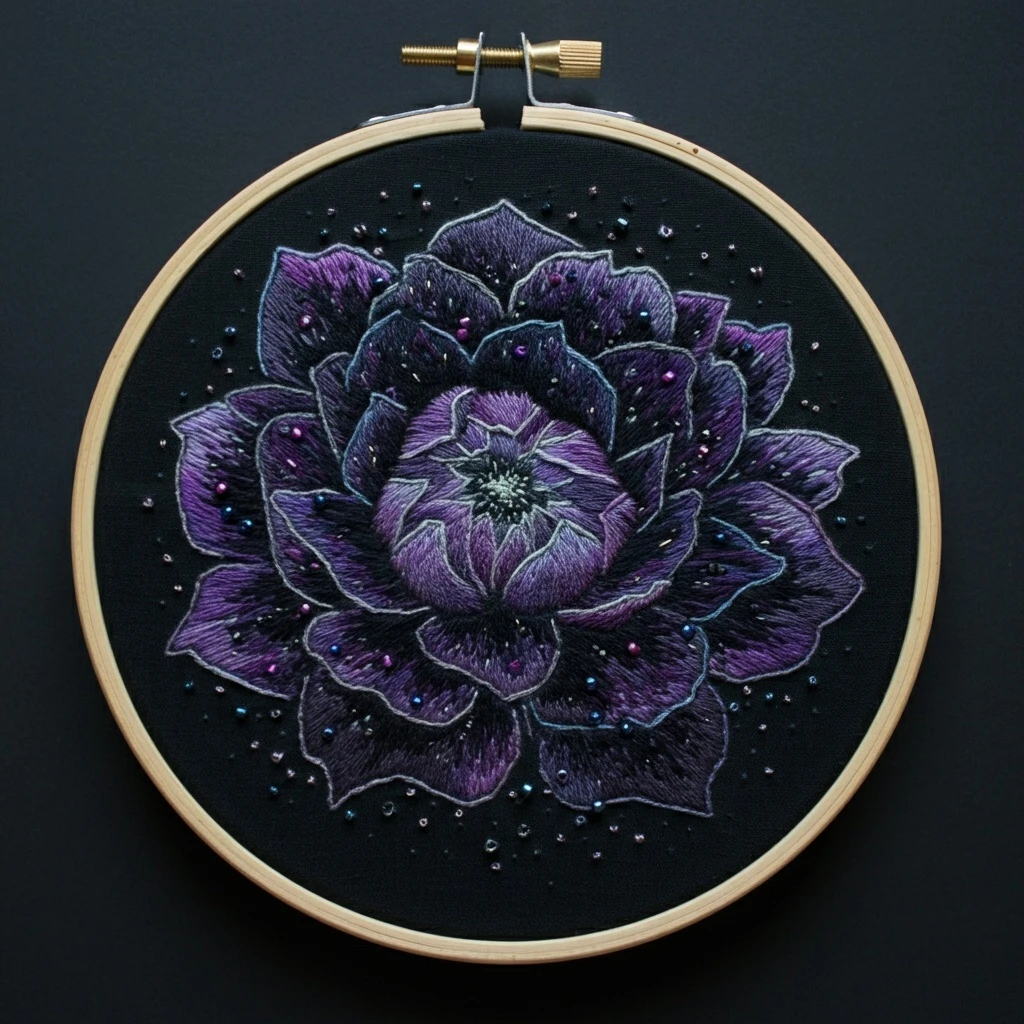
Deep Violet Nebula Flower
A dramatic dark-fabric floral design with layered violet petals, cool blue edge-lighting, smoky charcoal shadows, pale lavender highlights, and tiny bead-like star speckles that give the blossom its celestial glow.
Color story
The design works best as a deep-value palette rather than a bright floral palette. Keep the outer petals grounded in near-black grape and pewter, then pull light toward the center with lavender, pale blue, and silver-white accents. Use the turquoise sparingly; it should read as nebula glow, not as a dominant petal color.
Thread-count guidance
- Petal shading: 1 strand for long-and-short stitch gives the smoothest painterly blend on dark fabric.
- Large petal fill: 2 strands can be used for faster coverage, but switch back to 1 strand near edges and highlight transitions.
- Outlines and veins: 1 strand of DMC 168, 211, or 3843 keeps the line delicate and luminous.
- Center texture: 1–2 strands for French knots; vary wraps from one to two wraps for natural height.
- Nebula dots: 1 strand for tiny straight stitches or single-wrap French knots; beads are optional.
Blending plan
Work from dark to light on each petal: 310 / 3799 → 154 → 550 → 552 → 553 → 210 / 211. Place the darkest stitches at the base and under overlaps, then feather mid-violet stitches toward the petal tip. Add blue only where an edge catches imaginary moonlight.
For a softer transition, thread the needle with one strand 550 and one strand 552, then use pure 553 or 210 for the final highlight strokes.
Stitch map by design area
| Area | Recommended stitches | Practical notes |
|---|---|---|
| Outer petals | Long-and-short stitch, directional satin stitch, split stitch guide lines | Follow the curve of each petal from base to tip. Keep stitches slightly irregular in length so violet tones blend like soft brushstrokes. |
| Petal rims | Split stitch, stem stitch, couching for crisp edges | Use DMC 168 for most outlines, then add tiny DMC 3843 strokes only on selected edges to create the cool nebula glow. |
| Inner flower cup | Short satin stitch, fishbone-style strokes, tiny straight stitches | Use brighter lavender near the central opening. Angle stitches toward the center so the bloom looks cupped and dimensional. |
| Center cluster | French knots, colonial knots, seed stitch | Mix 168, 3756, and a touch of 3799. Knots should be denser in the middle and looser toward the petals. |
| Star field | Single seed stitches, single-wrap French knots, bead accents | Vary spacing and color. Concentrate dots around the flower but leave breathing room so the black fabric remains elegant. |
| Deep creases | Tiny straight stitches, split stitch shadows, negative space | Do not overfill every dark area. Let the ground fabric and DMC 310 create natural depth between petal layers. |
Outlining details
Start with a fine split-stitch outline in 3799 or 154 before filling. After petal fill is complete, re-outline only the most important front edges with 168. This keeps the layered flower readable without making every line equally bright.
Shading guidance
Shade each petal as a small individual shape. Darken where petals tuck under one another, then place 210 and 211 only on raised ridges. Too much light lavender will reduce the midnight mood.
Texture suggestions
For a velvety petal surface, keep stitches close and parallel in small sections. For the cosmic background, contrast that smooth fill with tiny knots, seed stitches, and occasional metallic glints.
Beginner-friendly working order
- Transfer the pattern with a light pencil or water-soluble white marker suitable for dark fabric.
- Stitch all main petal outlines first in one strand of 3799 or 154.
- Fill the outer petals from darkest to mid-violet, one petal at a time.
- Add inner petals with slightly brighter violet and lavender highlights.
- Stitch the center knots last so they stay raised and clean.
- Add star speckles after the flower is complete; step back often to avoid overcrowding.
Helpful habit: park your highlight colors until the end. On dark cloth, pale stitches are very visible, so the final sparkle layer should be deliberate and minimal.
Fabric, hoop, and finishing tips
Fabric choice
Black or very dark navy cotton, linen-cotton blend, or tightly woven evenweave will support the luminous violet palette. If the fabric is thin, back it with a lightweight stabilizer to prevent puckering in dense petal fills.
Needles
Use a size 7–9 embroidery needle for most petal work and a size 10 needle for one-strand outlining or metallic details. A beading needle helps if you add tiny seed beads.
Tension
Keep the hoop drum-tight but not stretched. Dense satin and long-and-short stitches can pull dark fabric, so loosen the hoop when resting and re-tighten before stitching.
Finishing
Press from the back on a towel to protect knots and beads. Trim stray pale fibers carefully; they are more noticeable on black cloth than on light linen.