
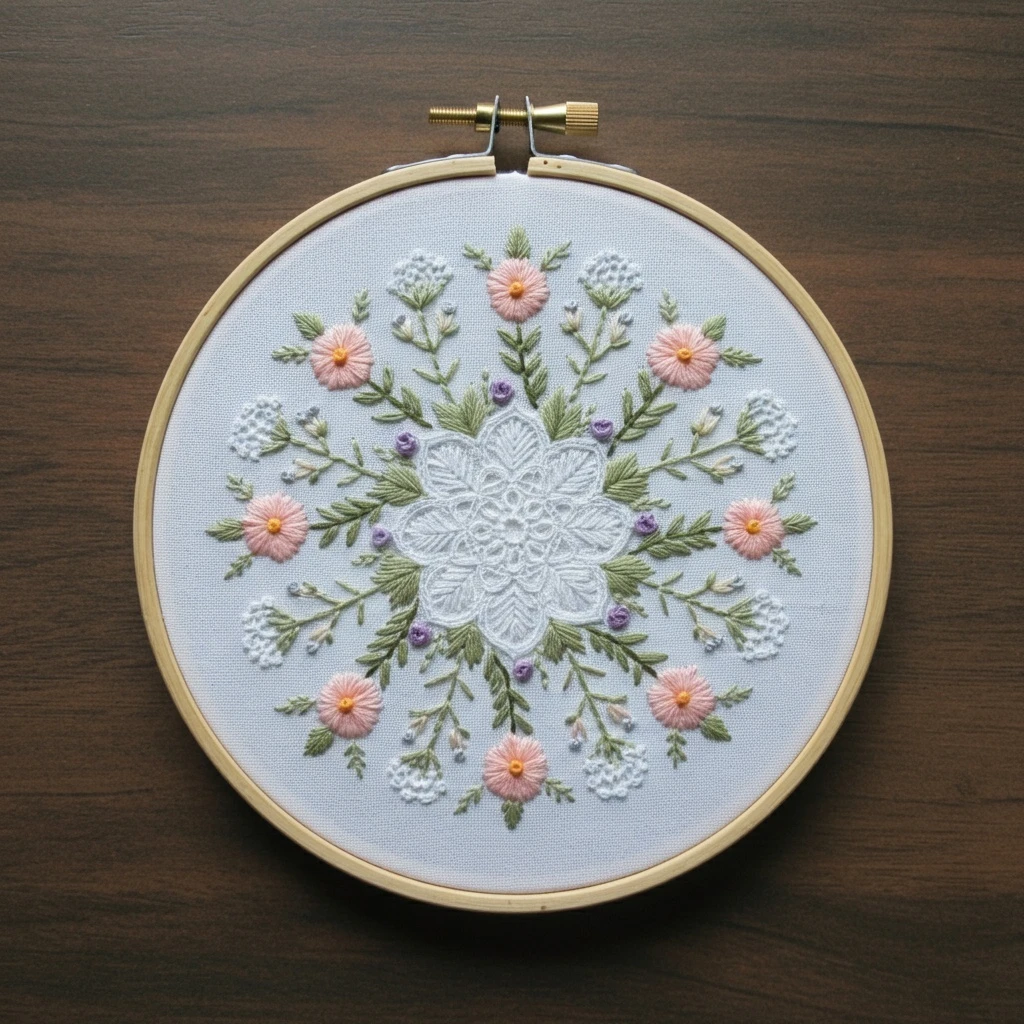
Delicate White Mandala and Pastel Pink Flowers
A quiet, airy hoop design built around a lace-like white central mandala, blush-pink daisy blossoms, soft sage stems, small lavender buds, and clustered white wildflowers. The overall look is gentle and symmetrical, so the best embroidery approach is light thread coverage, clean outlining, and soft texture rather than heavy filling.
Design Color Read
The reference image shows a balanced wreath composition: a large white mandala at the center, peach-pink flowers spaced around the circle, fine olive and sage stems radiating outward, white dotted flower clusters, and a few muted violet accent buds. The fabric appears cool off-white or very pale blue-gray, which helps the white stitching remain visible while keeping the whole piece soft.
For a polished finish, keep the palette restrained. Use bright white for the raised mandala highlights, a second softer white or pale gray for shadow lines, two or three blush pinks for petals, and two greens for leaf depth.
Suggested DMC Palette
Stitch Plan by Design Area
Thread Count & Coverage Guide
| Area | Recommended strands | Why it works |
|---|---|---|
| Mandala outlines | 1 strand for inner details, 2 strands for outer petals | Keeps the whitework delicate while making the main flower shape readable. |
| Pink petals | 2 strands | Provides smooth coverage without making the pastel blossoms bulky. |
| Stems and fine vines | 1–2 strands | Use 1 strand for thin offshoots and 2 strands for the main circular structure. |
| French knots | 1 strand wrapped twice or 2 strands wrapped once | Creates varied knot sizes for white clusters and yellow centers. |
| Leaf shading | 1 strand overlay | Lets you add darker green shadows without covering the soft sage base. |
Blending, Shading & Texture
Soft pink flower blend
Use 963 for most petals, then stitch short 3716 strokes from the center outward. Add a few 761 stitches only at the base to create warmth without turning the flowers coral.
White mandala definition
White-on-light fabric needs quiet contrast. Outline some inner mandala veins with 3865, then add selective B5200 highlights on the topmost curves. A single strand of 762 under a petal fold can make the lace pattern visible.
Natural foliage movement
Alternate 3052 and 3364 on leaves so the wreath does not look flat. Add 3051 only on leaves tucked behind flowers or near the mandala base.
Raised floral texture
French knots in the white clusters and yellow centers should be slightly irregular. This creates the hand-stitched botanical feel visible in the reference image.
Beginner-Friendly Working Order
- Start with the central mandala outline. Stitch the largest petal shapes first so the wreath stays centered and symmetrical.
- Add main stems next. Work from the center outward with stem stitch, rotating the hoop instead of twisting your wrist.
- Fill leaves before flowers. This lets pink petals sit visually on top of the greenery.
- Stitch pink flowers from pale to dark. Lay 963 first, then add 3716 and 761 accents after the petal shape is clear.
- Save knots for last. French knots catch thread easily, so finish white clusters, yellow centers, and lavender buds near the end.
Practical Finishing Tips
Fabric choice
A pale blue-gray, ivory, or warm white linen/cotton blend works best. If using pure white fabric, make the mandala more visible with extra 3865 and a few 762 shadow stitches.
Needle & tension
Use a size 7–9 embroidery needle. Keep tension relaxed, especially on satin petals and long mandala curves, so the fabric does not pucker.
Hoop size
A 6-inch hoop suits the spacing of the wreath. For a smaller hoop, reduce thread count on stems and avoid bulky knots.
Clean presentation
Press from the back on a towel after stitching. Trim jump threads carefully because pale fabric and whitework show shadows easily.