
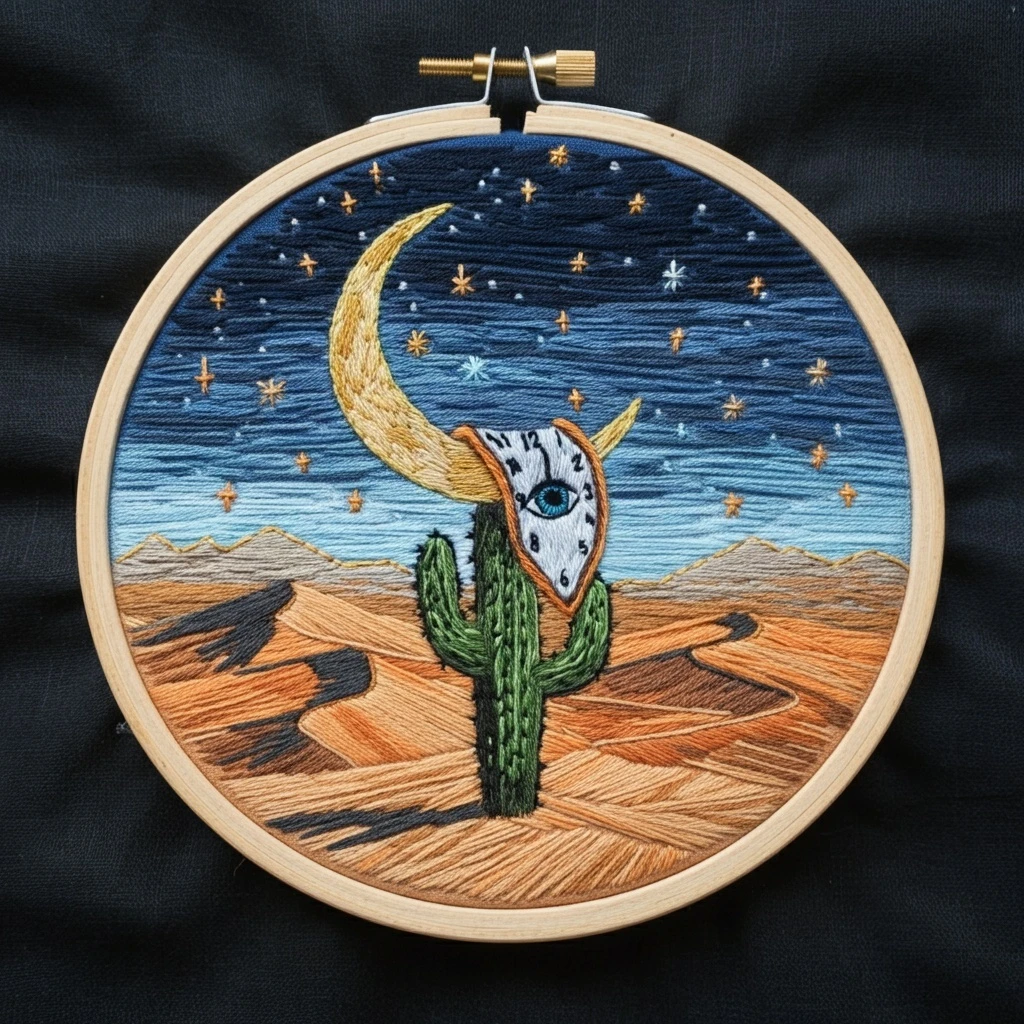
Desert Surrealism Melting Clock on a Cactus Under a Starry Sky

Desert Surrealism Melting Clock on a Cactus Under a Starry Sky - DMC Palette & Stitching Suggestions
Desert Surrealism  Melting Clock on a Cactus Under a Starry Sky
DMC palette & embroidery guide

Desert Surrealism Melting Clock on a Cactus Under a Starry Sky

A dreamlike desert hoop with a deep midnight-to-turquoise sky, golden crescent moon, sparkling stars, sandy ridges, a green cactus centerpiece, and a pale melting clock with a bright blue eye. The palette needs strong contrast, but the finish should still feel soft and hand-stitched rather than graphic.

Surreal focal clockStarry gradient skyGolden crescent moonCactus rib textureWarm desert floor

Color reading from the design

The reference design combines a night-sky upper half with a warm desert lower half. Key visual elements are a navy and blue horizontal sky, scattered white and golden stars, a large textured golden crescent, distant pale mountains, orange sand with darker dune shadows, a ribbed green cactus, and a white-gray melting clock edged in rusty orange with black numerals and a vivid turquoise eye.

Practical approach: treat the composition as three layers: smooth sky first, warm landscape second, focal objects last. The clock and moon sit on top visually, so save their outlines, numbers, eye, and highlights until the background is complete.

Suggested DMC floss palette

These DMC colors are selected as a practical embroidery palette for the visible tones in the image. Use the notes to adapt the palette to your fabric and preferred stitch density.

DMC 939
Very Dark Navy Blue
Deepest upper sky, tiny shadow gaps, and selective contrast around stars.
DMC 823
Dark Navy Blue
Main night-sky bands and dark blue transitions behind the crescent.
DMC 3765
Very Dark Peacock Blue
Mid-sky shading where navy begins to lift toward the horizon.
DMC 3846
Light Bright Turquoise
Bright lower sky, clock eye iris, and tiny cool highlights.
DMC 3821
Straw
Crescent moon highlights and the brightest gold star centers.
DMC 783
Medium Topaz
Moon shading, star arms, and warm metallic-looking accents without metallic thread.
DMC 3865
Winter White
Clock face, pale stars, crisp moon glints, and tiny mountain highlights.
DMC 762
Very Light Pearl Gray
Soft clock shadows, pale mountain faces, and cooling the white areas.
DMC 310
Black
Clock numerals, hands, eye outline, and the sharpest micro-details only.
DMC 934
Black Avocado Green
Cactus shadow side, base, and dark rib lines.
DMC 470
Light Avocado Green
Cactus mid-tones, arms, and brighter rib highlights.
DMC 977
Light Golden Brown
Sunlit sand, dune tops, and the warm desert foreground.
DMC 921
Copper
Clock outline, desert ridge warmth, and orange shadows in the dunes.
DMC 433
Medium Brown
Dune shadow paths, mountain outlines, and grounding lines at the bottom.

Stitch plan

Long & short stitchBest for the horizontal sky gradient, moon texture, and shaded sand planes.
Satin stitchUse for the clock face, bold crescent segments, and small star arms.
Split stitchCleanly outlines the melting clock, crescent edge, mountain ridges, and dune paths.
Stem stitchPerfect for cactus arms, curved ribs, and flowing clock edges.
Straight stitchUse short radiating stitches for stars and directional desert texture.
French knotsAdd tiny white star dots and optional cactus spine points.

Thread-count guidance

  • Sky: 1 strand for smooth painterly bands; 2 strands only if your fabric shows through too much.
  • Crescent moon: 2 strands for coverage, with single-strand gold strokes on top for texture.
  • Clock face: 2 strands of 3865 or 762 for fill; 1 strand for numerals, hands, and eye outline.
  • Cactus: 2 strands for body fill; 1 strand for vertical ribs and tiny spine marks.
  • Stars: 1 strand for crisp points; use knots only for the smallest dots.

Blending and shading ideas

Build the sky in horizontal layers. Begin with DMC 939 at the top, blend through 823 and 3765, then soften toward 3846 near the horizon. Keep stitches mostly horizontal to echo the reference texture.
Texture the crescent instead of flattening it. Mix DMC 3821 and 783 in alternating long-and-short strokes, following the moon curve. Add a few 3865 strokes along the inner edge for glow.
Make the clock look soft and melting. Fill with 3865, shade the lower bends with 762, then outline with 921. Keep the outline slightly irregular so it feels draped over the cactus.
Use sharp detail only at the focal point. The eye, numbers, and cactus ribs can be crisp; keep distant mountains and sand looser so the clock remains the star.

Texture suggestions

For the surreal style, contrast smooth areas with tactile details. The sky should feel soft and streaked, the moon fibrous and luminous, the cactus ribbed, and the desert floor directional. Change stitch angles between dunes so the sand reads as layered paths rather than one flat block.

For a subtle sparkle effect without metallic floss, place one stitch of DMC 3821 over a smaller DMC 3865 star dot, or use a single tiny straight stitch in 783 beside the white point.

Outlining details

  • Use DMC 921 around the clock before adding black numerals; the warm border keeps the clock integrated with the desert palette.
  • Outline the cactus with DMC 934, but avoid heavy black so the green form stays natural.
  • Use DMC 310 only for the numbers, clock hands, eye line, and a few necessary accents.
  • For mountains, use one strand of 433 or 762 rather than dark outlines, preserving distance.

Beginner-friendly practical tips

  • Transfer the clock numerals lightly and stitch them last so they do not disappear under fill stitches.
  • Keep the sky threads short, about 35-40 cm, because dark blues show fuzz quickly.
  • Work light stars after the sky is complete; add knots only when the background tension is stable.
  • Stitch the cactus before the clock border if the clock overlaps it, so the melting edge can sit cleanly on top.
  • Use a sharp needle for single-strand details and a slightly larger embroidery needle for 2-strand fills.
  • Do not overpack satin stitches on the clock face; leave room for numbers and the eye.
  • When stitching on dark fabric, place a pale under-stitch beneath moon highlights and clock whites.
  • Press finished work from the back over a towel so stars, moon texture, and cactus ribs keep their lift.

Recommended stitching order

Fill the sky from dark navy to turquoise using DMC 939, 823, 3765, and 3846.
Add distant mountains and desert sand with DMC 762, 977, 921, and 433.
Stitch the cactus body and arms with DMC 934 and 470, then add single-strand rib details.
Work the crescent moon and gold stars with DMC 3821, 783, and small 3865 highlights.
Finish the melting clock: white-gray fill, copper outline, black numerals, and bright turquoise eye.

Leave a Reply

Your email address will not be published. Required fields are marked *