
DMC palette & embroidery tips
Detailed Dalmatian Portrait
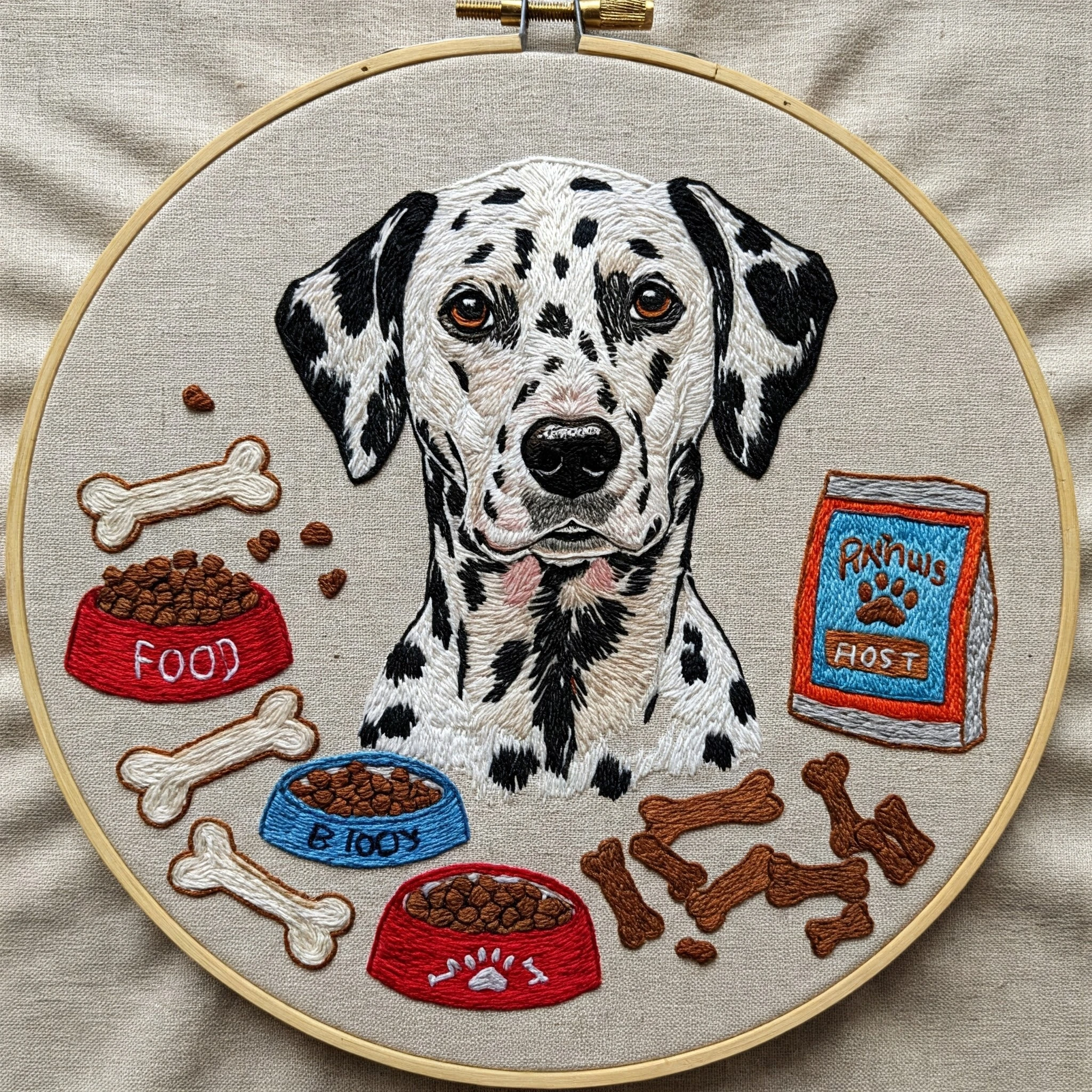
A lively pet portrait embroidery with a white-and-black Dalmatian face, expressive amber eyes, glossy nose, floppy spotted ears, warm brown dog treats, red and blue bowls, and playful food packaging accents on neutral linen.
Suggested DMC Color Palette
The design relies on high contrast: crisp black spots over creamy white fur, warm brown eyes and treats, plus cheerful red and blue accessories. Keep the black details controlled and use pale gray, beige, and soft pink to make the face look dimensional rather than flat.
DMC 310
Black
Dalmatian spots, ears, nostrils, mouth line, pupils, and the darkest packaging lettering.
DMC 3799
Pewter Gray – Very Dark
Softened edges inside black ears, nose shadows, and spot transitions where pure black feels too harsh.
DMC 415
Pearl Gray
Cool fur shadows around cheeks, muzzle sides, under ears, and the underside of white bones.
DMC 762
Pearl Gray – Very Light
Gentle contouring on white fur and faint shadows between directional white stitches.
DMC 3865
Winter White
Main fur fill, bone centers, bright muzzle strokes, nose highlight, and eye catchlights.
DMC 950
Desert Sand – Light
Warm facial undertones around the muzzle, brow, cheek folds, and inner ear highlights.
DMC 758
Terra Cotta – Very Light
Soft pink lower lip, chin patches, and warm skin shadows around the mouth.
DMC 801
Coffee Brown – Dark
Outer iris, kibble shadows, dog bones, treat outlines, and deep brown label accents.
DMC 975
Golden Brown – Dark
Mid-tone treats, iris glow, crunchy kibble tops, and warm biscuit fills.
DMC 976
Golden Brown – Medium
Bright amber eye highlights, lighter biscuit ridges, and raised kibble texture.
DMC 321
Red
Red food bowls, playful label details, and strong accent areas around the pet portrait.
DMC 814
Garnet – Dark
Red bowl shadows, lower curves, and darker folds beneath lettering.
DMC 3843
Electric Blue
Blue bowl and package panel, bright stitching on accessory areas, and contrast against warm browns.
DMC 798
Delft Blue – Dark
Blue bowl shadows, label outlines, and small lettering details on the food bag.
DMC 648
Beaver Gray – Light
Food bag sides, bone shadows, and a subtle separator where white objects sit on linen.
DMC 938
Coffee Brown – Ultra Dark
Deepest creases in treats, kibble outlines, and fine shadows around stitched biscuit shapes.
Stitch Map
- White fur: work short-and-long stitch in curved rows from the forehead down the muzzle; vary stitch length so the coat looks natural.
- Black spots and ears: fill with satin stitch for small spots and long-and-short stitch for the ears, adding 3799 along one edge for soft shine.
- Eyes: layer a tiny satin oval in 801, add 975 and 976 near the lower iris, then finish with 310 pupil and a 3865 catchlight.
- Nose: use satin stitch or padded satin in 310, with 3799 for reflected shine and a few short 3865 highlight strokes across the bridge.
- Bowls, bones, and treats: use satin stitch for smooth bowls, split stitch for outlines, French knots and seed stitches for kibble texture, and stem stitch for bone edges.
Thread Count Guide
| Area | Strands | Reason |
|---|---|---|
| Face details, spots, mouth | 1 strand | Keeps the portrait crisp and avoids bulky dark lines on the muzzle. |
| White fur fill | 1–2 strands | Creates directional fur with soft coverage and gentle blending. |
| Ears and larger black patches | 2 strands | Gives rich coverage while still allowing gray accent stitches. |
| Bowls and food bag panels | 2–3 strands | Produces saturated red and blue areas with a smooth, graphic finish. |
| Kibble, biscuits, and bones | 2 strands | Adds raised texture and enough weight to balance the portrait. |
Blending & Shading Plan
Outlining Details
Use one strand of 310 in split stitch for the nose, mouth crease, major spots, ear contours, and eye rims. For bones and pale objects, outline with 648 or 801 instead of black so they remain soft against the linen. Keep package lettering and bowl words simple: backstitch with one strand and shorten the stitch length around curves.
Texture Suggestions
Make the dog’s coat with overlapping directional stitches rather than flat satin blocks. The ears can be denser and smoother, while the muzzle should have shorter broken strokes. For kibble, combine French knots, colonial knots, and tiny seed stitches in 801, 975, 976, and 938. Raised satin or whipped backstitch gives the dog bones a rounded biscuit edge.
Beginner-Friendly Practical Tips
- Use a tightly held hoop and a sharp embroidery needle; white fur stitches look cleaner when the fabric stays drum-tight.
- Mark fur direction lightly on the pattern before stitching: forehead strokes radiate upward, cheek strokes sweep outward, and neck strokes fall downward.
- Do not overfill the white areas. Leave a little linen texture visible between some stitches to keep the portrait airy and hand-stitched.
- For the nose, add the highlight last with one strand of 3865 or 762, using very small straight stitches across the top curve.
- Work red and blue accessory fills with parallel satin stitches, then add a darker lower edge to make bowls and packaging look rounded.
- If the lettering on bowls or packaging feels too small, simplify it to short backstitched marks; neat placement matters more than perfect text.
- Press from the back over a folded towel so raised kibble knots, biscuit texture, and nose padding are not flattened.